

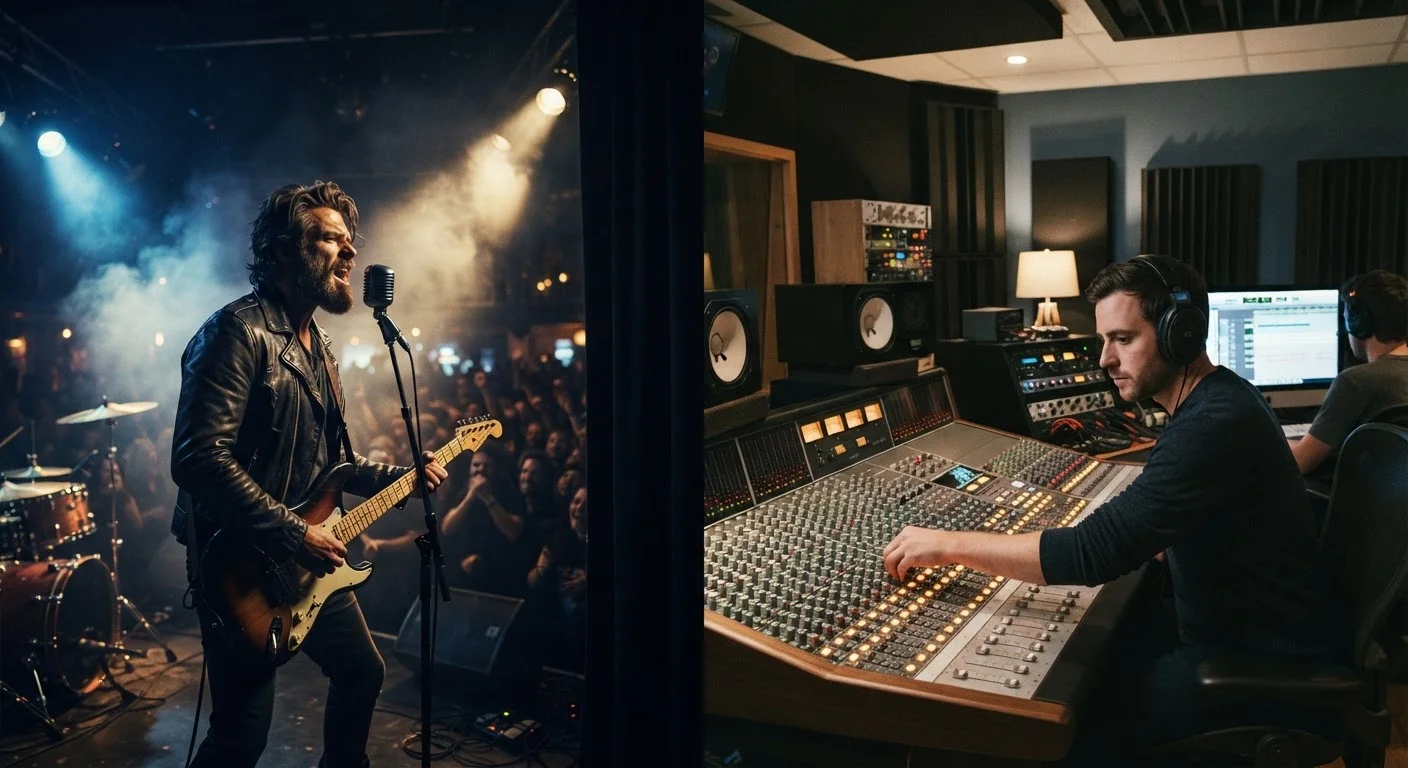
Key Takeaways
Option A
Live Performance
The unrepeatable, communal art of the present moment.
Best for: Artists and audiences who prize raw energy, spontaneity, and shared emotional experience in real time.
Option B
Studio Recording
The meticulous craft of shaping a permanent sonic document.
Best for: Musicians and producers focused on sonic precision, layered arrangement, and lasting artistic legacy.
If you want to understand an artist's creative vision at its most controlled and fully realized
Studio Recording
The studio allows artists to sculpt every detail - arrangement, texture, dynamics - into a precisely intended statement that will endure unchanged.
If you want to experience music as a living, communal event shaped by the room and the moment
Live Performance
No recording can replicate the physical energy of a crowd, the unpredictability of a performer in the moment, or the feeling of sharing something unrepeatable.
If you are a new performer deciding where to invest your practice time first
Live Performance
Stage experience builds presence, adaptability, and audience instincts that ultimately inform and deepen studio work as well.
If you are a music producer or sound engineer exploring different career paths
Studio Recording
Studio craft - mixing, arranging, sound design - is a specialized discipline with its own deep creative and technical vocabulary.
Two Stages, Two Entirely Different Disciplines
It is tempting to think of live performance and studio recording as two sides of the same coin - both involve musicians, instruments, and songs. But experienced artists will tell you they are almost entirely different disciplines, demanding different instincts, different preparation, and a fundamentally different relationship with imperfection.
A live performance is, at its core, a social contract struck in real time. The performer and the audience enter into something together that neither can fully control. A voice that cracks on a held note, a guitarist who leans into a solo that stretches well beyond the album version, a drummer who reads the crowd's energy and pushes the tempo just slightly - these are not flaws. They are the signature of live art. As every performance is genuinely one of a kind, shaped by acoustics, equipment, and human presence.
The recording studio, by contrast, is a space defined by the possibility of revision. Every take can be evaluated, compared, layered, or discarded. The microphone captures detail that no concert hall audience would ever perceive - the subtle breath before a phrase, the resonance of a room, the tiny imperfections of a fingertip against a string. In the studio, those details matter enormously.
| Criterion | Live Performance | Studio Recording |
|---|---|---|
| Core environment | Public, shared, ephemeral | Private, controlled, permanent |
| Relationship with mistakes | Embraced as part of the art | Corrected, reframed, or edited |
| Audience interaction | Real-time, physical, reciprocal | Absent during creation |
| Primary skill demanded | Presence and adaptability | Precision and critical listening |
| Time structure | Linear, cannot be rewound | Iterative, built across multiple sessions |
| Sound scope | Shaped by room acoustics and PA | Controlled to microscopic detail |
| Artistic outcome | Unrepeatable event | Lasting sonic document |
What Each Format Demands From the Performer
Stage performance rewards the ability to project - not just volume, but intention and presence. A performer must hold a room's attention across distance, ambient noise, and distraction. The craft of connecting with an audience relies on physical communication - eye contact, movement, pacing, and silence - that no recording can replicate. Many seasoned performers describe the live experience as collaborative improvisation, where the crowd's energy is itself a kind of instrument. Improvisation traditions across cultures, from jazz to flamenco, were built specifically around this live dynamic.
Studio performance demands something almost opposite: the capacity to deliver emotionally resonant takes in a context stripped of all external stimulus. There is no crowd feedback, no adrenaline of a shared moment. Instead, there is repetition, critical listening, and the discipline of starting over. Producers often speak of chasing a specific feeling across dozens of takes - a quality of vulnerability or urgency that cannot be manufactured but must be coaxed out in the right conditions.
~57%
U.S. adults who attended a live music event
According to a National Endowment for the Arts survey, roughly 57% of American adults reported attending at least one live music performance over a multi-year study period.
100+
Takes sometimes recorded for a single vocal
Industry producers have noted that major studio projects can involve well over a hundred recorded takes for a single vocal performance before a final version is selected.
Set construction also differs sharply between formats. A live set list is a carefully shaped emotional arc designed to move an audience through peaks and valleys over the course of an evening. An album's track sequence serves a different purpose - guiding a solitary listener through an artistic statement, often across multiple sittings and years of repeated engagement.
When the Studio Recording Becomes the Expectation
One of the most fascinating tensions in contemporary music is the relationship between recorded and live versions of the same song. Studio recordings - particularly in the age of streaming - become the reference point against which live performances are measured. Audiences often arrive at a concert having absorbed an album hundreds of times, which means they carry deeply internalized expectations about how a song should sound.
Artists navigate this in strikingly different ways. Some replicate their recordings as faithfully as technology and human performance allow - a reassuring contract with an audience that came to hear what they already love. Others deliberately deconstruct or expand their studio material on stage, treating the live show as an opportunity for reinvention. The gap between what a song sounds like on record versus what it sounds like in a room - explored in depth when considering how venue size changes a performance - is itself a creative variable that thoughtful artists use intentionally.
Neither approach is inherently more valid. What matters is whether the choice serves the artistic vision and the audience relationship the performer wants to build. The richest careers in music tend to belong to artists who understand both formats deeply and know exactly which rules they are choosing to follow or break.
The Rise of the 'Live Album' as a Hybrid Form
Live albums occupy an interesting middle ground between the two formats. Recorded in front of an audience but refined in post-production, they attempt to preserve the energy of a performance while applying the editorial standards of the studio. Some live albums - from recordings by artists ranging from Johnny Cash to Beyoncé - are considered as definitive as any studio release, blurring the line between the two disciplines rather than resolving it.