

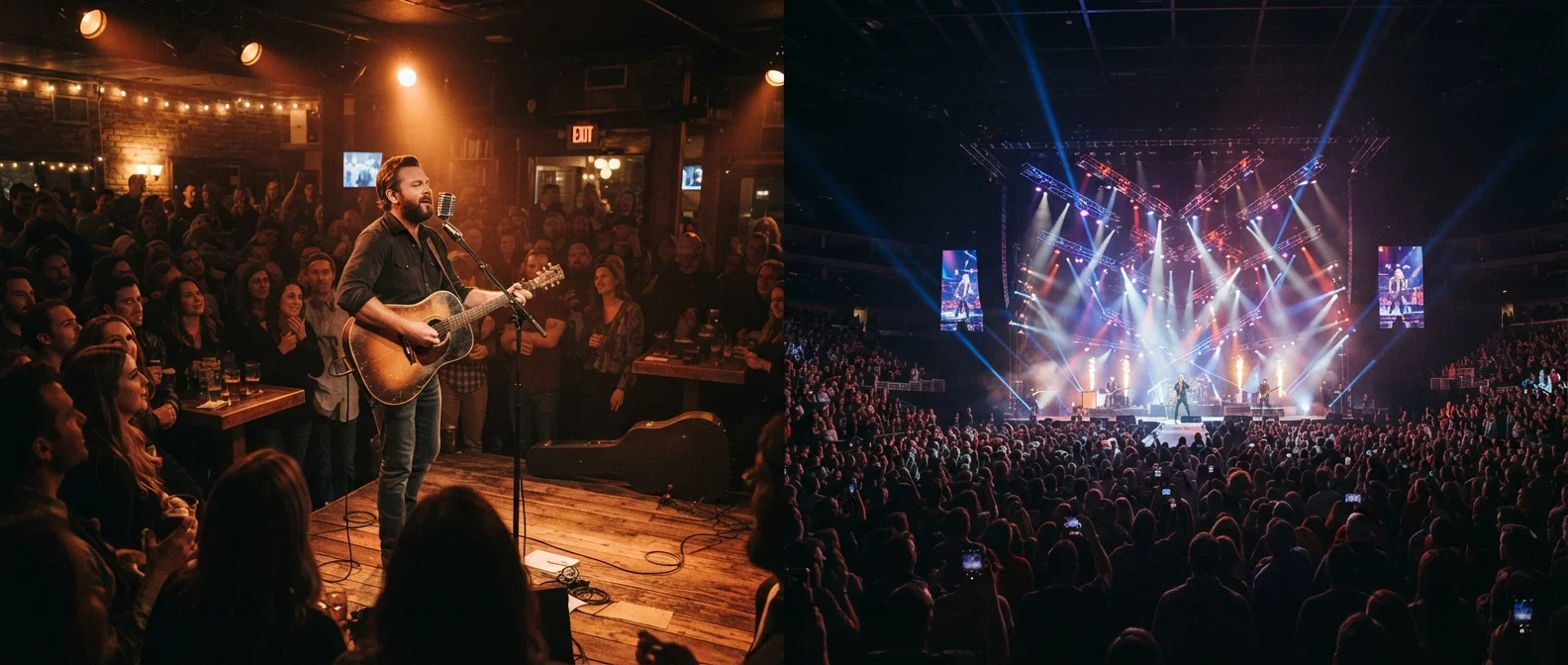
Key Takeaways
Natural resonance rewards subtle, expressive playing
Without electronic processing, every nuance of tone and dynamics reaches the audience directly, making small variations in touch and breath dramatically meaningful.
Performer-audience connection is immediate and unfiltered
In intimate settings, eye contact, physical proximity, and shared silence create a sense of communal experience that amplified shows struggle to replicate.
Lower technical dependency reduces variables and failure points
Acoustic performance doesn't rely on PA systems, monitors, or mixing engineers, eliminating a category of technical problems that can derail amplified shows.
Encourages active, attentive listening from the audience
When a performance depends on quiet to be heard fully, audiences naturally become more engaged participants rather than passive spectators.
Reach is physically limited by human projection
Even highly trained singers and instrumentalists cannot fill large venues without electronic support - the laws of acoustics set a hard ceiling on unaided sound.
Sound quality depends heavily on real-time engineering decisions
A poor mix, monitor feedback, or an undertrained front-of-house engineer can compromise an amplified performance in ways that no amount of stage skill can fully correct.
Intimacy and spontaneity are harder to sustain at scale
Large productions often require rigid setlists, scripted moments, and choreographed cues, which can reduce the sense of organic connection that makes live music feel alive.
Visual and gestural language must be exaggerated to read at distance
Subtlety in body language and facial expression is lost beyond a certain distance, pushing performers toward broader physicality that can feel artificial in smaller contexts.
Acoustic environments are unpredictable and venue-specific
Every large room has its own sonic fingerprint - standing waves, dead spots, reflective surfaces - that engineers must diagnose and compensate for at each new location.
Our Verdict
Acoustic and amplified performance are not simply two points on a volume dial - they are genuinely different arts, each with its own demands and rewards. Acoustic settings reward subtlety, presence, and the kind of vulnerability that fills a small room. Amplified settings require technical collaboration, physical stagecraft, and arrangements that survive the physics of large spaces. The best performers understand both modes and adjust accordingly.
Anyone curious about the craft behind live music - whether you're a working musician, a dedicated concertgoer, or simply someone who has ever wondered why a song hits differently in a small venue than in a stadium.
The Physics of Sound in Different Spaces
Sound is physical. It moves through air as pressure waves, bounces off walls, ceilings, and bodies, and arrives at the listener's ear shaped by every surface it has touched along the way. In a 150-seat club with exposed brick and low ceilings, a guitar's overtones linger in the room like warmth. In a 20,000-seat arena with concrete floors and steel rafters, those same overtones scatter into acoustic mush before they reach the back rows.
This is why the choice between acoustic and amplified performance is never purely aesthetic - it's a response to physics. A trained singer can project naturally to fill a room of a few hundred people, using breath support and resonance techniques developed over years of practice. But past a certain threshold, the human voice simply cannot compete with the geometry of the space. Amplification becomes not a stylistic preference but a practical necessity.
Acoustics, equipment, and crowd energy all interact differently depending on scale, which is part of why no two shows feel quite the same even on a long tour.
What Acoustic Performance Does Well
There is a reason the word "acoustic" has become associated with authenticity in popular culture. Strip away amplification and the relationship between performer and audience becomes immediate and unmediated. A breath before a phrase, a string buzz, the slight crack in a voice during an emotional passage - these details survive intact in a small room and carry enormous expressive weight.
Natural resonance rewards subtle, expressive playing
Without electronic processing, every nuance of tone and dynamics reaches the audience directly, making small variations in touch and breath dramatically meaningful.
Performer-audience connection is immediate and unfiltered
In intimate settings, eye contact, physical proximity, and shared silence create a sense of communal experience that amplified shows struggle to replicate.
Lower technical dependency reduces variables and failure points
Acoustic performance doesn't rely on PA systems, monitors, or mixing engineers, eliminating a category of technical problems that can derail amplified shows.
Encourages active, attentive listening from the audience
When a performance depends on quiet to be heard fully, audiences naturally become more engaged participants rather than passive spectators.
Acoustic performance also creates a specific kind of collective attention. When an audience knows that silence matters - that a whispered lyric depends on their stillness - they tend to lean in rather than drift away. This dynamic is one of the most powerful tools a performer can use, as explored in our look at connecting with an audience.
The Trade-Offs of Amplification
Amplification solves the reach problem but introduces layers of complexity that performers in small rooms never face. A sound engineer at a large venue is essentially co-producing the concert in real time, balancing dozens of inputs, managing feedback risks, and compensating for the acoustic quirks of a specific building. On any given night, that collaboration can elevate a performance or undermine it.
Reach is physically limited by human projection
Even highly trained singers and instrumentalists cannot fill large venues without electronic support - the laws of acoustics set a hard ceiling on unaided sound.
Sound quality depends heavily on real-time engineering decisions
A poor mix, monitor feedback, or an undertrained front-of-house engineer can compromise an amplified performance in ways that no amount of stage skill can fully correct.
Intimacy and spontaneity are harder to sustain at scale
Large productions often require rigid setlists, scripted moments, and choreographed cues, which can reduce the sense of organic connection that makes live music feel alive.
Visual and gestural language must be exaggerated to read at distance
Subtlety in body language and facial expression is lost beyond a certain distance, pushing performers toward broader physicality that can feel artificial in smaller contexts.
Acoustic environments are unpredictable and venue-specific
Every large room has its own sonic fingerprint - standing waves, dead spots, reflective surfaces - that engineers must diagnose and compensate for at each new location.
Large-venue shows also demand a different kind of physical performance. Subtle facial expressions read in a 200-seat theater are invisible from row 40 of an arena. Performers adapt by leaning into broader gesture, stronger stage movement, and visual production elements - lighting, video screens, choreography - that carry meaning across distance. The intimacy of the music itself often has to be manufactured through other means.
The Monitor Mix: A Hidden Performance Layer
In amplified shows, performers on stage often hear a completely different mix than the audience does. Stage monitors - speakers aimed back at the performers - are essential for staying in tune and in time. In large venues, in-ear monitor systems have largely replaced floor wedge speakers, giving each performer a customized personal mix. When this system fails, musicians can lose pitch reference entirely, which is why monitor engineers are considered critical members of a touring production team.
For a deeper look at how these choices play out between live and recorded contexts, see our piece on live performance vs. studio recording.
Adapting the Performance to the Room
Experienced performers don't simply transplant a show from one venue size to another - they rebuild it. Arrangements that work acoustically often need restructuring for amplified contexts: a delicate fingerpicked guitar intro may need reinforcement with keyboards or percussion to maintain its emotional impact when rendered through a large PA system. Tempos sometimes shift subtly because reverb in large halls adds milliseconds of delay that can muddy fast passages.
~340 m/s
Speed of sound in air at room temperature
This physical constant means sound from a stage takes roughly 50-60 milliseconds to reach the back of a 60-foot room, a delay engineers must account for in large-venue speaker delay lines.
20,000+
Seats in a typical major arena venue
Venues of this scale require sophisticated distributed speaker systems and digital signal processing to deliver intelligible audio across the entire seating area.
Vocalists frequently change their microphone technique depending on the space - pulling back from the mic to soften intensity in close quarters, or working closer to it in large halls to retain warmth in a mix. These micro-adjustments are invisible to most audiences but form the core of professional stagecraft.
The relationship between instrument design, room design, and cultural context runs deeper than most listeners realize. A concert hall built for orchestral music imposes very different constraints than a festival field or a jazz cellar - each space has a history that shapes what sounds right within it. That connection between physical environment and musical expression is explored further in our piece on how material culture shapes sound.