

Key Takeaways
The Inward Trap: Why Beginners Lose the Room
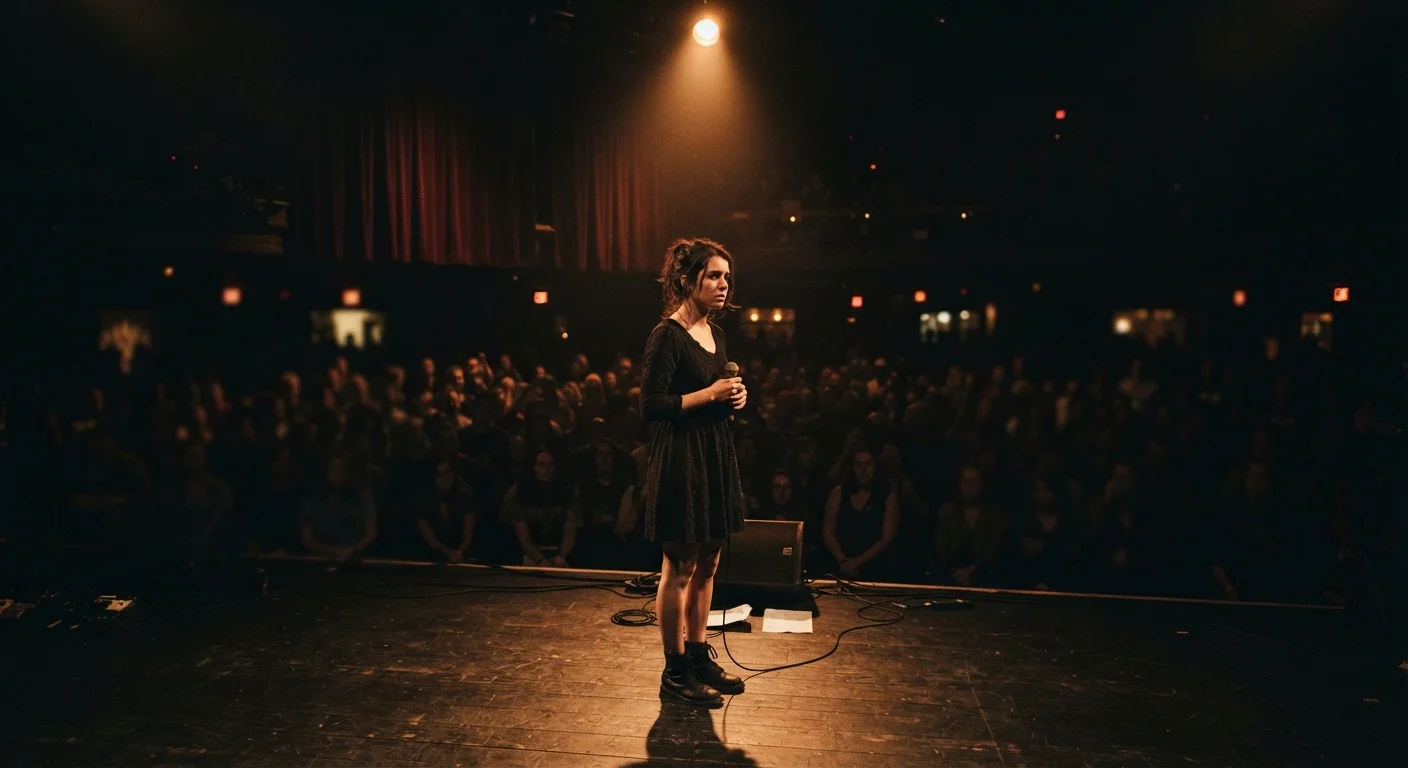
There is a particular kind of loneliness that happens on stage - not the loneliness of an empty room, but of a full one. New performers often describe the experience of looking out at an audience and feeling, paradoxically, completely alone. That feeling is a symptom of one of the most common and correctable mistakes in early performance: turning all of your attention inward.
When nerves spike, the nervous system's response is to tighten focus on what feels controllable - the next line, the next chord, the mechanics of breath and movement. The audience, which should be the entire reason for the performance, becomes a blur. The performer retreats into a kind of private rehearsal happening in public, and the audience senses the absence immediately.
The craft insight that changes everything for most beginners is that performing is fundamentally an act of communication, not display. Every choice - tempo, volume, physical stillness, the willingness to hold a pause - is a word in a conversation you are having with real people in real time. As explored in what makes live performance genuinely alive, that sense of presence in the moment is what separates a show from a recording.
Performing for yourself instead of the room - playing or speaking inward rather than projecting outward toward the audience.
Why it happens: Nerves drive new performers to retreat into their own head. Focusing on internal cues - Am I hitting the right note? Did I remember that line? - feels safer than engaging with hundreds of strangers staring back.
Treating silence as failure rather than as a deliberate, powerful tool.
Why it happens: Beginners associate silence with forgetting something or losing the audience. They rush to fill every gap, which ironically creates an airless, exhausting performance with no room for the audience to feel anything.
Using unfocused, scanning eye contact that skims the room without landing anywhere.
Why it happens: New performers are told to 'make eye contact with the audience,' so they sweep their gaze across the crowd in a mechanical arc that connects with no one and reads as anxious rather than confident.
Apologizing for mistakes mid-performance through visible winces, muttered corrections, or broken momentum.
Why it happens: The instinct is understandable - performers feel exposed when something goes wrong and want the audience to know they know. But the audience almost always notices the reaction more than the original error.
Performing the emotion of a piece rather than pursuing a genuine experience of it in real time.
Why it happens: Memorization and repetition can flatten material into a demonstration rather than a living act. Performers end up illustrating sadness or joy rather than accessing something authentic in the moment.
The Subtler Mistakes: Silence, Eye Contact, and Emotional Honesty
Beyond the broad inward-focus problem, a handful of subtler habits quietly undermine connection in ways beginners rarely detect on their own. Silence is the most counterintuitive. Most new performers treat any gap in sound or speech as an emergency to be corrected, when in fact a well-placed pause is one of the most commanding tools available. Comedians know this better than almost any other performers - the beat after a punchline is where the laugh actually lives.
Memorization Alone Won't Save You
Knowing your material backward is necessary but not sufficient for audience connection. Performers who over-rehearse technical precision - every note, every word - can deliver a technically flawless performance that leaves audiences cold. The material must feel alive in the moment, not recalled from storage. Balance repetition with exploration so spontaneity survives the rehearsal process.
Eye contact deserves its own discussion because the advice most beginners receive - "look at the audience" - is technically correct but practically useless without guidance on how. Scanning the room creates a visual equivalent of speaking to no one. The fix is granular: complete a real thought while genuinely looking at one person, then move on. It feels exposed at first, which is precisely what makes it effective.
Perhaps the deepest mistake is the difference between performing emotion and experiencing it. A performer who has rehearsed grief into a mechanical shape will look like they are illustrating a feeling rather than having one. Audiences are extraordinarily sensitive to this distinction, even when they can't articulate why a performance felt hollow. This challenge connects directly to the broader question of artistic development - how skill and authenticity are built through practice, not born whole.
Presence Is a Skill, Not a Gift
Many beginners believe stage presence is something performers either have or don't - a natural charisma that can't be taught. Research in performance pedagogy consistently challenges this. Presence is developed through deliberate practice, self-awareness, and willingness to fail publicly. Treating it as innate lets new performers off the hook from doing the actual work of building it.
The structure of a performance also shapes connection in ways that aren't immediately obvious. How a set is sequenced - which moment opens, which closes, where the quieter material lands - can make the difference between an audience that feels carried somewhere and one that feels shuffled through a playlist. For performers ready to think at this level, understanding the logic behind performance order is a natural next step in the craft.
7%
Words' share of emotional communication
Psychological research, including foundational work by Albert Mehrabian, suggests that in emotionally charged communication, verbal content accounts for a surprisingly small fraction of how feeling is conveyed - nonverbal cues carry far more weight.
30 sec
Time audiences form first impressions
Performance coaches and theatre educators widely cite studies indicating that audiences establish an emotional impression of a performer within the first thirty seconds of a set or scene.
Connection with an audience is never a single gesture or technique. It is an accumulation of small, deliberate choices that tell the room: I am here, I see you, and this is for you. That message, communicated consistently and honestly throughout a performance, is what audiences carry home.