

| Most common DTI threshold for mortgage approval | 43% or below (Consumer Financial Protection Bureau general guidance) |
| Typical emergency fund target | 3-6 months of essential expenses (Widely cited personal finance guideline; individual needs vary) |
| 50/30/20 rule split | 50% needs, 30% wants, 20% savings/debt (Framework popularized in budgeting education) |
| Zero-based budget starting point | Income minus all allocations = $0 (Core principle of the zero-based method) |
Why Budgeting Has Its Own Language
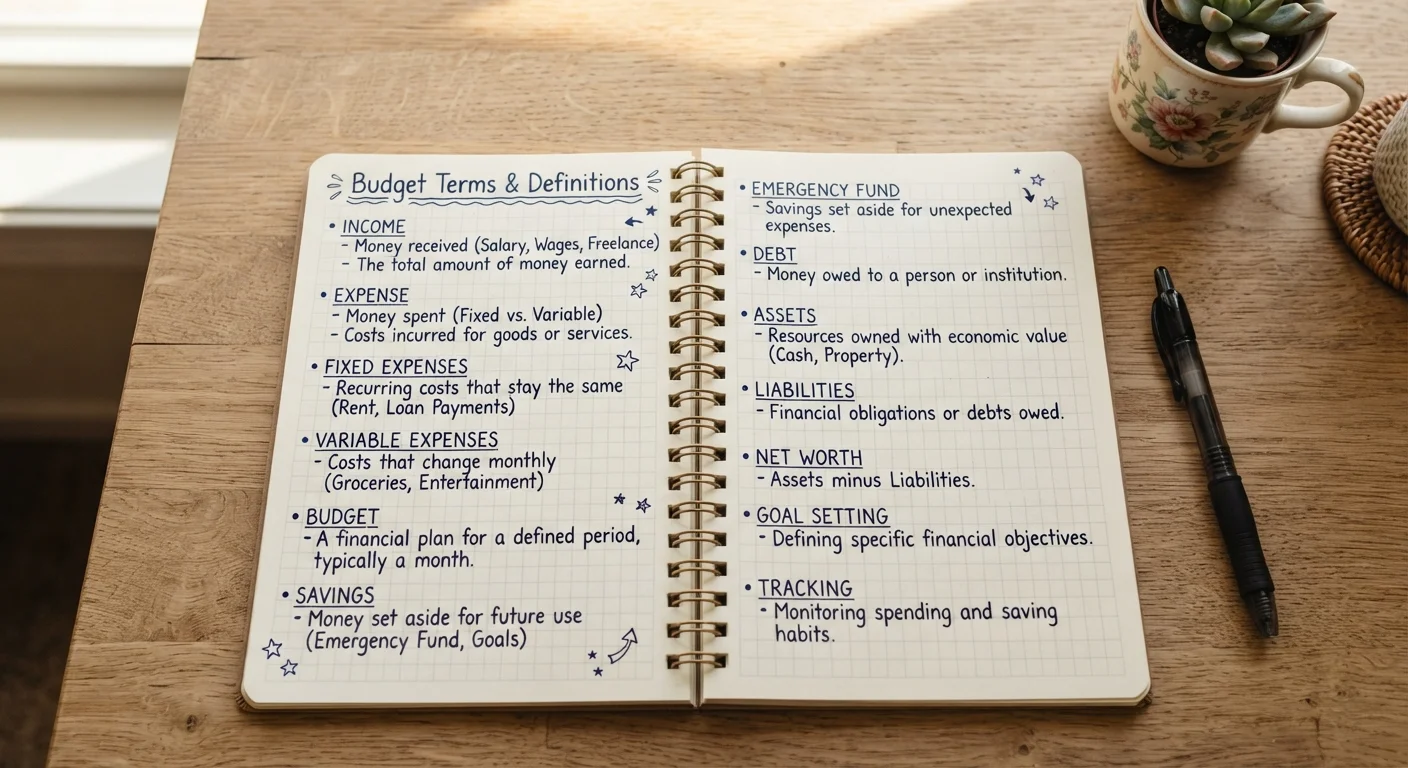
Pick up any budgeting guide and you'll quickly run into terms that feel more at home in an accountant's office than at a kitchen table. Words like discretionary spending, cash flow, and debt-to-income ratio carry specific meanings that shape how budgeting advice is given - and how it should be applied. Misreading even one term can lead to a plan that doesn't hold up in practice.
This reference covers the vocabulary you're most likely to encounter when building or adjusting a personal budget. Whether you're reading a primer on what a budget actually is or exploring the 50/30/20 rule and other popular frameworks, having these definitions on hand will make the material click faster.
Putting the Terms Together
Budgeting terms don't exist in isolation - they connect into a practical system. Your net income sets the ceiling. Fixed expenses come off the top first because they're non-negotiable in the short term. What's left has to cover variable expenses, discretionary spending, and ideally a contribution to an emergency fund or sinking fund.
The relationship between income and outgo is your cash flow. When cash flow is positive and consistent, a budget surplus accumulates. When expenses regularly outpace income, a budget deficit emerges - a signal worth addressing before it compounds into larger debt. For context on how these same concepts scale up to government finance, see the federal budget process explained.
| Most common DTI threshold for mortgage approval | 43% or below (Consumer Financial Protection Bureau general guidance) |
| Typical emergency fund target | 3-6 months of essential expenses (Widely cited personal finance guideline; individual needs vary) |
| 50/30/20 rule split | 50% needs, 30% wants, 20% savings/debt (Framework popularized in budgeting education) |
| Zero-based budget starting point | Income minus all allocations = $0 (Core principle of the zero-based method) |
Your debt-to-income ratio ties personal cash flow to your broader financial profile. Lenders examine it when you apply for a mortgage or personal loan, but it's also a useful self-check: a rising DTI can indicate that debt obligations are crowding out other financial goals. For a deeper dive into related financial statements, the balance sheet explained without the jargon offers helpful context on how assets and liabilities interact. And when you're ready to move beyond budgeting into building wealth, investing terms for beginners is a natural next step.
These Definitions Are a Starting Point
Budgeting vocabulary can vary slightly depending on the source - a financial adviser, a bank, or a personal finance app may use terms with minor differences in scope. The definitions here reflect common usage in the context of personal household budgeting. For decisions specific to your situation - especially those involving debt, credit, or taxes - consulting a licensed financial professional is always worthwhile.
This article is for general informational and educational purposes only and does not constitute personalized financial advice. For guidance tailored to your specific situation, consult a qualified, licensed financial professional.