

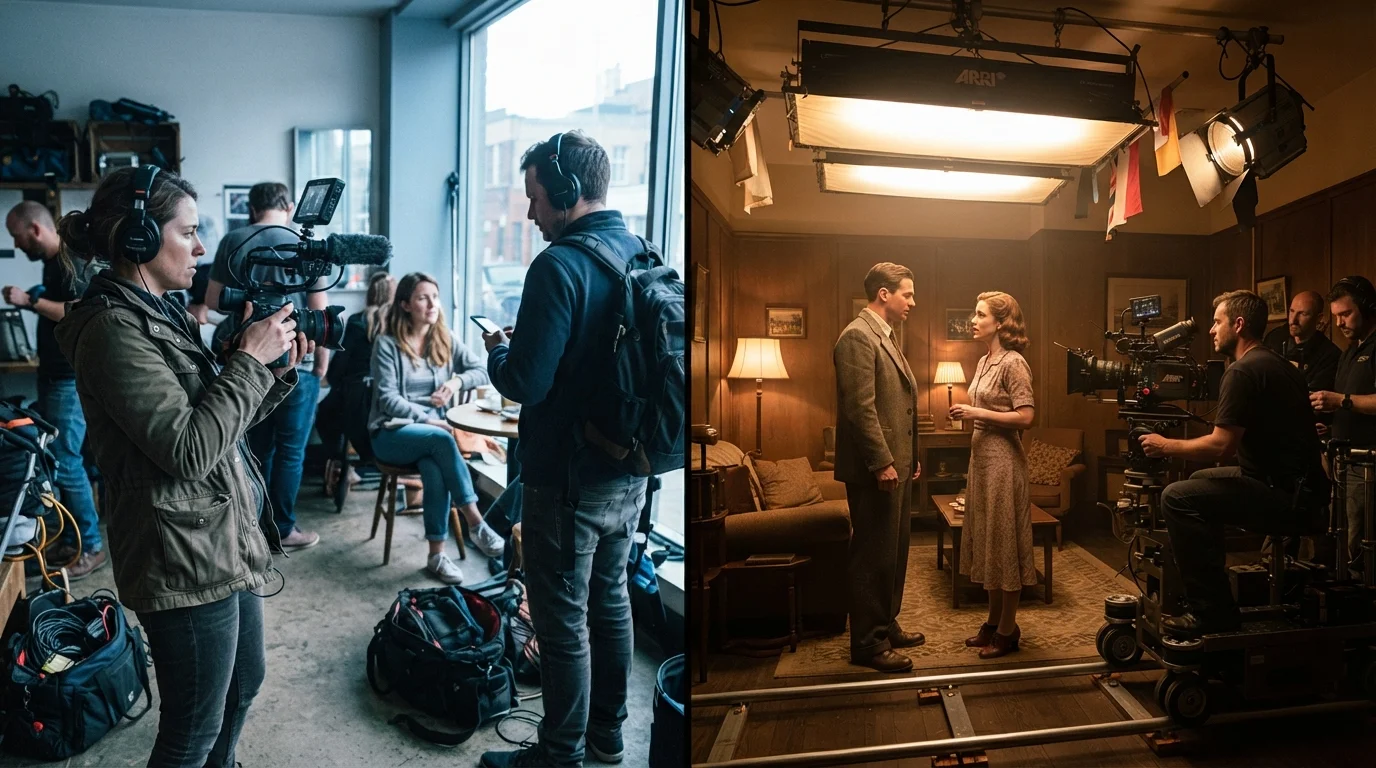
Key Takeaways
Option A
Documentary
The unmediated record - reality captured as it unfolds.
Best for: Viewers who want verified journalism, firsthand testimony, and evidence-based storytelling rooted in actual events and real people.
Option B
Docudrama
The dramatized account - truth shaped by theatrical craft.
Best for: Viewers who want emotional access to historical events or private moments that cameras could never have captured in real time.
If you want journalism and verified fact
Documentary
Documentaries are held to standards of evidence and sourcing. When well-made, they present verifiable claims grounded in real footage, documents, and firsthand accounts.
If you want emotional immersion in historical events
Docudrama
Docudramas can put audiences inside moments - private conversations, inner struggles - that no camera ever witnessed, making history feel viscerally present.
If you're researching or studying a real event
Documentary
Docudramas compress, invent, and dramatize; documentaries, at their best, preserve primary sources and cite verifiable evidence.
If you want a compelling narrative experience based on a true story
Docudrama
The scripted structure of a docudrama allows for narrative arc, dramatic pacing, and character development that pure documentary rarely achieves.
Two Formats, One Reality - Handled Very Differently
When a film opens with the words "Based on a true story" or "A documentary about...", most viewers instinctively adjust their expectations. But those phrases carry very different weight depending on which format they appear in. Documentaries and docudramas both draw from reality - but the way they use that reality, and the promises they make to the audience, are fundamentally distinct.
A documentary works from the world as it exists. Filmmakers capture events in real time or assemble archival footage, conduct interviews with real participants, and construct an argument or narrative from genuine evidence. The filmmaker's role is curatorial and investigative - they are organizing truth, not inventing it. Think of the observational style of Grey Gardens (1975) or the investigative depth of 13th (2016): the camera is a witness.
A docudrama, by contrast, reconstructs events using actors, scripts, and staged scenes - often because the events happened before cameras existed, or because the most dramatic moments occurred in private. Productions like The Crown or HBO's Recount are built on documented historical facts, but the dialogue, blocking, and emotional beats are invented or heavily inferred. The filmmaker's role here is closer to a novelist working from historical research.
Understanding this distinction is part of broader media literacy - a skill that becomes more valuable as streaming platforms blur genre labels for marketing advantage. For a wider look at how genre conventions shape what we watch, see our guide to film genres and what defines them.
| Criterion | Documentary | Docudrama |
|---|---|---|
| Core material | Real footage, interviews, archives | Actors, scripts, staged scenes |
| Relationship to fact | Evidence-bound; must source claims | Fact-inspired; fills gaps with drama |
| Dialogue | Recorded from real people | Written or heavily inferred |
| Creative freedom | Limited to real-world material | Broad; imagination fills the record |
| Risk to viewer | Editorial bias, framing choices | Fabrication mistaken for history |
| Accountability standard | Journalistic and evidentiary | Artistic; may carry disclaimers |
| Emotional access | Limited to what cameras captured | Can depict private, inner moments |
Where Things Get Genuinely Blurry
The honest truth is that the line between documentary and docudrama is not always clean - and the history of nonfiction filmmaking is full of works that deliberately straddle it. Errol Morris's The Thin Blue Line (1988) used dramatic reenactments so carefully crafted that they functioned as visual argument, not embellishment. Werner Herzog has described his approach as seeking "ecstatic truth" rather than literal fact. These films expanded what documentary could do, but they also opened the door to confusion.
The stakes rise when audiences can't tell the difference. A docudrama that depicts a real person saying something they never said - even something plausible, even something that fits the historical record - is an act of fabrication. When viewers don't recognize that, they walk away with false memories of history presented as fact. This is the central ethical tension: docudramas borrow the credibility of the real while exercising the freedom of fiction.
1922
Year the documentary form was named
Robert Flaherty's Nanook of the North (1922) is widely credited as the film that established nonfiction filmmaking as a distinct genre - though it included staged scenes, a tension that has never fully resolved.
~60%
Viewers who can't reliably distinguish the two formats
Media literacy research consistently finds that a significant portion of general audiences conflate documentary and docudrama, often relying solely on marketing language rather than formal cues.
1950s
Decade docudrama emerged on American television
Early U.S. television dramas based on news events helped establish the docudrama as a distinct format, with productions like You Are There blending historical recreation and journalistic framing.
Responsible productions typically signal their methods - through title cards, disclaimers, or press materials that explain what is documented versus imagined. But those signals are easy to miss, especially on streaming platforms where genre labels are notoriously loose. Learning how to watch a film more critically - attending to framing, sourcing, and formal choices - helps viewers ask the right questions before accepting what they see as historical record.
Why the Distinction Matters Beyond Film School
This isn't an abstract debate for critics and academics. The documentary-docudrama distinction shapes how millions of people understand real events, real people, and real history. When a docudrama about a political scandal reaches a wide audience, the invented dialogue and dramatized scenes can become the dominant cultural memory of those events - even among people who know, in the abstract, that the film took liberties.
Documentaries carry their own risks. Editorial selection, interview framing, and music cues all shape a viewer's interpretation, even when every image is real. The most scrupulous documentary filmmaker still makes choices that guide the audience toward particular conclusions. Neither format delivers unmediated truth - but documentaries are accountable to evidence in ways that docudramas are not.
The rise of the hybrid - sometimes called "docu-fiction," "faction," or the mockumentary - has only deepened the confusion. Mockumentaries like Best in Show play the formal conventions of documentary for comic effect; more ambiguous works like I, Tonya use talking-head interviews and competing testimonies to deliberately unsettle the viewer's sense of what happened. These experiments are often artistically rich, but they demand an active, questioning audience. For context on how serialized storytelling introduces its own layers of narrative complexity, our piece on serialized TV vs. episodic TV explores related tradeoffs.
The most useful habit a viewer can develop is simply to ask: What am I actually watching, and what obligations does this format carry? That question, asked before the credits roll rather than after, changes everything about how you receive a story.