

Key Takeaways
The Universal Language of the Unscripted Moment
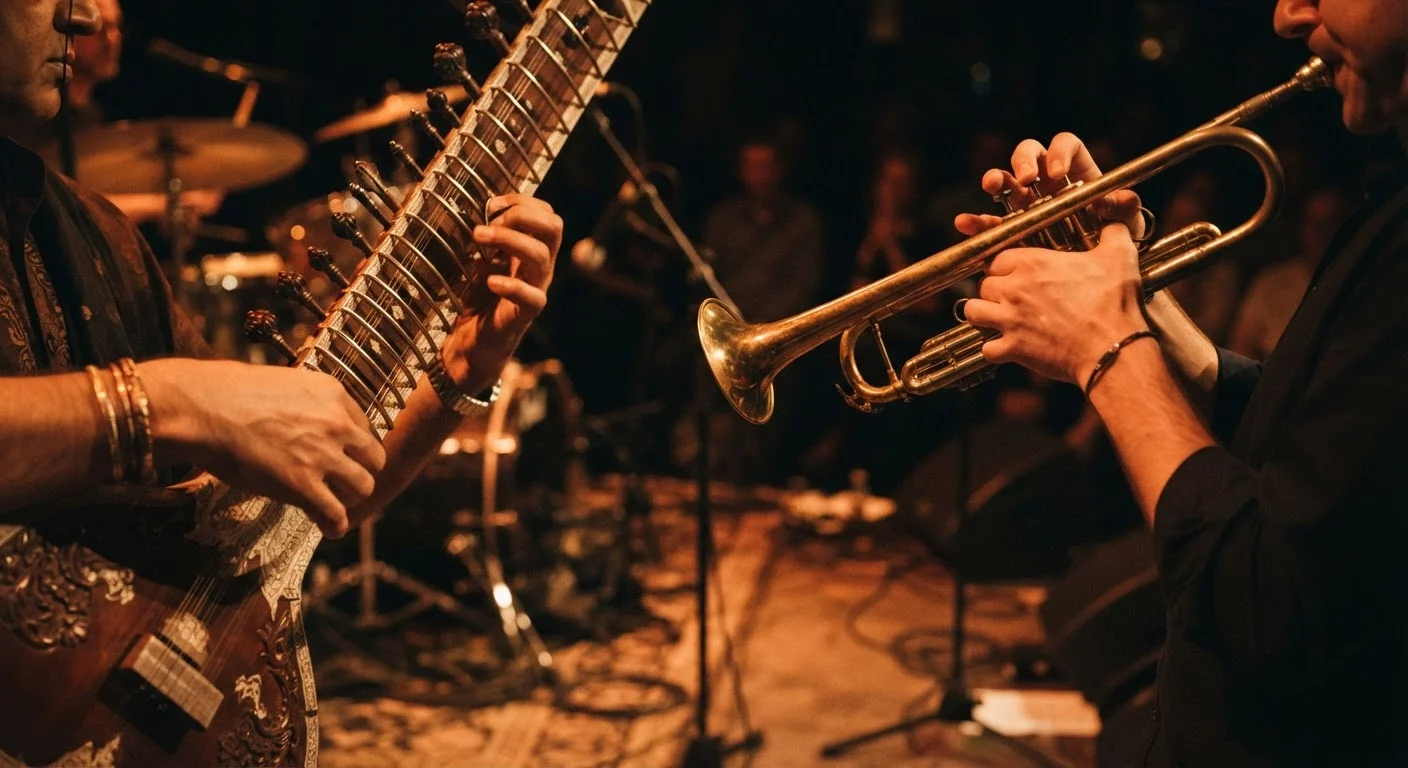
There is a particular electricity that runs through a room when a musician departs from the written page and begins to invent in real time. That electricity is improvisation - and it is among the oldest forms of human musical expression. Far from being a modern or Western phenomenon, spontaneous musical creation sits at the heart of traditions spanning every inhabited continent, from the raga-based performances of North India to the cante jondo wails of Andalusia.
What makes improvisation such a rich subject is precisely that it is never truly free. Every tradition that prizes it also disciplines it, surrounding the spontaneous moment with deep structural scaffolding - scales, rhythmic cycles, emotional archetypes, social rituals. The performer is simultaneously rule-follower and rule-bender. To understand how different cultures approach this balance is to understand something fundamental about how human beings communicate through sound.
Jazz's own improvisational roots stretch back through African call-and-response traditions, European harmonic language, and the unique Creole culture of New Orleans - a reminder that no musical practice emerges in isolation.
Jazz: Democracy in Real Time
Jazz improvisation is perhaps the most globally recognized form of spontaneous musical creation. At its core is a social act: musicians listen to one another intensely, trading phrases, responding to rhythmic cues, and collectively building something none of them planned. The soloist improvises over a chord progression - often called the changes - while the rhythm section simultaneously adapts to support and challenge the improviser.
The tradition draws on the African practice of call-and-response, a conversational musical structure in which one voice poses a musical idea and another answers it. This communal ethos means that even a technically dazzling solo is understood as part of a group conversation, not a solo exhibition.
Jazz improvisation is fundamentally a group conversation, not a solo exhibition.
Indian Classical Music: The Raga as a Living Architecture
In both Hindustani (North Indian) and Carnatic (South Indian) classical traditions, improvisation unfolds within the framework of a raga - a melodic structure that specifies not just which notes to use, but how to approach and leave each one, which ornaments are appropriate, and even what time of day or emotional mood the raga is meant to evoke.
A skilled performer may spend decades mastering a single raga before truly improvising within it. The elaboration section of a performance, known as the alap, is entirely unmetered and improvised, a slow unfolding of the raga's personality. What sounds like pure spontaneity to an untrained ear is in fact a highly codified exploration of a musical universe that has been cultivated for centuries.
A raga is not just a scale - it is a living emotional world a performer inhabits through improvisation.
Flamenco: Emotion as the Governing Law
Flamenco improvisation is inseparable from the concept of duende - a Spanish term describing a heightened, almost haunted state of emotional authenticity that performers and audiences seek together. A flamenco guitarist, singer, and dancer improvise in close dialogue, responding to one another's gestures and emotional intensity rather than following a fixed score.
The rhythmic cycles, called palos, provide structural grounding - but within those cycles, the performer is free, even expected, to digress, to elongate a phrase, to cry out. Flamenco improvisation is governed less by harmonic theory than by emotional truth, making it one of the most viscerally expressive improvisational traditions in the world.
In flamenco, emotional truth is the governing law - not a written score.
Blues: Telling Stories Through Variation
The blues tradition, which emerged from the African American experience in the Deep South during the late 19th and early 20th centuries, treats improvisation as storytelling. The 12-bar blues form provides a flexible container, and within it, singers and instrumentalists bend notes, stretch phrases, and vary lyrics from performance to performance to reflect immediate feeling.
Blues improvisation is intimately tied to the concept of the blue note - pitches deliberately played or sung slightly off standard pitch for expressive effect. This microtonal flexibility, rooted in African musical practices, gave the blues its characteristic ache and became one of its most influential contributions to global popular music. The blues also laid crucial groundwork for what would become jazz and rock.
Blues improvisation is fundamentally an act of storytelling through spontaneous variation and emotional expression.
West African Griot Tradition: Memory, History, and the Improvising Voice
Among the most ancient improvisational traditions still practiced today is that of the griot - a hereditary musician-storyteller found across West African cultures. Griots serve as living archives, preserving genealogies, historical narratives, and social values through song. Their performances blend memorized material with spontaneous composition, adapting to the specific audience, occasion, and social context of each event.
The kora, a 21-string instrument central to griot performance, allows for rich improvisation over a droning harmonic base. Griot improvisation is never purely personal - it is a public act with social responsibilities, and the musician's choices carry real cultural weight. This tradition reminds us that improvisation has always been about more than musical skill; it is a form of communal knowledge-keeping. The instruments themselves carry history, embedding cultural meaning in their very construction.
Griot improvisation is a form of communal knowledge-keeping, not just musical spontaneity.
Why Improvisation Still Matters Today
In an era when studio production can polish every imperfection away, improvisation insists on the irreplaceable value of the live, unrepeatable moment. It demands vulnerability from performers and active listening from audiences. That relationship - where a crowd's energy genuinely shapes what a musician plays - is something no recording can fully replicate. For a deeper look at how the live and recorded arts diverge, see our exploration of live performance versus studio recording.
Across all the traditions explored here, one truth holds: improvisation is a craft earned through years of disciplined study. It rewards curiosity - both in performers willing to take risks and in listeners willing to follow them into unfamiliar territory.
How to Listen to Improvisation More Actively
When attending a live performance rooted in improvisation, try to identify the underlying structure - the repeating chord pattern in jazz, the rhythmic cycle in flamenco, the raga's characteristic phrases in Indian classical music. Once you can hear the framework, you can begin to appreciate how the performer moves within and against it. That contrast between constraint and freedom is where the magic happens.