

Key Takeaways
Material Culture in Music
Material culture refers to the physical objects a society creates - tools, clothing, buildings, and yes, musical instruments. When we apply that idea to music, we're asking what the construction of an instrument reveals about the people who made it: where they lived, what resources they had, and what they believed music was for. Every carving, every stretched hide, every length of bamboo is a kind of historical document.
Organology - the academic study of musical instruments - sits at the intersection of musicology, anthropology, and archaeology, examining how instruments encode cultural knowledge across generations.
The Instrument as Artifact
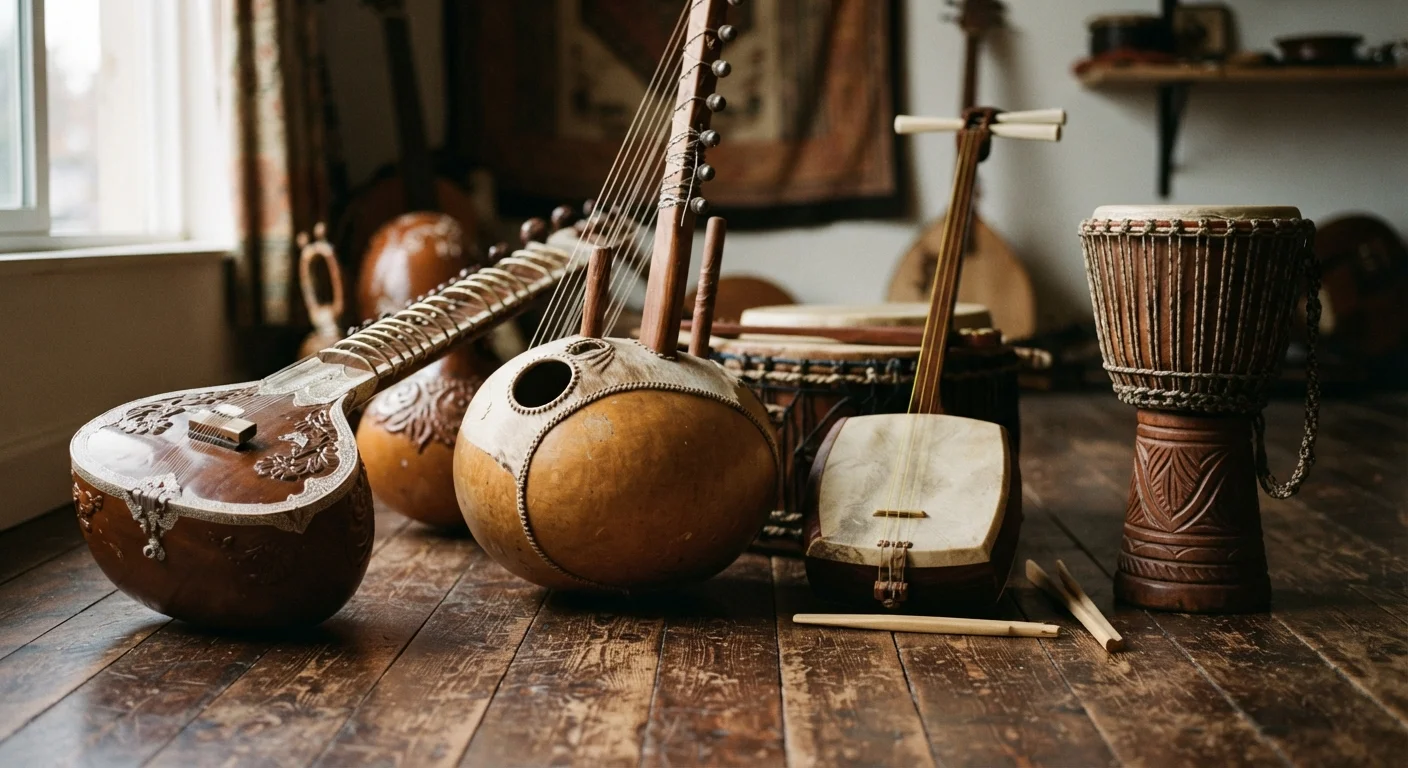
Walk into any museum of natural history and you'll find instruments displayed alongside pottery, textiles, and tools - and that placement is deliberate. A carved gourd resonator, a set of bronze bells, a frame drum stitched from deer hide: these objects tell stories that written records often can't. They reveal which trees grew in a forest, which animals were domesticated, and which trade routes carried ivory or gut string across continents.
This is what scholars mean when they talk about material culture: the idea that the physical things humans make are inseparable from the social world that produced them. Applied to music, the concept asks us to stop treating instruments as neutral delivery systems for sound and start reading them as compressed histories.
~60,000
Years since earliest known bone flute
Archaeological evidence suggests bone flutes found in European cave sites date back roughly 60,000 years, making instrument-making one of humanity's oldest documented activities.
300+
Distinct instrument families catalogued
The Hornbostel-Sachs classification system, developed in 1914 and still in use, organizes musical instruments into major categories that span cultures worldwide.
~90%
Of traditional instrument woods under ecological pressure
Researchers and luthiers have noted that many tonewoods historically used in instrument-making - including Brazilian rosewood and certain mahoganies - face severe supply constraints due to deforestation and export restrictions.
Consider the violin family, which rose to prominence in 16th-century northern Italy. Its distinctive warm resonance is partly a product of the slow-grown spruce harvested from Alpine forests, the craftsmanship economy of cities like Cremona, and the specific varnishes available to luthiers of that era. Change any one of those variables and you change the instrument - and therefore the music built around it. As listeners, we're always hearing history, even when we don't realize it.
Environment, Economy, and the Logic of Local Materials
Almost every traditional instrument begins with what the land offers. The mbira - a lamellaphone (an instrument played by plucking tines) from Zimbabwe - was historically made with iron smelted locally, mounted on a hardwood soundboard, and placed inside a gourd resonator that amplified its buzzing, layered tones. Each component traces back to the ecology and metallurgical tradition of the Shona people. The mbira wasn't designed in the abstract; it was assembled from what the world around its makers provided.
The same logic applies across cultures. Hawaiian gourds, Andean pan pipes cut from highland reed, Chinese silk strings - these are not accidents of craft. They reflect ecosystems, agricultural practices, and in some cases the specific demands of ceremony. When a bamboo flute produces a breathy, airy tone, part of what you're hearing is the hollow cellular structure of the grass itself, a characteristic that players and makers across East and Southeast Asia learned to use expressively over centuries.
“Musical instruments are not mere tools for producing sounds - they are the crystallized record of a people's encounter with their world, shaped by everything from the forests they lived in to the gods they worshipped.”
— Bruno Nettl, Ethnomusicologist and Professor Emeritus, University of Illinois
Trade and colonialism complicated this picture considerably. The spread of steel strings into cultures that had used gut or silk, or the adoption of the guitar across Latin America following Spanish colonization, shows how materials move with power. The result is never simple replacement - local players almost always reshape imported instruments to fit their own musical logic, creating hybrid forms that carry multiple histories at once. This process of creative adaptation connects directly to the broader story of how American vernacular genres cross-pollinate, where European instruments met African rhythmic traditions and Indigenous landscapes.
What Sound Ideals Reveal About Cultural Values
Material choices aren't purely practical - they're also aesthetic and philosophical. Many Japanese traditional instruments, such as the shakuhachi flute and the koto zither, prize a quality called sawari: an intentional buzz or roughness built into the instrument's design. This sonic ideal runs counter to the Western classical preference for a pure, clear tone. Neither is objectively better; they represent different beliefs about what music is supposed to do and what beauty sounds like.
In West African griot traditions, the kora - a 21-string instrument combining features of a lute and a harp, built from a calabash gourd and covered with cowhide - carries with it a social role as a keeper of oral history. The instrument's resonant, harp-like tone is inseparable from its function: accompanying poetry, genealogy, and praise-song. You cannot fully understand the kora's construction without understanding the griot's place in society.
This connection between sound ideals and social function extends to how different cultures approach improvisation - the same values that shape an instrument's construction often shape the freedom (or constraint) a player is expected to exercise when performing on it. An instrument built for communal ceremony has different affordances than one designed for solo virtuosity. The object itself encodes expectation.
Reading Instruments, Hearing History
The practical takeaway for any music listener is a simple invitation: when you hear an unfamiliar instrument, let curiosity about its construction be your entry point. What is it made from? Where do those materials come from? What does the culture that built it seem to value in sound? These questions don't require academic training - they require only the willingness to treat a musical performance as more than entertainment.
For musicians, this perspective raises the stakes of instrument choice and craft. The sounds that emerge from a live performance versus a studio recording are shaped not just by skill but by the physical objects in players' hands - objects with histories that stretch back far beyond the rehearsal room. Understanding that history deepens what a performance can mean, both for the player and the audience.
Instruments are not passive tools. They are the result of accumulated decisions - about materials, about aesthetics, about what music is for - made by generations of people whose names we may never know. To play one, or simply to listen, is to participate in a conversation that has been going on for a very long time.