

Key Takeaways
Balance Sheet
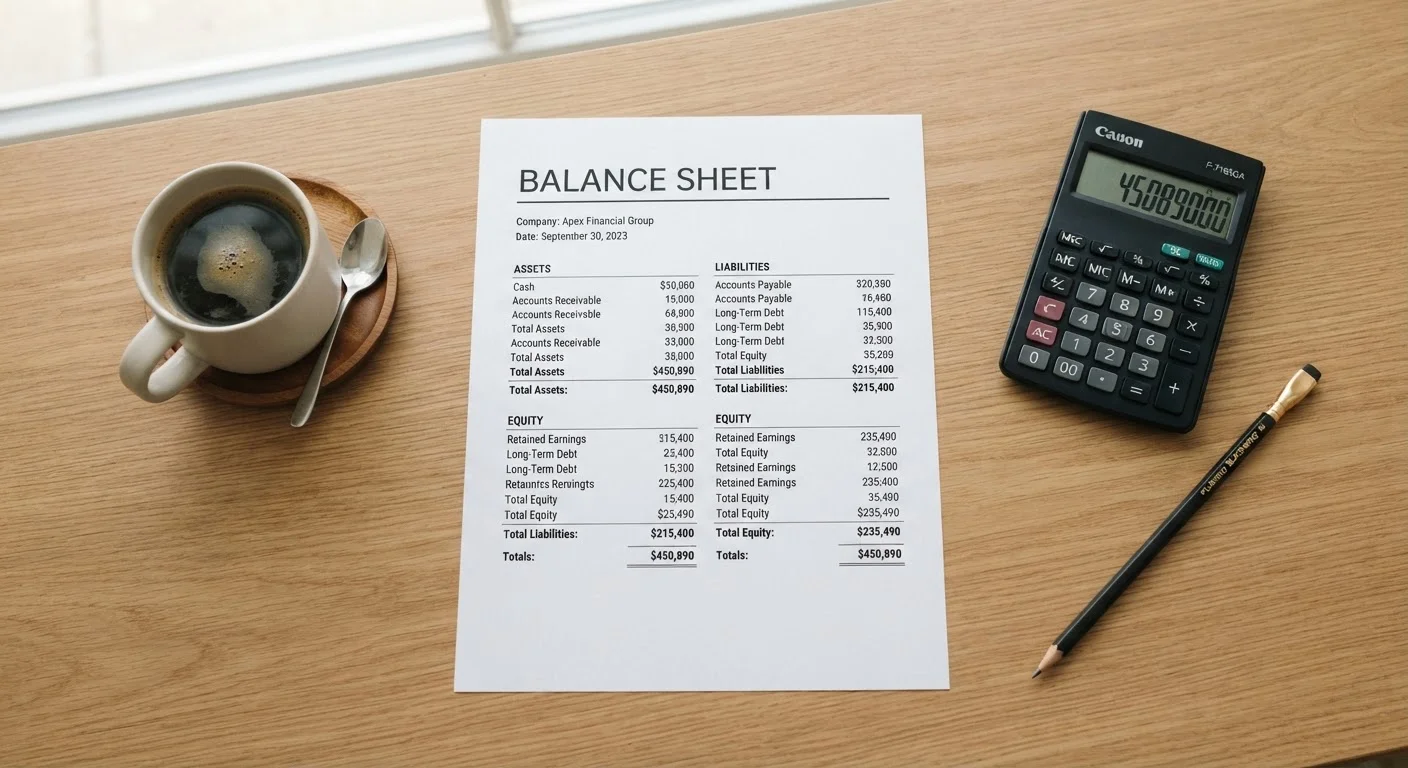
A balance sheet is a financial snapshot of a business at a specific point in time. It shows what the business owns (assets), what it owes (liabilities), and what's left over for the owners (equity). Think of it as a photograph of a company's financial position on a single day.
In accounting, the balance sheet is governed by the fundamental equation: Assets = Liabilities + Owner's Equity. This equation must always balance - hence the name.
What a Balance Sheet Actually Shows
A balance sheet answers one fundamental question: Where does this business stand financially right now? Unlike an income statement - which tracks money coming in and going out over a period of time - the balance sheet is a still frame. It captures everything the business owns and owes on a single date.
That makes it one of the most useful documents a business owner, lender, or investor can look at. It doesn't tell you how the business got to where it is. But it clearly shows the current foundation. For a deeper look at how the balance sheet fits alongside other financial documents, see the financial statements every small business owner should understand.
The Three Sections, Explained Plainly
Every balance sheet, regardless of company size, is organized into three parts:
Assets
Assets are everything the business owns or controls that has economic value. These are typically divided into current assets - things that can be converted to cash within a year, like cash on hand, accounts receivable, and inventory - and non-current assets, which include equipment, real estate, and intangible items like patents.
Liabilities
Liabilities are the business's obligations - what it owes to others. Current liabilities include bills due within the year, such as accounts payable, short-term loans, and accrued wages. Long-term liabilities include mortgages and multi-year loans. Understanding whether debt is secured or unsecured also matters here; secured vs. unsecured debt work very differently and affect risk in distinct ways.
Owner's Equity
Equity is what's left when you subtract liabilities from assets. It represents the owner's stake in the business - retained earnings, initial investment, and any additional capital contributed. A growing equity balance over time is generally a healthy sign.
82%
Of small businesses that fail cite cash flow problems
According to data cited by the U.S. Small Business Administration, poor cash management - visible through financial statements including the balance sheet - is among the leading causes of small-business failure.
1 in 3
Small business owners who review financials monthly
Research from the National Federation of Independent Business suggests a significant portion of small-business owners do not regularly review core financial statements, including the balance sheet.
The Equation That Holds It All Together
The accounting equation is deceptively simple: Assets = Liabilities + Owner's Equity. Every transaction a business makes affects at least two parts of this equation simultaneously, keeping it in balance.
If a business takes out a $20,000 loan, assets increase by $20,000 (cash in the bank) and liabilities also increase by $20,000 (the loan obligation). The equation stays balanced. This double-entry logic is the backbone of how balance sheets are built and why they must always - by definition - balance.
Check Your Balance Sheet Quarterly
Many small business owners only look at their balance sheet at tax time - but reviewing it quarterly helps you catch problems early. A growing liabilities column or shrinking equity can signal trouble months before it becomes a crisis. Your accounting software can usually generate one automatically.
How to Use a Balance Sheet to Gauge Business Health
A balance sheet becomes most useful when you look beyond the raw numbers and start asking ratio-based questions. For example:
- Debt-to-equity ratio: How much of the business is financed by debt versus owner investment? A high ratio can signal over-reliance on borrowing.
- Current ratio: Dividing current assets by current liabilities shows whether the business can cover short-term obligations. A ratio below 1 suggests a potential cash crunch.
- Working capital: The difference between current assets and current liabilities. Positive working capital means the business can fund its day-to-day operations.
These metrics are standard tools for lenders and investors. If you want to go deeper, key financial ratios every small business owner should know offers a practical breakdown of the most widely used measures.