

Key Takeaways
Why Art Movements Matter Beyond the Museum
Most of us encounter art through a school field trip, a postcard on a refrigerator, or a print hanging in a waiting room. We recognize something is happening on the canvas - color, shape, emotion - but rarely do we ask why art looked the way it did at a particular moment in history, or why it suddenly changed. That question turns out to be one of the more revealing things you can ask about any society.
Art movements aren't trends invented by critics in Paris or New York. They are collective responses to real conditions: political upheaval, social injustice, industrial change, war, migration, and the ongoing human need to make sense of the world. When artists share a set of ideas and begin working in conversation with each other, a movement emerges - and sometimes it changes not just aesthetics, but how entire communities understand themselves.
The five movements below are among the most consequential in American visual art history. You don't need a degree to appreciate them. If anything, knowing the story behind the work makes standing in front of it a richer experience. For a practical guide to noticing what's actually in front of you the next time you visit a gallery, see our guide to reading a painting.
The Hudson River School (1820s-1870s)
Before the United States had centuries of cathedrals or ancient ruins to paint, its artists turned to what the young nation did have in abundance: staggering wilderness. The Hudson River School - a loose group of painters centered in New York, including Thomas Cole and Frederic Edwin Church - elevated the American landscape into something almost sacred. Their vast canvases of the Catskills, Niagara Falls, and the American West told a story about national destiny and the spiritual grandeur of unsettled land.
The movement arrived at a critical moment. As industrialization began reshaping the Eastern Seaboard and westward expansion accelerated, these paintings offered Americans an idealized vision of what the continent was - and an implicit argument for preserving it. Historians often credit Hudson River School imagery with helping cultivate the public sentiment that eventually led to the creation of national parks. The paintings weren't neutral landscapes; they were quietly political documents wrapped in breathtaking color.
These weren't neutral landscapes - they were quietly political documents wrapped in breathtaking color.
The Harlem Renaissance (1920s-1930s)
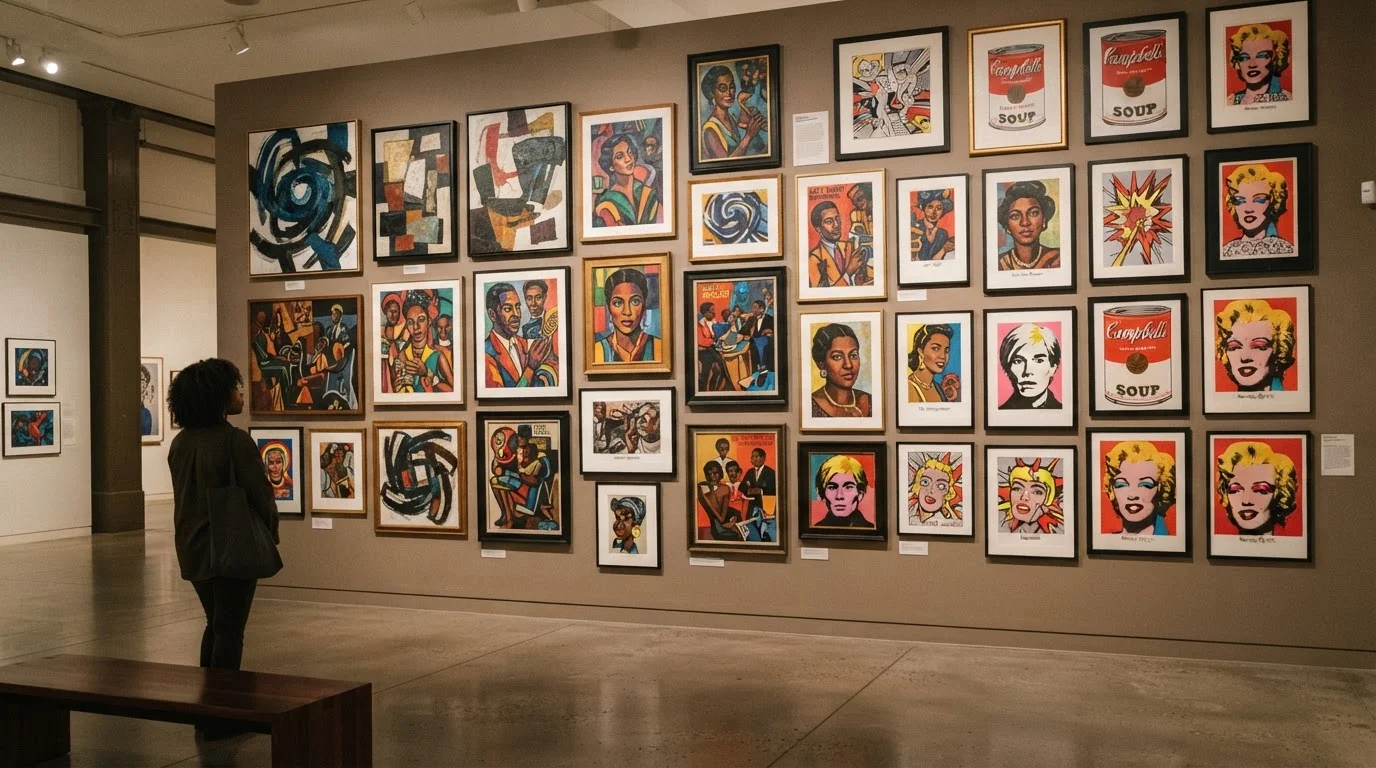
During the 1920s, Harlem in New York City became the creative center of Black American life - a place where writers, musicians, and visual artists gathered to define a new cultural identity in the aftermath of the Great Migration. Painters and sculptors such as Aaron Douglas, Augusta Savage, and Jacob Lawrence drew on African artistic traditions, the energy of jazz, and the urgent politics of civil rights to produce work that insisted on the full humanity and complexity of Black American experience.
The Harlem Renaissance mattered because it directly challenged the dominant cultural narrative. Museums, galleries, and mainstream publications had largely excluded or caricatured Black subjects. These artists reclaimed the frame entirely. Douglas's bold graphic style became iconic; Savage's sculptures depicted ordinary Black figures with monumental dignity. The movement planted seeds that flowered across literature, music, and performance as well, demonstrating how visual art can anchor an entire cultural awakening.
These artists didn't just paint - they reclaimed the cultural frame that had excluded them.
Abstract Expressionism (1940s-1950s)
After the devastation of World War II, a group of New York-based artists - among them Jackson Pollock, Mark Rothko, and Lee Krasner - decided that traditional representation simply wasn't adequate to express what the modern world felt like. They abandoned recognizable subjects in favor of gesture, scale, and raw emotion. The results were enormous canvases that demanded a physical and psychological response from the viewer rather than a narrative reading.
Abstract Expressionism shifted the center of the art world from Paris to New York, a cultural realignment with lasting consequences. It also introduced the idea that the process of making a painting - the drips, the sweeping brushwork, the spontaneous decisions - was itself meaningful content. For viewers unfamiliar with the movement, the work can feel baffling. But understanding the postwar anxiety and existential urgency behind it transforms the experience of standing in front of a Rothko color field or a Pollock drip painting.
For the first time, how a painting was made became as meaningful as what it depicted.
Pop Art (1950s-1960s)
By the late 1950s, American consumer culture had exploded - supermarket shelves, billboard advertising, comic books, and celebrity magazines were everywhere. Pop Art, led by figures including Andy Warhol, Roy Lichtenstein, and Jasper Johns, responded by dragging those commercial images directly into the gallery. Soup cans, Brillo boxes, and blown-up comic panels became the subject matter of serious fine art.
The movement asked an unsettling question: if mass-produced imagery saturates everyday life, why should fine art pretend to exist in a separate, elevated realm? Pop Art was simultaneously a celebration and a critique of consumer society - and that ambiguity is part of what makes it so durable. It also democratized visual culture in a real sense: the imagery was familiar to everyone, regardless of their education. You didn't need an art history degree to recognize what you were looking at. That accessibility was the point.
Pop Art democratized the gallery by using imagery that already belonged to everyone.
The Feminist Art Movement (1970s)
In the early 1970s, artists and critics began asking a pointed question: why were the vast majority of works in major American museum collections made by men? The Feminist Art movement, associated with figures such as Judy Chicago, Miriam Schapiro, and the collective activism of the Guerrilla Girls, challenged the institutional biases that had long determined whose work was shown, collected, and celebrated.
The movement didn't just advocate for inclusion - it reimagined what art could look like and what subjects deserved to be taken seriously. Chicago's large-scale collaborative installation The Dinner Party, created in the late 1970s, honored women throughout history using craft forms - ceramics, needlework - that had been dismissed as decorative rather than fine art. In doing so, the movement reframed the very definition of artistic seriousness, expanding the conversation about whose stories visual culture has an obligation to tell.
Feminist artists didn't just demand inclusion - they redefined what counted as serious art.
Art as a Mirror - and a Catalyst
What links all five movements is a refusal to let visual art be merely decorative. Each one insisted that painting, sculpture, and image-making could carry the weight of history, identity, and argument. That conviction is still alive in galleries and public murals today.
Visit With Context in Mind
Before your next museum visit, spend five minutes reading about when a particular work was made and what was happening in the world at that time. Even a rough sense of historical context - a war, a social movement, a technological shift - can turn a painting from a beautiful object into a conversation. Many major museum websites offer free timelines and movement guides as starting points.
If abstract work is still a puzzle, our companion piece Abstract Art Decoded walks through the intentions and decisions behind paintings that don't depict recognizable objects - it may shift how you see an entire category of work. Art movements, like the eras of film and television that ran parallel to them, reflect a culture in conversation with itself. Just as cinema reinvented its grammar in the 1960s and 70s - explored in our look at Golden Age Hollywood versus New Hollywood - visual art has repeatedly broken its own rules to say something new. The result, across centuries, is a record of who Americans were, what they feared, what they celebrated, and what they demanded the world finally see.