

Key Takeaways
Abstract Art
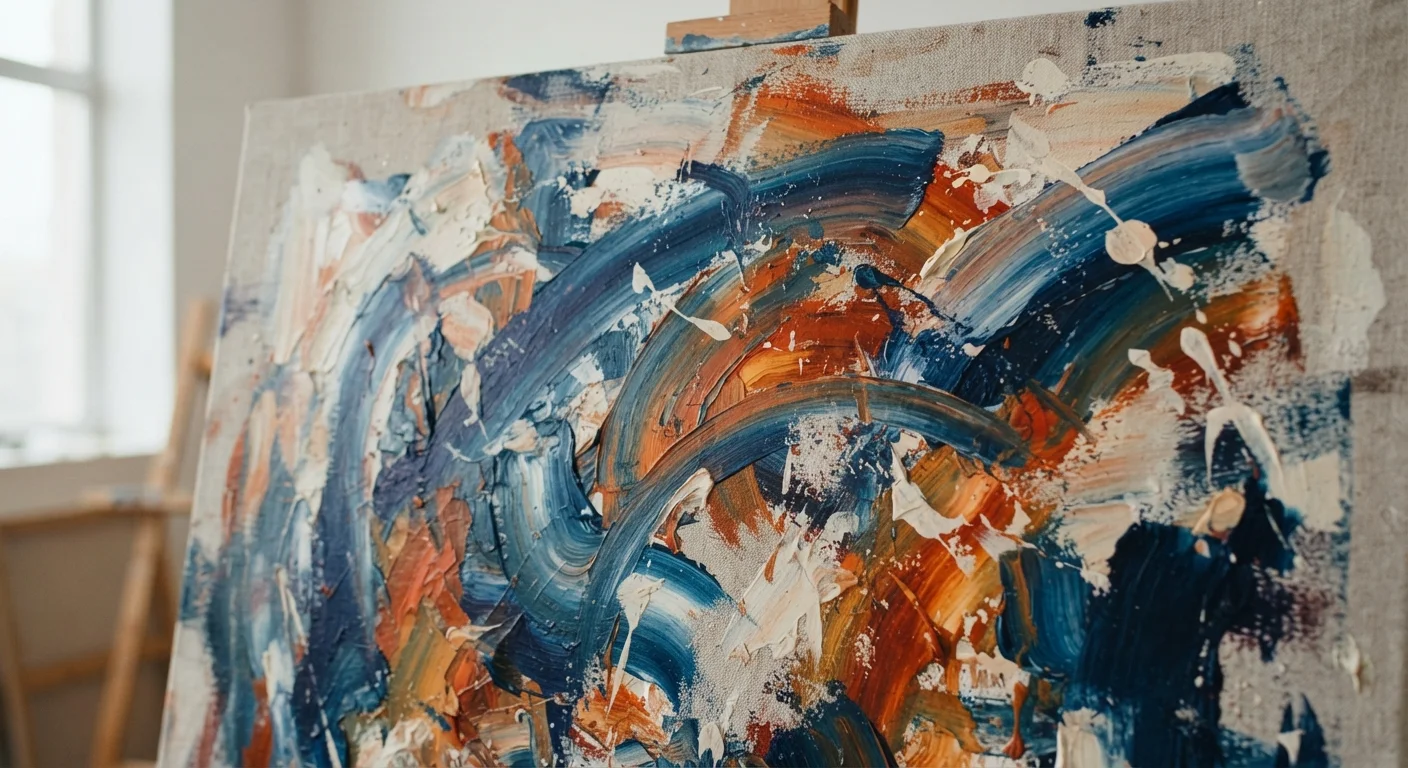
Abstract art is artwork that does not attempt to represent recognizable objects, people, or places from the real world. Instead, it uses color, shape, line, texture, and composition to express ideas, emotions, or visual experiences on their own terms. The absence of a literal subject is intentional - the painting itself is the subject.
Abstraction exists on a spectrum: some works are partially abstract (distorting recognizable forms), while others are fully non-representational, bearing no visual connection to the physical world.
The Myth of the Empty Canvas
Stand in front of an abstract painting long enough and the question often surfaces: Is anything actually happening here? It's an honest reaction. When there's no face, no landscape, no still life to anchor your gaze, the brain reaches for a foothold and sometimes finds none. That disorientation can feel like failure - yours or the artist's.
But abstract art isn't about emptiness. It's about the decision to strip away the literal in order to say something that representation cannot. When an artist fills a canvas with nothing but a deep crimson field fading into black, they're not avoiding subject matter - they're choosing color itself as the subject. The experience of standing before that painting, the weight it creates in your chest, is the message.
Understanding this reframes the whole encounter. Abstract artists aren't leaving something out. They're working with a different vocabulary - one built from visual elements rather than depicted things. Learning to notice line, light, and composition can open these works up considerably, even without any art-world background.
What Artists Are Actually Deciding
Every mark in an abstract painting is a choice. Consider the decisions stacked inside a single work: Which colors sit next to each other, and how does that pairing create tension or harmony? Where does the eye naturally travel across the canvas? Is the paint applied in thick, physical gestures or in translucent washes? Is there a center of gravity, or does the composition deliberately resist one?
1910s
Decade when fully non-representational painting emerged
Art historians generally trace the first fully abstract works to Wassily Kandinsky and others working in Europe in the early twentieth century.
$72.8M
Sale price of a Mark Rothko canvas at auction
Rothko's 'No. 6 (Violet, Green and Red)' sold at Christie's in 2014, reflecting the sustained institutional and market value placed on mid-century American abstraction.
Top 5
Abstract Expressionism's global art-world ranking
New York's Abstract Expressionist movement of the 1940s-50s is broadly credited with shifting the center of the global art world from Paris to New York, according to major art history surveys.
These aren't arbitrary. When Abstract Expressionist painters like Willem de Kooning worked in the 1940s and 1950s, their violent, energetic brushwork was a deliberate statement - a rejection of the polished, academic painting that had defined prestige for centuries. The rawness was the argument. When Color Field painters like Helen Frankenthaler poured diluted paint directly onto unprimed canvas, allowing it to soak and bleed, they were exploring how color could generate its own emotional atmosphere without any assistance from form.
How color actually functions visually - through hue, saturation, and contrast - is a significant part of what abstract artists are manipulating. Color is rarely neutral; it carries cultural weight, psychological associations, and visual energy that the artist can harness or subvert.
Emotion, Idea, and Experience as Subject Matter
If abstract art has no recognizable subject, what is it about? The honest answer: often, it's about things that don't have easy images. Grief. Spiritual longing. The feeling of a city at night. The pressure of historical violence. These are real human experiences, and they resist illustration.
“I am not interested in relationships of color or form or anything else. I am interested only in expressing basic human emotions - tragedy, ecstasy, doom, and so on.”
— Mark Rothko, Abstract Expressionist painter, widely regarded as one of the most influential figures in twentieth-century American art
Mark Rothko famously said he was not interested in color or form for their own sake - he was after expressing basic human emotions: tragedy, ecstasy, doom. His large-scale color canvases were designed to engulf the viewer, creating an almost physical encounter with those emotional states. The scale mattered. The trembling edges where colors met mattered. None of it was decoration.
This is what separates abstract art from simply being "random" - the presence of intent. The artist has identified an experience or idea and found a visual language capable of carrying it. Your job as a viewer isn't to decode a hidden message, but to let the work register in your own body and emotional response. That response is real data.
For a broader sense of how these ideas emerged through American history, the art movements that reshaped American visual culture offer essential context - from the Harlem Renaissance through the Abstract Expressionist moment that put New York on the global art map.
How to Engage With It on Your Own Terms
No decoder ring is required to have a genuine experience of abstract art. But a few practical habits can shift the encounter from baffling to absorbing.
- Give it time. Abstract work often reveals itself slowly. A painting that seems flat at first may begin to pulse with energy after a few minutes of attention.
- Notice your physical response. Does the work feel heavy or light? Agitated or calm? These reactions aren't imaginary - they're the work communicating.
- Read a single sentence of context. Knowing that Rothko was a Russian Jewish immigrant haunted by themes of mortality, or that Frankenthaler was experimenting with the boundary between painting and drawing, gives the eye something to work with.
- Resist the urge to conclude. Abstract art doesn't typically resolve into a single reading. Sitting with ambiguity is part of the experience, not a sign that you're missing something.
The broader truth is that abstract art asks more of its audience than representational painting - but the return is proportionally richer. When a work with no faces, no landscape, and no story nonetheless moves you, you've encountered something that language alone couldn't have delivered.