

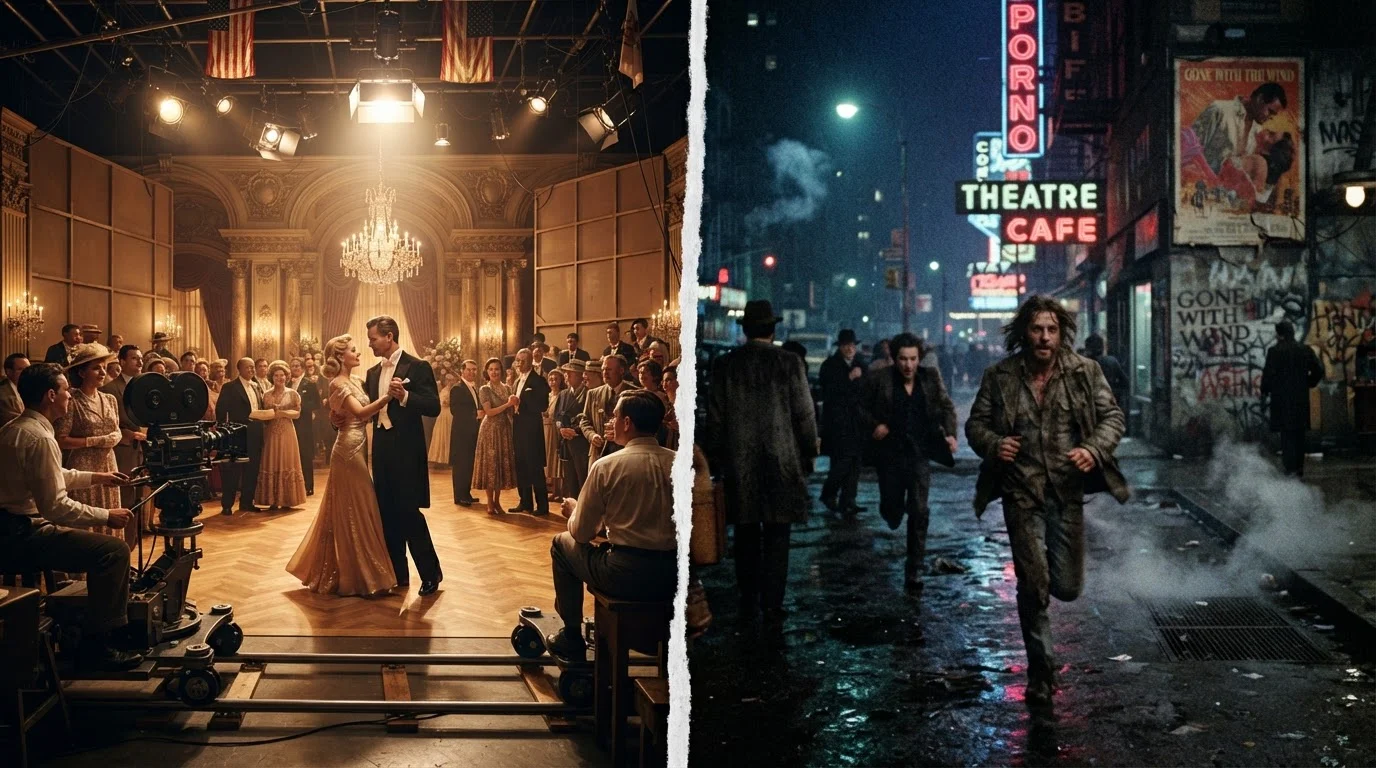
Key Takeaways
Option A
Golden Age Hollywood
The studio-controlled dream factory at its most polished and powerful.
Best for: Readers interested in classic Hollywood spectacle, the studio system, and the mythology of old-school American filmmaking.
Option B
New Hollywood
The director-driven rebellion that dragged American cinema into the modern world.
Best for: Readers drawn to auteur-driven storytelling, countercultural art, and the films that broke every established rule.
If you love sweeping spectacle, polished craft, and classic genre storytelling
Golden Age Hollywood
The studio system produced technically magnificent films built to entertain mass audiences. Its formal beauty and genre clarity remain unmatched.
If you want cinema that challenges, provokes, and reflects real social complexity
New Hollywood
New Hollywood dismantled comfortable formulas to grapple with Vietnam, race, gender, and disillusionment - producing some of the most personal American films ever made.
If you're tracing the roots of modern blockbuster filmmaking
New Hollywood
Films like Jaws and Star Wars emerged at the tail end of this era and essentially invented the modern Hollywood blockbuster model.
If you're studying how entertainment industries are built and sustained
Golden Age Hollywood
The studio system represents one of the most complete vertical integration models in entertainment history, with lessons still relevant today.
The Dream Factory: What Golden Age Hollywood Actually Was
From roughly the early 1930s through the late 1950s, Hollywood operated as a tightly managed industrial system. A handful of major studios - MGM, Warner Bros., Paramount, RKO, and 20th Century Fox - controlled production, distribution, and exhibition simultaneously. They owned the theaters. They owned the stars, who were kept under exclusive, long-term contracts. They employed directors, writers, and cinematographers on salary, all working within a clearly defined hierarchy.
The result was a kind of factory filmmaking that was, paradoxically, often extraordinary. The studio system produced westerns, musicals, screwball comedies, and melodramas with remarkable consistency and craft. Genre conventions weren't constraints so much as shared grammar - audiences knew what they were getting, and studios knew how to deliver it beautifully. Understand the broader history of those genre conventions with our reference guide to film genres.
Governing all of it was the Hays Code (formally the Motion Picture Production Code), a self-regulatory document adopted industry-wide in 1934. It banned depictions of interracial romance, sympathetic portrayals of crime, and explicit sexuality, among dozens of other restrictions. The result was a cinema of suggestion and implication - sometimes brilliantly inventive, sometimes deeply sanitized.
| Criterion | Golden Age Hollywood | New Hollywood |
|---|---|---|
| Approximate period | Early 1930s - late 1950s | 1967 - early 1980s |
| Power structure | Studio executives in control | Directors as primary auteurs |
| Content regulation | Hays Production Code | MPAA rating system (from 1968) |
| Visual style | Polished, controlled studio aesthetics | Handheld, location shooting, realism |
| Storytelling tone | Genre conventions, moral resolution | Ambiguity, antiheroes, open endings |
| Key influences | Theater, literary adaptation, vaudeville | European art cinema, documentary |
| Star system | Contract players owned by studios | Independent talent with creative agency |
The Rebellion: How New Hollywood Emerged
By the mid-1960s, the studio system was crumbling. The Supreme Court's 1948 Paramount Decree had forced studios to divest their theater chains, fracturing their vertical control. Television was eating into cinema attendance. And audiences - particularly younger ones shaped by the civil rights movement, Vietnam, and cultural upheaval - were growing impatient with Hollywood's polished evasions.
Into this vacuum stepped a new generation of filmmakers who had studied Italian neorealism, the French New Wave, and the work of Akira Kurosawa. Directors like Arthur Penn, Robert Altman, Francis Ford Coppola, Martin Scorsese, and later Steven Spielberg and George Lucas arrived with film school training and a hunger to make movies that felt true. The influence of foreign cinema on American directors during this period can hardly be overstated.
When the MPAA replaced the Hays Code with a rating system in 1968, the floodgates opened. Bonnie and Clyde (1967) and Easy Rider (1969) had already signaled the shift - moral ambiguity, graphic violence, and antiheroes were suddenly not just permitted but celebrated. The director became the central creative authority, borrowing the French auteur theory, which held that a filmmaker's personal vision should be visible across their work.
1948
Year of the Paramount Decree
The U.S. Supreme Court's antitrust ruling forced major studios to sell their theater chains, beginning the slow unraveling of the studio system's total control.
1968
Year the MPAA rating system launched
The Motion Picture Association of America replaced the restrictive Hays Code with an age-based rating system, fundamentally expanding what American films could portray.
5 studios
Major studios controlling Golden Age Hollywood
MGM, Warner Bros., Paramount, RKO, and 20th Century Fox collectively dominated production, distribution, and exhibition during the height of the studio era.
What Was Gained, What Was Lost
New Hollywood gave American cinema honesty. Films like Chinatown, Taxi Driver, and The Godfather explored corruption, trauma, and moral failure without flinching. They trusted audiences to sit with discomfort. The craftsmanship remained extraordinary - but now it served personal, often dark visions rather than institutional entertainment goals.
Yet something was also lost in the transition. The studio system, for all its control and censorship, had sustained a vast ecosystem of skilled craftspeople working at the peak of their abilities within collaborative structures. The economics of the new model were more unstable, and the director-as-genius mythology sometimes marginalized the collaborative labor that made films actually work. Understanding how film financing shifted across both eras helps clarify why - our companion piece on how the film industry gets films made traces that evolution directly.
Both eras also reflected and shaped broader culture. Golden Age Hollywood offered escape and aspiration during the Depression and World War II. New Hollywood mirrored a nation questioning its own institutions - a parallel visible across the visual art movements reshaping American culture during the same decades. Neither era was wholly good or wholly flawed. Together, they form the full story of what American cinema is.
Where New Hollywood Ends Is Debated
Film historians disagree on exactly when New Hollywood concluded. Many mark the release of Jaws (1975) and Star Wars (1977) as the turning point, arguing that their blockbuster success handed power back to studios and shifted focus toward high-concept, commercially engineered films. Others extend the era into the early 1980s. The boundaries are porous - which is part of what makes this period so endlessly fascinating to study.