

Key Takeaways
Our Verdict
Folk, country, and Americana are not competing genres so much as neighboring territories with a shared map. Each draws from the same deep well of rural American musical experience but channels it toward different audiences, institutions, and artistic intentions. Understanding where one ends and another begins helps listeners engage more deeply with why these sounds still resonate.
| Best for | Recommended |
|---|---|
| Listeners drawn to political and communal storytelling | Folk |
| Audiences who enjoy polished production and broad emotional themes | Country |
| Fans seeking genre-crossing artistic independence and craft-forward recordings | Americana |
The Common Ground: Where These Genres Begin
Any honest map of American roots music has to start with the acknowledgment that its borders are contested - and always have been. Folk, country, and Americana all trace lineage to the same tangled inheritance: the ballad traditions of the British Isles, the blues and gospel of the American South, the fiddle tunes of Appalachian communities, and the working songs of laborers who built and crossed this country. As our coverage of what music genres actually are and why the lines keep blurring explores, genre labels are often imposed after the fact, shaped as much by industry decisions as by artistic ones.
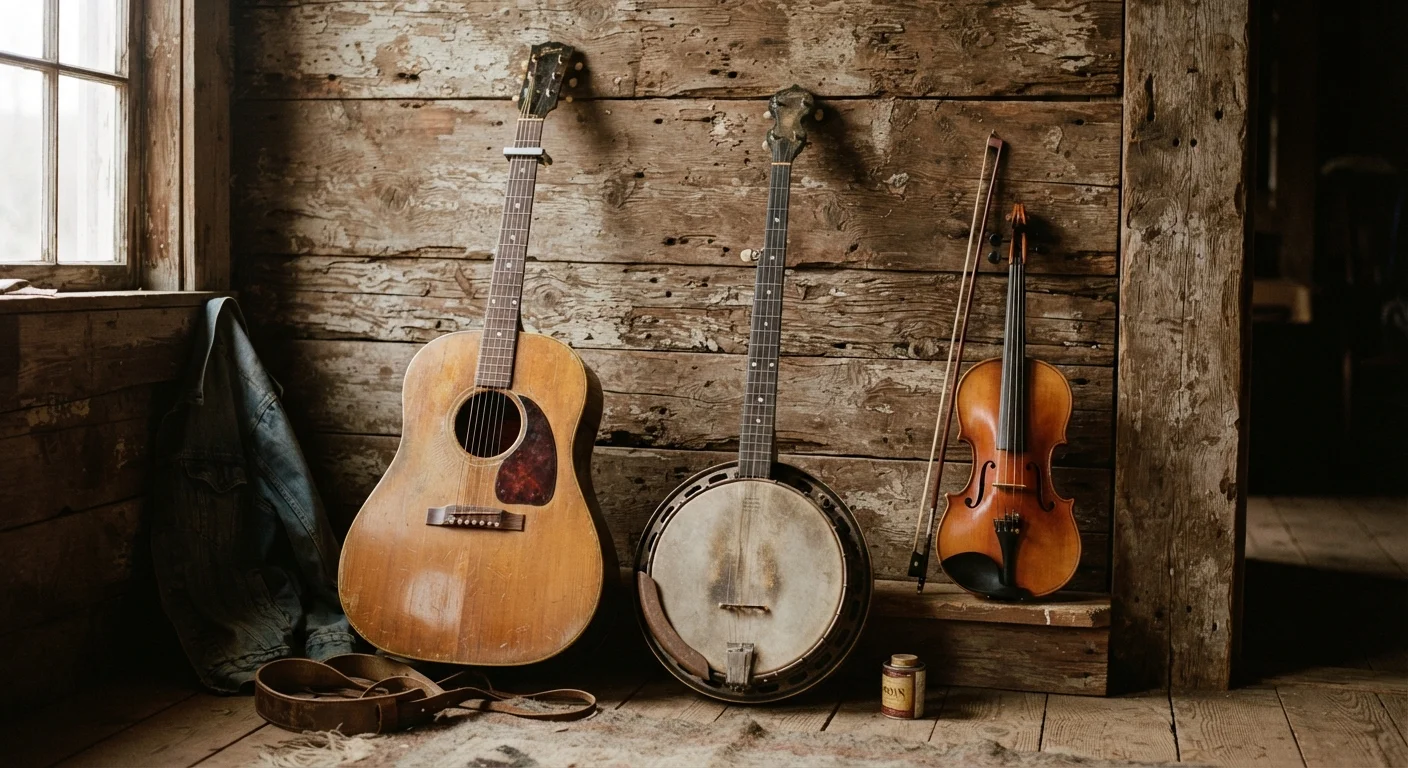
What these three traditions share most deeply is an investment in the song itself - in lyric, narrative, and melody stripped of excess. The acoustic guitar, banjo, fiddle, and mandolin appear across all three. So does a preoccupation with place: the holler, the highway, the small town left behind. The craft of songwriting - its verses, its hooks, its emotional architecture - is central to all three. See the craft of songwriting for a closer look at how that structure works across genres.
Folk: The People's Archive
Folk music's defining quality is its relationship to community transmission. Historically, folk songs were not authored in the modern sense - they were passed mouth to ear, altered with each retelling, belonging collectively to a people rather than an individual. The 20th-century folk revival, centered in the 1940s through 1960s and associated with figures like Woody Guthrie and Pete Seeger, reintroduced this ethic to mass culture while adding an explicitly political dimension: folk became the sound of labor movements, civil rights organizing, and anti-war protest.
That activist thread remains part of folk's DNA today, though contemporary folk encompasses a wide range of approaches - from confessional singer-songwriters to shape-note choral traditions. What distinguishes folk from its cousins is less a sonic signature than an ideological stance: skepticism of commercial production, emphasis on acoustic simplicity, and a belief that music should speak to shared experience rather than individual stardom. The instruments themselves often carry history; when instruments tell history is a lens that applies especially well here.
Country: The Commercial Tradition
Country music's trajectory diverges from folk most sharply at the point of industrialization. When the Grand Ole Opry began broadcasting in 1927 and Nashville consolidated its recording infrastructure through the 1940s and 1950s, a distinctly commercial country sound emerged - one that retained rural imagery and emotional directness while embracing orchestration, vocal polish, and radio-ready production. The "Nashville Sound" of the late 1950s, developed partly to compete with rock and roll, added lush string arrangements and smooth vocal choruses to what had previously been a rougher, more regional music.
This commercial evolution is neither a corruption nor a betrayal - it reflects how country has always been willing to absorb and adapt. Country has incorporated Western swing, honky-tonk, rockabilly, pop, and hip-hop influences across its history. Its geographic and demographic identity has also shifted: once tied specifically to the rural South and Southwest, country now commands arenas globally. What it retains, even in its most produced forms, is an emphasis on emotional sincerity - the broken heart, the open road, the stubborn pride of working-class life.
| Folk | Country | Americana | |
|---|---|---|---|
| Origin Era | Pre-20th century, revival 1940s-60s | Commercially codified 1920s-1950s | Defined as format in 1990s |
| Core Ethos | Community, collective transmission | Commercial sincerity, emotional directness | Artistic independence, genre fluidity |
| Typical Instrumentation | Acoustic guitar, banjo, dulcimer | Steel guitar, fiddle, drums, strings | Varied - guitar, pedal steel, keys |
| Production Style | Minimal, acoustic-forward | Polished, radio-ready | Craft-forward, often live-feeling |
| Institutional Home | Universities, folk festivals, labor orgs | Nashville industry, CMAs | Americana Music Association, AAA radio |
| Political Dimension | Historically strong, often explicit | Generally conservative or apolitical | Variable, often implicit |
Americana: The Category That Refused Categories
Americana is the youngest of these three identities as a formal genre designation. The Americana Music Association was founded in 1999, and the genre's radio format emerged in the mid-1990s partly as a home for artists who were too roots-inflected for mainstream country radio but too polished or genre-fluid for traditional folk circuits. Think of artists whose work blends country instrumentation with rock energy, or folk storytelling with soul phrasing - music that resists a single shelf.
Critically, Americana tends to foreground artistic independence and craft over commercial calculation. It has become a space where critical and industry recognition can meet: the Americana Music Honors & Awards ceremony, held annually in Nashville, draws widespread media attention. This is a genre that is, in many ways, defined by what it is not - not slick enough for mainstream country, not ideologically freighted like revival folk, not trying to be either. That negative space is also its creative freedom.
A Useful Listening Exercise
To hear the distinctions in practice, try placing three recordings side by side: a traditional Appalachian ballad, a classic Nashville country single from the 1960s, and an Americana album from the past decade. Listen for production choices, instrumental texture, and lyric subject matter. The overlap will be real - but so will the differences in intention and address.
Why the Distinctions Still Matter
It might be tempting to collapse all three into a single "roots music" category and move on. But the distinctions carry real meaning - for artists seeking community, for listeners navigating streaming platforms, and for understanding how American culture processes its own history. A folk singer performing at a labor rally and a country star headlining a stadium are both drawing from shared wells, but they are doing fundamentally different cultural work.
Genre also shapes how music is recorded and presented. Live performance and studio recording demand different approaches, and folk, country, and Americana each carry different assumptions about which matters more. Folk often prizes the live, unmediated moment; country's legacy is tied to studio craft; Americana sits somewhere between, often valuing the feeling of a live take captured with care. Knowing these distinctions turns listening into a richer act of cultural engagement.