

Key Takeaways
Envelope Budgeting
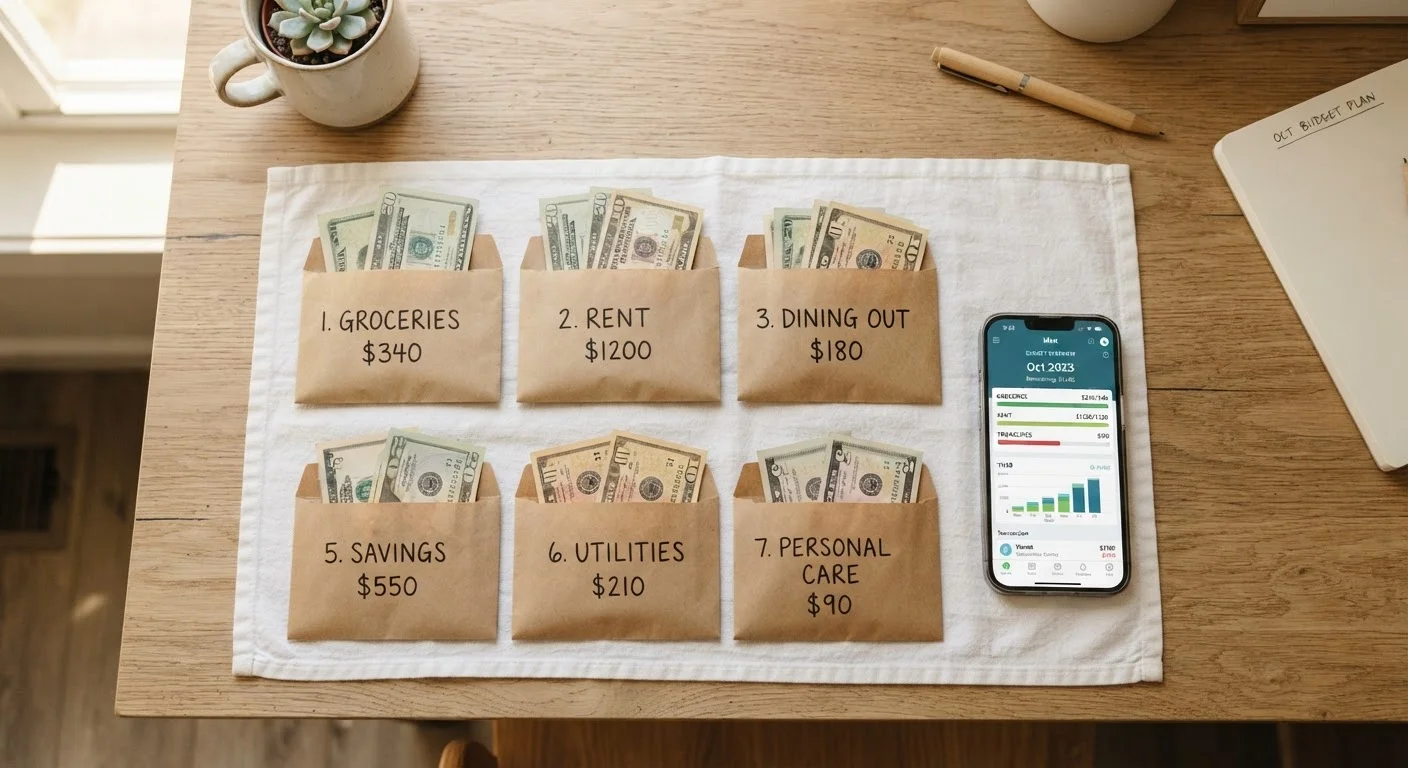
Envelope budgeting is a spending system where you divide your take-home income into separate categories - each represented by a physical or virtual "envelope" - and only spend what's in each one. Once an envelope is empty, spending in that category stops until the next budget period. The method creates a hard, visible limit on discretionary spending.
In its original cash form, the system functions as a real-time constraint on liquidity per category, eliminating the cognitive lag between swiping a card and seeing the balance effect - a gap that often leads to overspending.
How the Envelope Method Works
The envelope method is straightforward by design. At the start of each pay period, you look at your take-home income and assign every dollar to a category - groceries, gas, dining out, entertainment, and so on. Each category gets a labeled envelope loaded with exactly that amount in cash. When you shop for groceries, you pull from the grocery envelope. When it's empty, grocery spending stops.
That simplicity is the point. There's no ambiguity about whether you can afford that restaurant dinner; you either have money in the dining envelope or you don't. The physical act of handing over cash - and watching the envelope thin out - creates a feedback loop that card-based spending rarely provides.
For a broader look at how this method compares to other popular frameworks, see how the envelope method stacks up against the 50/30/20 rule and zero-based budgeting.
Start With Your Three Biggest Variable Categories
If the envelope system feels overwhelming, begin with just the three spending categories where you historically overspend most. Track those for one full month before expanding to additional envelopes. A smaller system you stick with beats a comprehensive one you abandon after two weeks.
Why the Psychology Behind It Still Holds Up
Behavioral finance research has long recognized that people spend differently depending on payment method. Paying with cash tends to feel more "real" than tapping a card, a phenomenon sometimes called the "pain of paying." Envelope budgeting exploits that psychology deliberately - the finite, visible nature of cash in a physical envelope creates a natural brake on spending.
Even for people who never use cash, the underlying principle translates. The critical element isn't the paper envelope; it's the pre-commitment - deciding in advance how much a category gets, rather than spending freely and reconciling later.
“The best budget system is the one you'll actually use. Envelope budgeting works because it makes the abstract concrete - it turns a number on a screen into a tangible limit.”
— Financial Educators Council, Nonprofit financial literacy organization
Envelope Budgeting in a Digital Context
Today, most people manage finances without touching physical bills. That doesn't make the envelope framework obsolete - it just changes the implementation. Digital budgeting tools allow users to create virtual envelopes that draw from a connected bank account, categorizing each transaction automatically and updating the "envelope" balance in real time.
The functional difference from traditional cash envelopes is worth noting: a virtual envelope doesn't physically stop you from overspending the way an empty wallet does. Discipline must be supplied by the user, not the mechanism. That's a meaningful trade-off - convenience versus constraint.
If you're building your first budget and unsure where to start, the ground-up spending plan walkthrough offers a practical starting point before layering in envelope categories. You can also use the monthly budget setup checklist to organize your income and expense information before assigning envelope amounts.
Strengths and Limitations to Weigh
Envelope budgeting excels at controlling variable, discretionary spending - the categories where most overspending happens. It's also one of the more intuitive frameworks for people new to budgeting, since the mechanics are visible and concrete.
Its limitations are equally real. Managing physical cash in an era of online shopping and autopay is genuinely inconvenient. The system works less well for fixed expenses like rent, utilities, or insurance premiums, which don't benefit from an envelope because they're predictable and rarely overspent. And for households with irregular income, pre-assigning amounts to categories each month requires an extra layer of planning.
Envelope Budgeting Isn't All-or-Nothing
You don't have to apply the envelope method to every line in your budget. Many people use it only for discretionary categories - like food, fun, and clothing - while handling fixed bills through autopay as usual. A hybrid approach can deliver most of the benefits with far less friction.
For a thorough comparison with other approaches - including zero-based budgeting's similar "every dollar has a job" logic - the zero-based budgeting overview provides a balanced look at trade-offs. The broader complete personal budgeting resource covers how to choose a method that suits your income pattern and goals.
This article is for general informational and educational purposes only and does not constitute personalized financial advice. Consult a qualified financial professional for guidance specific to your situation.