

Key Takeaways
Option A
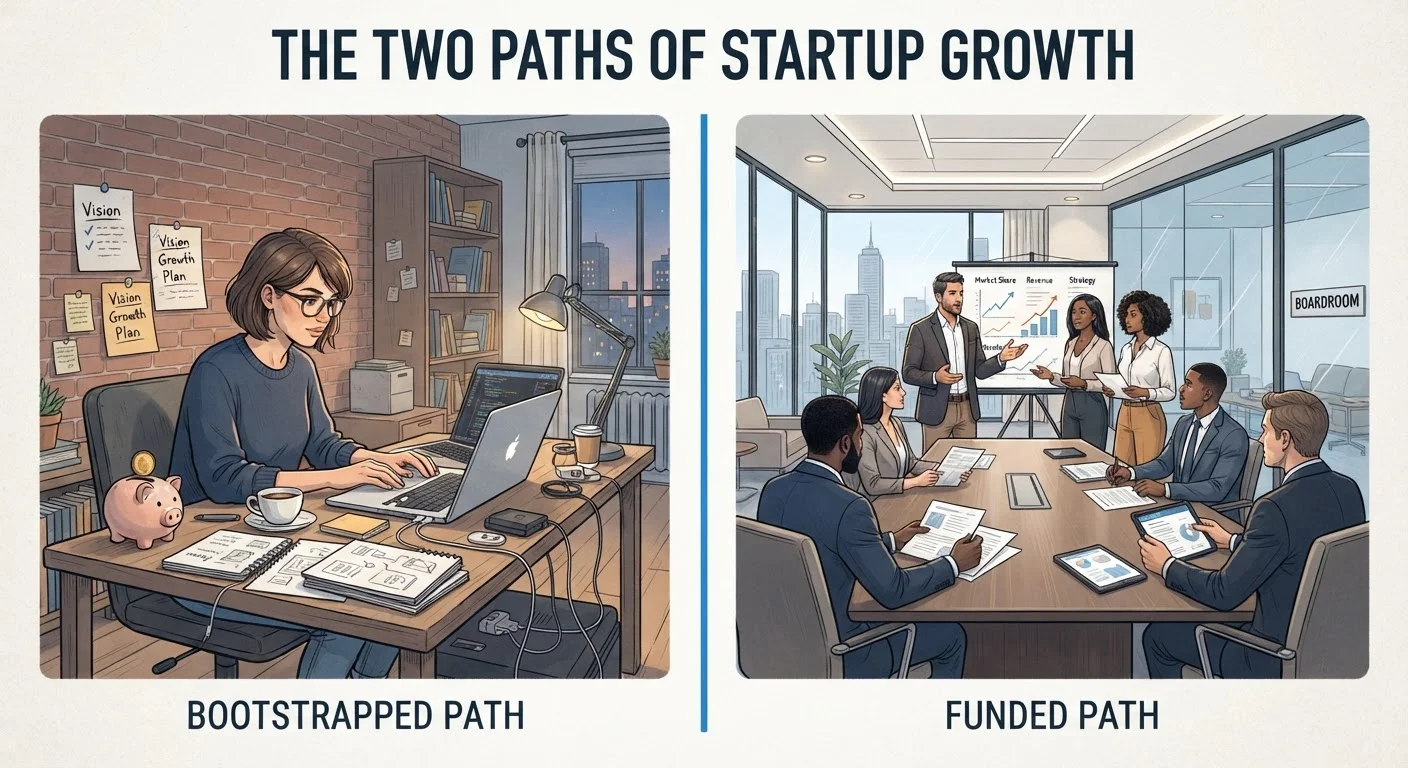
Bootstrapping
The self-reliant, founder-controlled approach.
Best for: Founders who want to retain full ownership, move at their own pace, and can grow the business on revenues or personal savings.
Option B
Outside Funding
The accelerated, investor-backed growth model.
Best for: Founders targeting rapid scale, operating in capital-intensive markets, or pursuing opportunities with a narrow time window.
If you want to keep full decision-making control and own 100% of your company
Bootstrapping
Bootstrapping means no equity given away and no investors to answer to, so every strategic call stays with the founder.
If your market opportunity requires moving faster than revenue alone can support
Outside Funding
Investor capital allows rapid hiring, product development, and market entry that self-funding simply cannot match in a compressed timeline.
If you're building a lifestyle or service business with moderate growth ambitions
Bootstrapping
Businesses that don't require massive upfront capital or exponential scale rarely need - or benefit from - giving up equity to outside investors.
If you're entering a capital-intensive industry like hardware, biotech, or logistics
Outside Funding
High infrastructure and R&D costs in these sectors often make bootstrapping impractical without a substantial personal financial runway.
If you're a first-time founder still validating whether your idea has a real market
Bootstrapping
Starting lean forces rigorous validation and keeps financial exposure low while you gather real-world signal before scaling.
What Each Path Actually Means
Bootstrapping means funding a business primarily through personal savings, early customer revenue, or a combination of both - without bringing in outside investors. The founder bears the financial risk, but keeps complete ownership and autonomy. Many service businesses, consulting firms, and niche product companies are built exactly this way.
Outside funding refers to raising capital from external sources - most commonly angel investors, venture capital (VC) firms, or startup accelerator programs. In exchange for capital, investors typically receive an ownership stake (equity) in the company. Some founders also pursue debt-based financing through small business loans or revenue-based financing, which carries different terms. For a deeper look at how those structures compare, see debt and equity financing explained.
Understanding what it actually costs to launch a business is the necessary first step before deciding which funding model makes sense for your situation.
How Each Model Works in Practice
A bootstrapped founder typically starts small - perhaps offering services before building a product, or pre-selling to early customers to generate working capital. Growth is incremental and tied directly to cash flow. Overhead is scrutinized closely, and every dollar spent must be justified by near-term return. This discipline can be a genuine strength: lean operations tend to build durable, profitable habits from the start. The lean startup methodology aligns closely with this philosophy, emphasizing validation before investment.
An investor-backed founder operates differently. After raising a funding round, they typically hire quickly, build product in parallel, and compete aggressively for market share - often before the business is profitable. Investors expect a return on their capital, usually through an eventual acquisition or public offering. This creates a growth imperative that shapes every major decision.
| Criterion | Bootstrapping | Outside Funding |
|---|---|---|
| Ownership retained | 100% (typically) | Partial - equity given to investors |
| Growth speed | Tied to revenue growth | Accelerated by capital infusion |
| Accountability | Founder-only | Board and investor oversight |
| Financial risk | Concentrated on founder | Shared with investors |
| Profitability pressure | Immediate - survival depends on it | Deferred - growth prioritised first |
| Ideal market type | Niche, steady, relationship-driven | Large, fast-moving, winner-take-most |
| Fundraising time cost | None | Significant - months of founder time |
The Real Trade-Offs Founders Face
~77%
Small businesses rely on personal savings at launch
According to the U.S. Small Business Administration, the majority of small businesses are initially funded through personal or family savings rather than outside investors.
< 1%
Startups that receive venture capital funding
Venture capital is far less common than popular media suggests - the vast majority of new businesses never pursue or receive institutional investment.
20%
Typical early-stage equity stake per VC round
Angel and seed-stage investors commonly seek 10-25% equity per round, meaning multiple rounds can significantly dilute a founder's ownership over time.
Control vs. capital: The most fundamental tension is ownership. A bootstrapped founder who builds a $3 million business owns all of it. A founder who raises multiple rounds of venture funding may own a much smaller percentage of a far larger company - or may be pushed out entirely if performance falters.
Speed vs. sustainability: Outside funding enables speed, but speed isn't always a competitive advantage. In markets where customer relationships, reputation, and service quality matter more than raw growth, the bootstrapped approach often produces more sustainable businesses.
Risk profile: Bootstrapping concentrates financial risk on the founder personally. Outside funding transfers some of that risk to investors - but introduces accountability structures, board oversight, and performance expectations that can feel constraining.
Regardless of which path you choose, maintaining sound financial habits from day one is essential. See early-stage financial practices that keep startups solvent for practical guidance.
Choosing the Right Path for Your Business
There is no universally correct answer. The right funding model depends on three factors: the nature of your business, the competitive dynamics of your market, and your personal financial circumstances and goals.
A founder building a software tool for a niche professional audience may be able to reach profitability within a year on customer revenue alone - making outside funding unnecessary and potentially dilutive. A founder attempting to launch a nationwide logistics network faces a fundamentally different capital requirement.
It's also worth noting that these paths aren't always mutually exclusive. Many businesses bootstrap through early validation, then raise outside capital once they have proof of demand and stronger negotiating leverage. This sequencing can preserve equity in the most valuable early phase while still accessing growth capital later.
Business structure choices interact with funding decisions as well - whether you're building a service business or a product business affects your cash flow patterns and how attractive you'll appear to investors from the start.
This article is for general informational and educational purposes only and does not constitute financial or legal advice. Consult a qualified financial professional before making decisions about business financing.