

Key Takeaways
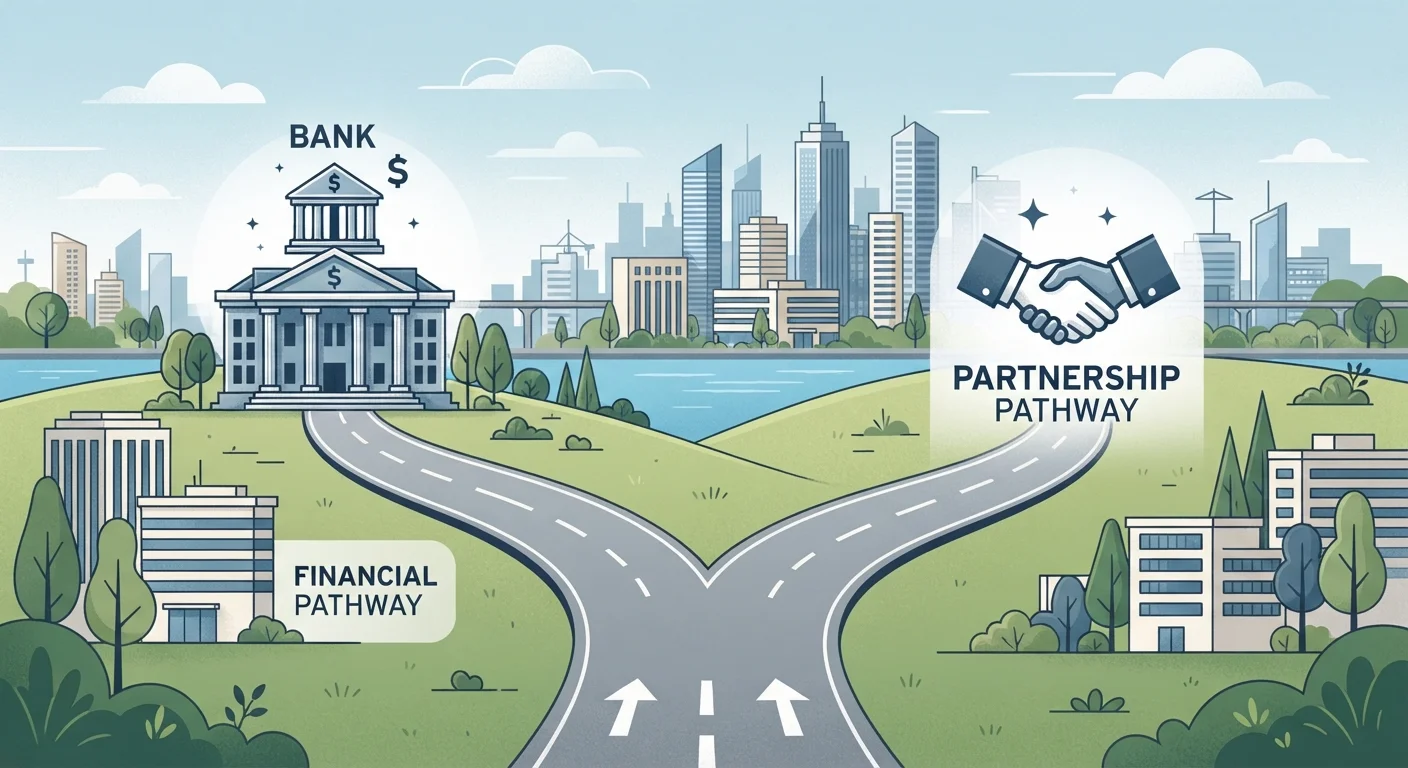
Option A
Debt Financing
The borrowing path - capital with a repayment obligation.
Best for: Businesses with steady cash flow that want to retain full ownership while funding operations or growth.
Option B
Equity Financing
The ownership path - capital in exchange for a stake in the business.
Best for: Early-stage or high-growth businesses that need capital without mandatory repayment obligations.
If your business generates reliable monthly revenue
Debt Financing
Predictable cash flow makes loan repayment manageable, and you keep full ownership of profits and decisions.
If you're pre-revenue or in a high-growth startup phase
Equity Financing
Without steady income, mandatory debt repayments can be dangerous. Equity investors share the risk alongside you.
If retaining full control of the business is a priority
Debt Financing
Lenders have no ownership stake - they get repaid and exit. Equity investors become permanent stakeholders with a voice.
If you need capital beyond what lenders will extend
Equity Financing
Investors can provide larger sums tied to growth potential rather than creditworthiness or collateral requirements.
If you want access to networks, mentorship, and strategic guidance
Equity Financing
Many equity investors - particularly venture capitalists and angel investors - bring industry connections and operational expertise alongside their funding.
The Core Distinction: Obligation vs. Ownership
Every business eventually faces a funding question: where does the capital come from? The two most fundamental answers are debt and equity. Understanding the difference - not just in mechanics but in real-world consequences - is essential for any business owner or entrepreneur.
Debt financing means borrowing money from a lender (a bank, credit union, or private creditor) with a contractual obligation to repay the principal plus interest over a defined period. The lender does not acquire any ownership in your business. The transaction ends when the debt is repaid. For a closer look at how those numbers translate into real commitments, see what a business loan really commits you to.
Equity financing means raising capital by selling a share of ownership in the business - to an angel investor, a venture capital firm, or through a public stock offering. There is no repayment schedule. Instead, investors receive a portion of future profits and, typically, some degree of influence over business decisions.
These aren't just two funding mechanisms - they represent two fundamentally different relationships between a business and the people backing it. This article is for general informational purposes and is not personalized financial or legal advice. Business owners should consult a qualified financial adviser or attorney before making capital structure decisions.
| Criterion | Debt Financing | Equity Financing |
|---|---|---|
| Repayment required | Yes - principal plus interest | No mandatory repayment |
| Ownership impact | None - lender has no stake | Ownership is diluted |
| Control over decisions | Retained fully by owner | Shared with investors |
| Cost structure | Interest rate (often tax-deductible) | Share of future profits and growth |
| Risk if business underperforms | Payments still required; default risk | No payments due; investor absorbs loss |
| Typical sources | Banks, credit unions, SBA loans | Angel investors, VCs, public markets |
| Best fit by stage | Established businesses with cash flow | Early-stage or high-growth companies |
What Debt Financing Actually Costs
The most visible cost of debt is interest - the fee a lender charges for making capital available. Interest rates vary based on creditworthiness, loan term, collateral, and market conditions. But interest is only part of the picture.
Debt financing creates a fixed financial obligation that exists regardless of how the business performs. A slow quarter doesn't pause your loan payment. This is the defining risk: cash flow disruption. If revenue dips and loan obligations remain, the business can find itself in financial distress. Borrowers who put up collateral - assets pledged as security - can lose those assets if they default.
That said, debt has real advantages. Interest payments on business loans are generally tax-deductible, reducing the effective cost of borrowing. And because lenders don't take equity, a profitable business keeps 100% of the upside. For a broader grounding in how these concepts fit into overall business money management, the guide on small business finance from the ground up offers useful context.
~43%
Small businesses using loans or lines of credit
According to the Federal Reserve's Small Business Credit Survey, roughly 43% of small firms applied for loans, lines of credit, or merchant cash advances in a recent survey year.
$330B+
Annual U.S. venture capital investment
The National Venture Capital Association has reported that annual U.S. venture capital deployment has exceeded $300 billion in peak years, reflecting the scale of equity financing activity.
What Equity Financing Actually Costs
Equity financing carries no mandatory repayment, which makes it appear "free" at first glance. It isn't. The cost is ownership dilution - and over time, that can be substantial.
When you sell 20% of your company to raise capital, you've sold 20% of every future dollar the business earns. If the company later becomes highly profitable, investors benefit proportionally. In high-growth scenarios, the total value transferred to equity holders can far exceed what a comparable loan would have cost in interest.
Equity investors also often expect influence. Depending on the terms negotiated, they may hold board seats, voting rights, or approval authority over major decisions. For founders who built a business around a specific vision, this shared control can create friction. The comparison between investor-backed and self-funded models is explored in more depth in this look at bootstrapping versus outside funding.
On the other hand, equity financing aligns investor interests with the business. Investors only profit if the business succeeds - they share downside risk in a way lenders do not.
Choosing a Structure: What Factors Matter Most
No single answer fits every business. The right capital structure depends on several concrete factors:
- Cash flow stability: Businesses with predictable revenue can service debt reliably. Those with volatile or seasonal income face higher risk from fixed obligations.
- Stage of the business: Early-stage companies with unproven revenue models often can't qualify for significant loans and may be better positioned for equity investment.
- Ownership priorities: Founders who want to retain decision-making authority should weigh carefully how much equity they're willing to give up.
- Growth trajectory: Equity investors typically expect substantial returns, making this path more suited to high-growth ambitions than stable, lifestyle businesses.
Many businesses ultimately use a blend of both - often called a mixed capital structure - adjusting the ratio as the company matures. Understanding how debt interacts with broader financial decisions, such as whether to prioritize paying down obligations or building reserves, is part of sound financial planning. The reasoning behind emergency fund versus debt payoff decisions offers a related lens on how to think about obligations and liquidity.
Debt Type Also Matters
Not all debt financing works the same way. Secured loans require collateral - an asset the lender can claim if you default - while unsecured loans rely on creditworthiness alone and typically carry higher interest rates. For a plain-language breakdown of how these structures differ, see secured vs. unsecured debt explained.
This article is for general informational and educational purposes only and does not constitute personalized financial, investment, or legal advice. Consult a qualified financial adviser or attorney for guidance specific to your business situation.