

Key Takeaways
Lean Startup Methodology
The lean startup is a framework for building and validating a new business through rapid experimentation rather than lengthy upfront planning. Instead of spending months developing a complete product before showing it to customers, founders release a stripped-down version early, gather real feedback, and use what they learn to improve. The goal is to reduce wasted time and money by testing assumptions before committing to them.
The methodology formalizes concepts like the Minimum Viable Product (MVP) and the Build-Measure-Learn feedback loop, drawing on lean manufacturing principles originally developed in the automotive industry.
Where the Idea Came From
The lean startup methodology emerged from Silicon Valley in the mid-2000s, shaped significantly by entrepreneur and author Eric Ries. Ries drew on his own experience at early-stage companies - including lessons from ventures that collapsed despite heavy investment - and synthesized them into a coherent framework. His 2011 book, The Lean Startup, brought these ideas to a global audience.
Before Ries, entrepreneur and academic Steve Blank had been developing a parallel concept called customer development - the idea that founders should spend as much time learning about customers as they do building products. Ries built on Blank's work and connected it to lean manufacturing principles rooted in the Toyota Production System, which emphasized eliminating waste and optimizing for continuous improvement.
The methodology arrived at a moment when the cost of launching a software product had dropped dramatically, making rapid experimentation genuinely feasible for the first time. That context matters: lean startup thrives when testing is cheap and feedback is fast. See our full early-stage journey guide for context on how these ideas fit into the broader process of starting a business.
The Core Ideas Explained
Three interlocking concepts sit at the center of the lean startup framework.
The Build-Measure-Learn Loop
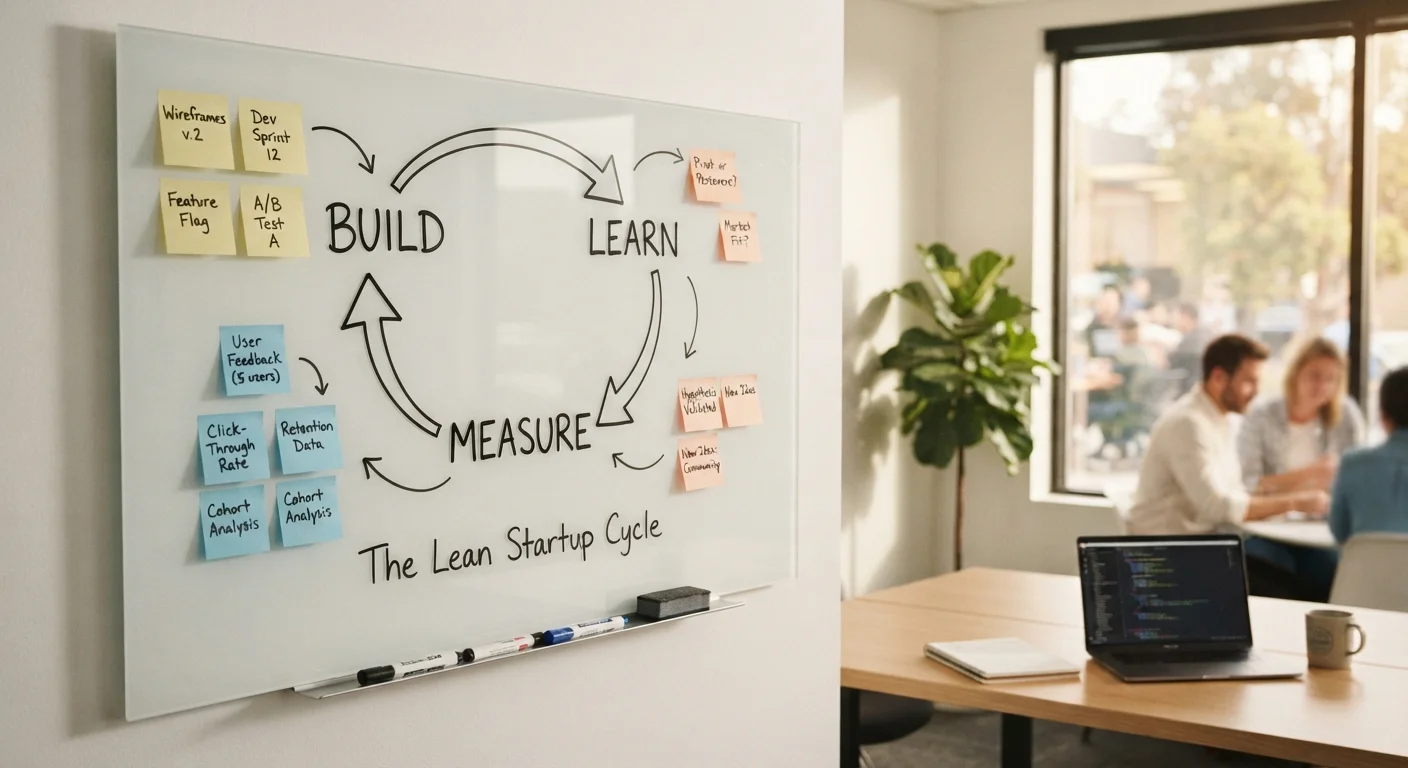
Rather than planning exhaustively before acting, lean startup encourages founders to move through a continuous cycle: build a simple version of something, measure how real users respond, and learn from that data to decide what to do next. Each loop should be completed as quickly as possible.
The Minimum Viable Product
The MVP is the version of a product with just enough features to test a specific assumption with real customers. It is deliberately incomplete. A restaurant might test a concept with a pop-up dinner before signing a lease. A software team might release a rough prototype before building full infrastructure. The purpose is not to impress - it is to learn. Understanding your startup costs before overbuilding is one practical reason MVPs matter financially.
Validated Learning and the Pivot
Lean startup treats learning as a legitimate output. When evidence suggests the current approach isn't working, founders are encouraged to pivot - shift strategy in a meaningful way while retaining what has been learned. A pivot is not random change; it is a deliberate response to data. This distinguishes the methodology from simply guessing and hoping.
90%
Startups that fail within the first few years
Research consistently cited in entrepreneurship literature suggests the majority of new ventures fail, often because they build products without validating customer demand first.
2011
Year 'The Lean Startup' was published
Eric Ries published the foundational text in 2011; it became a best-seller and helped codify lean principles for a generation of entrepreneurs.
3-6 weeks
Typical target cycle time for an MVP test
Lean practitioners generally aim to complete one Build-Measure-Learn cycle within weeks, not months, to preserve momentum and conserve resources.
Where Lean Startup Principles Apply
Despite its origins in tech, the lean startup framework applies broadly. Its underlying logic - test assumptions cheaply before committing heavily - is relevant to nearly any venture facing uncertainty about what customers want.
- Product businesses: A maker of physical goods can test demand through pre-orders or limited runs before manufacturing at scale.
- Service businesses: A consultant or agency can offer a narrow service to early clients before building out a full offering.
- Retail and food: Founders can test locations, menus, or price points in low-commitment formats before locking in leases or equipment.
- Nonprofits and social ventures: Program assumptions can be tested in small pilots before seeking major grant funding.
The methodology also informs decisions about funding. Founders who have validated real demand are generally in a stronger position when approaching investors or lenders. Our guide to bootstrapping vs. outside funding explores how validated traction affects those conversations.
Lean principles also complement solid market research. Before designing any MVP, founders benefit from understanding the landscape they're entering - our market research guide for first-time entrepreneurs walks through that process practically.
“The only way to win is to learn faster than anyone else. Startups that treat every product decision as an experiment position themselves to adapt before their resources run out.”
— Eric Ries, Author of 'The Lean Startup' and entrepreneur
What Lean Startup Doesn't Mean
The framework is sometimes misread as an excuse to launch something unfinished and hope for the best. That misses the point. An MVP still needs to deliver genuine value to the people who use it - it simply doesn't need to do everything. Quality in the narrow scope you've chosen still matters.
Lean startup also does not mean avoiding financial discipline. Rapid iteration has costs, and founders still need to track spending carefully. Keeping a startup financially healthy during this phase requires attention to cash flow even while moving fast.
Finally, the methodology does not guarantee success. It reduces certain types of risk - particularly the risk of building something nobody wants - but early-stage businesses face many other challenges that validated learning alone cannot solve. Founders should treat the lean startup framework as one useful lens, not a formula.