

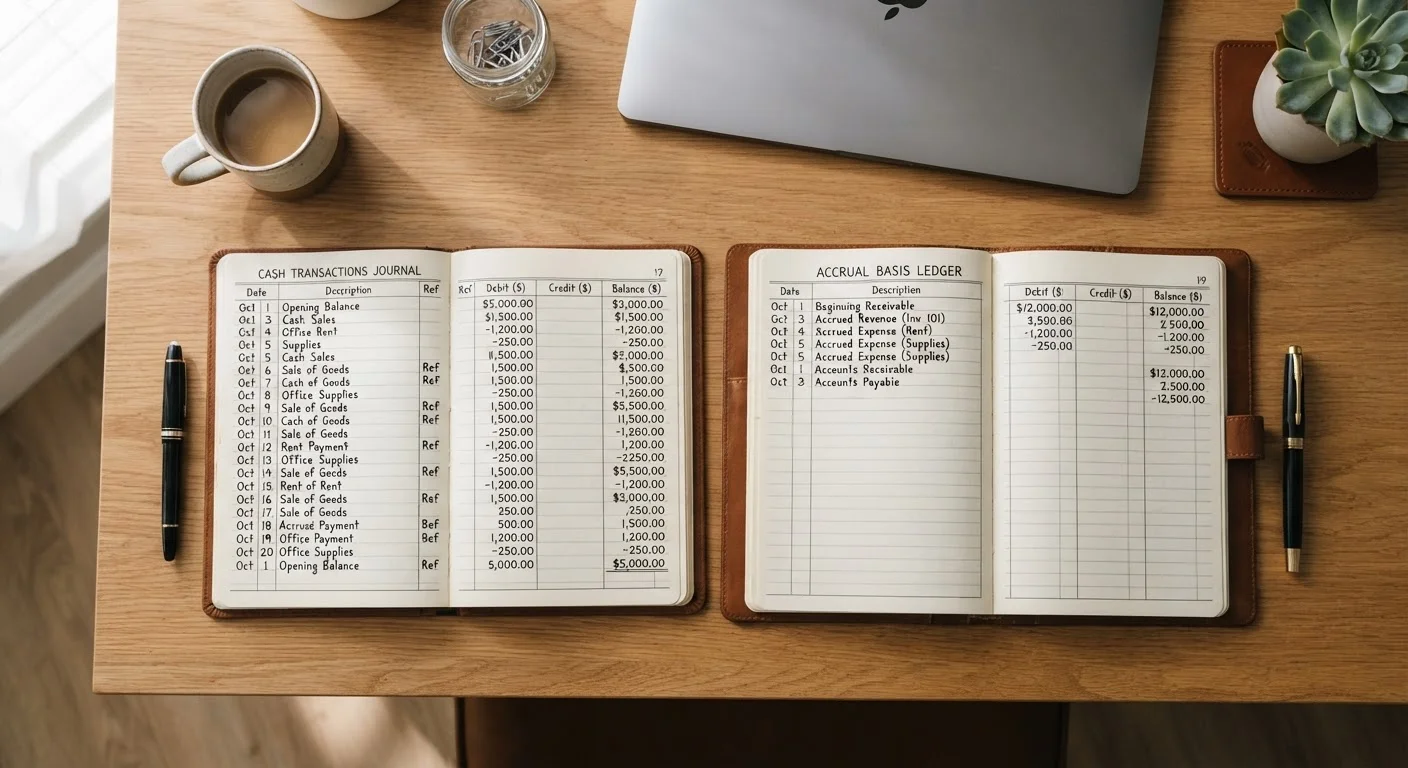
Key Takeaways
Our Verdict
Neither method is universally superior - the right choice depends on your business size, complexity, and goals. Cash accounting works well for solo operators and very small businesses that need simplicity and direct cash visibility. Accrual accounting is better suited to growing businesses that need an accurate view of financial performance over time, manage inventory, or seek outside financing.
| Best for | Recommended |
|---|---|
| Freelancers, sole proprietors, and micro-businesses | Cash Accounting |
| Businesses seeking loans, investors, or outside financing | Accrual Accounting |
| Businesses with inventory or long-term contracts | Accrual Accounting |
| Those who prioritize tax simplicity and minimal bookkeeping overhead | Cash Accounting |
Two Methods, Two Stories
When a business invoices a client in December but doesn't collect payment until February, which month does that revenue belong to? The answer depends entirely on which accounting method the business uses - and the difference matters far more than many small-business owners realize.
Accounting method selection shapes what your income statement shows, when you owe taxes, and how clearly your books reflect the actual health of your business. Understanding both approaches helps you read your own financials more accurately and make better decisions - especially as your business grows. For a broader look at what financial statements tell you, see what each financial statement reveals.
How Each Method Works
Cash accounting is straightforward: revenue is recorded when cash is received, and expenses are recorded when cash is paid out. If you invoice a client today but they pay in six weeks, nothing hits your books until that check clears. Most individuals and very small businesses naturally think this way - it mirrors how a personal bank account works.
Accrual accounting operates differently. Revenue is recorded when it is earned - typically when a product is delivered or a service is rendered - regardless of when payment arrives. Expenses are recorded when they are incurred, not when the bill is paid. This approach matches revenues with the costs that generated them, giving a more complete view of what a business actually earned during a given period.
| Cash Accounting | Accrual Accounting | |
|---|---|---|
| Revenue recorded when | Cash is received | Revenue is earned |
| Expenses recorded when | Cash is paid out | Expense is incurred |
| Complexity | Low - simpler bookkeeping | Higher - requires more tracking |
| Accuracy of financial picture | Reflects current cash position | Reflects true business performance |
| IRS requirement threshold | Available to smaller businesses | Required above ~$30M gross receipts |
| Best for lenders/investors | Less preferred | Strongly preferred |
| Tax timing control | More flexibility to shift timing | Less flexibility - timing follows activity |
Consider a contractor who completes a $20,000 job in March but doesn't receive payment until May. Under cash accounting, $20,000 appears as March revenue on no statement and May revenue on the books. Under accrual accounting, $20,000 is recognized in March - the period when the work was done.
What the IRS Says - and Who Gets to Choose
The choice between these methods isn't always entirely up to the business owner. The IRS sets rules based on business size and structure. As a general threshold, businesses with average annual gross receipts exceeding $30 million over the prior three years are required to use accrual accounting. Businesses that carry inventory may also face restrictions on using the pure cash method, though there are exceptions for smaller operations.
Sole proprietors and very small businesses typically have full flexibility to use cash accounting, which is why it remains the dominant choice for freelancers, independent contractors, and single-owner shops. S corporations, partnerships with corporate partners, and C corporations often face additional requirements.
Thinking About Switching Methods?
Changing from cash to accrual accounting (or vice versa) requires IRS approval via Form 3115, and the transition year can create unusual tax results. Before making the switch, work with a licensed CPA who can model the tax impact and ensure the change is filed correctly. Timing the switch to a lower-revenue year can sometimes reduce the one-time tax burden.
If you switch accounting methods, IRS Form 3115 governs that change - it is not a simple update. Consulting a licensed tax professional before switching is strongly advisable, as the transition can have meaningful tax timing implications.
The Real-Picture Problem: When Each Method Misleads
Both methods can distort your financial picture if misunderstood. Cash accounting can make a business look highly profitable in a month when several large invoices are paid - even if no new work was completed. Conversely, it can make a strong month look weak if clients pay late. This is closely related to the gap between profit and cash flow that catches many business owners off guard. For a deeper look at that distinction, see why a profitable business can still run out of cash.
Accrual accounting solves the timing problem but introduces its own complexity. Revenue recorded before cash is collected creates accounts receivable - a figure on your balance sheet that represents money owed, not money in hand. A business can appear profitable on paper while struggling with cash because clients haven't paid yet. Neither method is a perfect lens; each requires context.
Budgeting decisions also depend on using the right financial figures from your books. Understanding what your income numbers actually represent - and how accounting method affects them - connects directly to concepts like the difference between net and gross income for budgeting.
Practical Considerations for Small Business Owners
For most small businesses starting out, cash accounting is a reasonable default - it is easier to maintain, easier to understand, and aligns naturally with monitoring your bank balance. As a business adds employees, takes on longer-term contracts, carries inventory, or pursues outside financing, accrual accounting typically becomes more useful. Lenders and investors almost universally prefer accrual-based statements because they better reflect operational performance.
Whichever method you use, the most important thing is consistency. Mixing approaches or misapplying the method you've chosen produces financial statements that mislead both you and anyone else reviewing your books. A qualified accountant or CPA can help you evaluate which method aligns with your business model, tax situation, and growth plans.
This article is for general informational purposes only and does not constitute tax, legal, or financial advice. Consult a licensed tax professional or accountant for guidance specific to your business circumstances.