

Key Takeaways
Option A
Gross Income
The headline figure - before any deductions hit.
Best for: Understanding your total earnings, comparing job offers, and calculating certain tax-related figures.
Option B
Net Income
The money you actually take home and can spend.
Best for: Building a realistic household budget, planning monthly expenses, and managing day-to-day cash flow.
If you are building a monthly household budget
Net Income
Net income reflects the dollars that actually enter your checking account. Budgeting from any larger number creates plans that look balanced on paper but fall apart in practice.
If you are comparing two job offers or salary ranges
Gross Income
Gross figures allow apples-to-apples comparison between employers since each company's benefit and withholding structure differs. Convert to net afterward to see real take-home impact.
If you are self-employed or freelancing
Net Income
Freelancers must estimate and set aside self-employment taxes themselves. Your spendable budget should only include what remains after reserving for those obligations.
If you are applying for a loan or rental agreement
Gross Income
Most lenders and landlords use gross income to calculate debt-to-income ratios, so knowing your gross figure is essential for understanding eligibility thresholds.
What Each Number Actually Means
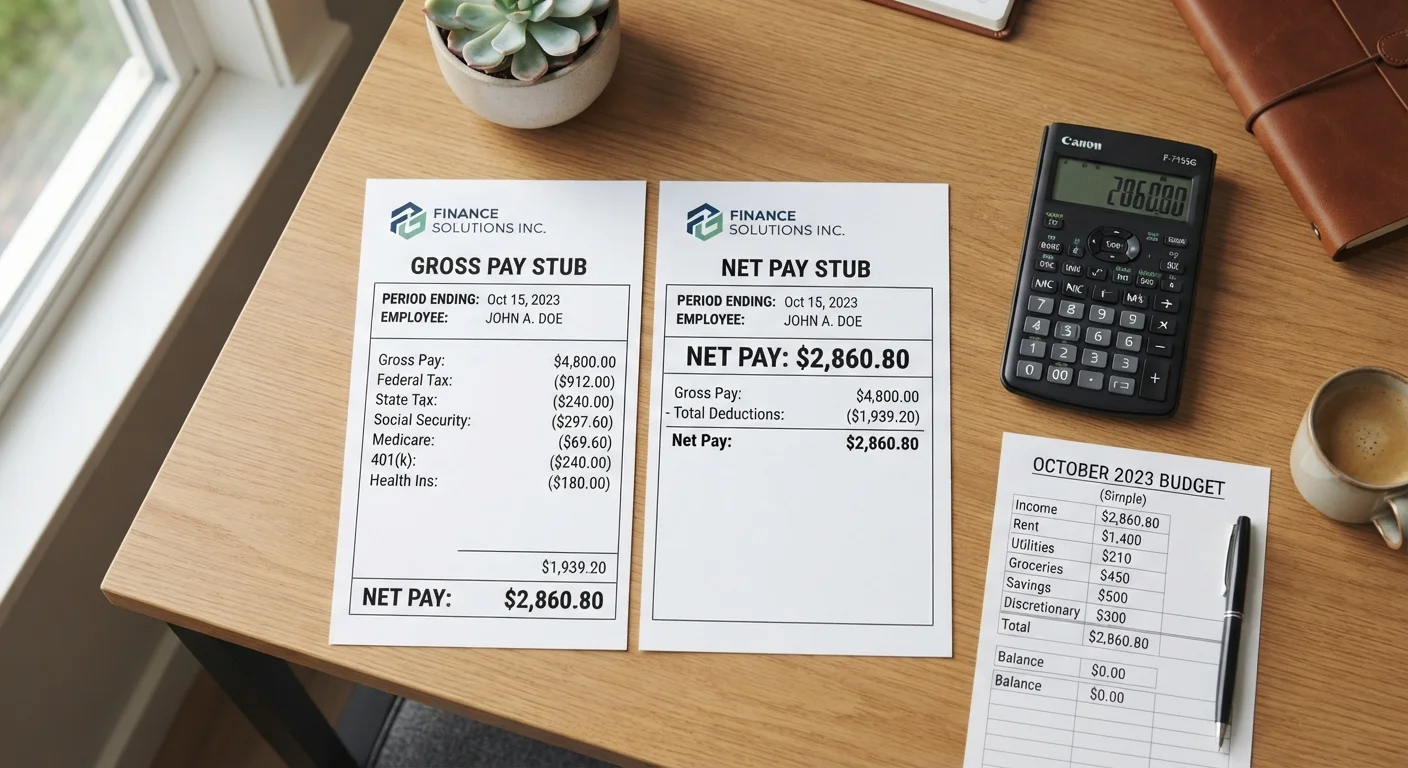
Gross income is the total amount you earn before any money is withheld. For a salaried employee, it is the annual figure stated in your offer letter divided into pay periods. For hourly workers, it is your rate multiplied by hours worked. It does not account for federal or state income taxes, Social Security and Medicare contributions (known as FICA taxes), health insurance premiums, retirement contributions, or any other payroll deductions.
Net income - sometimes called take-home pay - is what remains after every deduction has been subtracted. It is the dollar amount that actually deposits into your bank account. Depending on your tax bracket, benefit elections, and retirement contributions, net income can be significantly lower than gross. A common range is 65-80% of gross, though individual circumstances vary widely.
The gap between the two figures is not wasted money. Federal and state taxes fund public services, FICA contributions build Social Security credits, and pre-tax retirement contributions (such as those to a 401(k)) are still your money - they are simply held in a separate account growing for the future. Understanding what is being withheld and why is a foundational step in financial awareness. For a broader overview of budgeting fundamentals, see the complete personal budgeting resource.
Side-by-Side: How the Two Figures Compare
The table below illustrates the key differences at a glance. These distinctions determine not just what each number represents, but where each one is appropriately used.
| Criterion | Gross Income | Net Income |
|---|---|---|
| Definition | Total earnings before deductions | Take-home pay after all withholdings |
| Appears on | Offer letters, tax forms (W-2) | Bank deposits, pay stub bottom line |
| Includes taxes? | Yes - not yet subtracted | No - already withheld |
| Includes 401(k) contributions? | Yes - not yet deducted | No - already redirected |
| Use for personal budgeting | No - overstates spendable money | Yes - reflects real available funds |
| Use for loan applications | Yes - lenders use gross for DTI ratio | Rarely - depends on lender |
| Relevant for self-employed? | Arrives in full; taxes not withheld | Must be manually calculated after tax reserve |
Notice that gross income is the figure that appears in formal, institutional contexts - job listings, loan applications, tax filings - while net income governs your lived financial reality. Using the wrong number in the wrong context creates confusion; using gross income as your budget baseline is the most common and costly mistake first-time budgeters make.
Why Budgeting from Gross Income Fails
Imagine someone earning $60,000 per year in gross salary. Divided monthly, that is $5,000. If they build a spending plan around $5,000, assigning rent, groceries, transportation, and savings to that figure, the budget will almost certainly collapse within the first month. Why? Because their actual deposit - after federal taxes, state taxes, Social Security, Medicare, and a health insurance premium - might be closer to $3,700.
That $1,300 monthly gap is not a rounding error; it represents real expenses that have no room in a gross-based plan. Budgeters who make this mistake often feel like they are doing everything right yet still coming up short, which can lead to discouragement or the false belief that budgeting simply does not work for them. See common budgeting myths for more on misconceptions that derail good intentions.
The fix is straightforward: always locate your actual net deposit amount - from your pay stub or bank statement - and use that as the starting point for your spending plan. Every dollar you allocate must fit within that real, available figure.
~25-35%
Typical gap between gross and net pay
The exact percentage depends on federal and state tax brackets, filing status, and elected benefit deductions - making the gross-to-net difference highly individual.
15.3%
Self-employment tax rate on net earnings
Per IRS guidelines, self-employed individuals pay both the employee and employer share of Social Security and Medicare taxes, totaling 15.3% on net self-employment income.
1 in 3
Adults without any budget or spending plan
Multiple consumer finance surveys have consistently found that roughly a third of U.S. adults do not follow a formal budget, often citing confusion about where to start.
Special Cases: Self-Employment and Irregular Income
The gross-to-net calculation is automatic for traditional employees because employers handle withholding before the paycheck is issued. For self-employed individuals, freelancers, and gig workers, no one performs that withholding on their behalf. Their gross income arrives in full, which can create a dangerous illusion of abundance.
Self-employed workers are responsible for paying both the employee and employer portions of FICA taxes - a combined rate of 15.3% on net self-employment earnings as of current IRS guidelines - plus federal and applicable state income taxes. A common practice is to reserve a percentage of every payment received in a separate account designated for taxes. The appropriate percentage depends on income level, filing status, and deductions, so consulting a qualified tax professional is advisable for anyone navigating self-employment for the first time.
For those with variable or unpredictable income, the challenge is that "net income" changes month to month. A useful approach is to budget from a conservative baseline - such as the average of your three lowest-income months - to ensure commitments can be met even in slower periods. The guide to budgeting with irregular income covers practical strategies for this scenario in depth.
Building Your Budget on the Right Foundation
Once you have your verified net income figure, you are ready to build. The mechanics of allocating that money - across housing, food, transportation, savings, and discretionary spending - are covered step by step in your first spending plan walkthrough. A complementary skill is understanding fixed vs. variable expenses, which shapes how flexible your budget can be month to month.
One nuance worth remembering: some pre-tax deductions, like contributions to a traditional 401(k) or a Health Savings Account (HSA), lower your gross income for tax purposes while still directing money toward your future. These amounts never appear in your net deposit, but they represent real financial progress. When assessing your overall financial picture, account for them separately rather than treating them as simply "gone."
The core principle is simple: budget from net income, understand gross income. Let the gross figure inform conversations about salary, taxes, and lending. Let the net figure govern every spending decision you make.
This article is for general informational and educational purposes only. It does not constitute personalized financial, tax, or legal advice. Consult a qualified financial professional for guidance specific to your situation.