

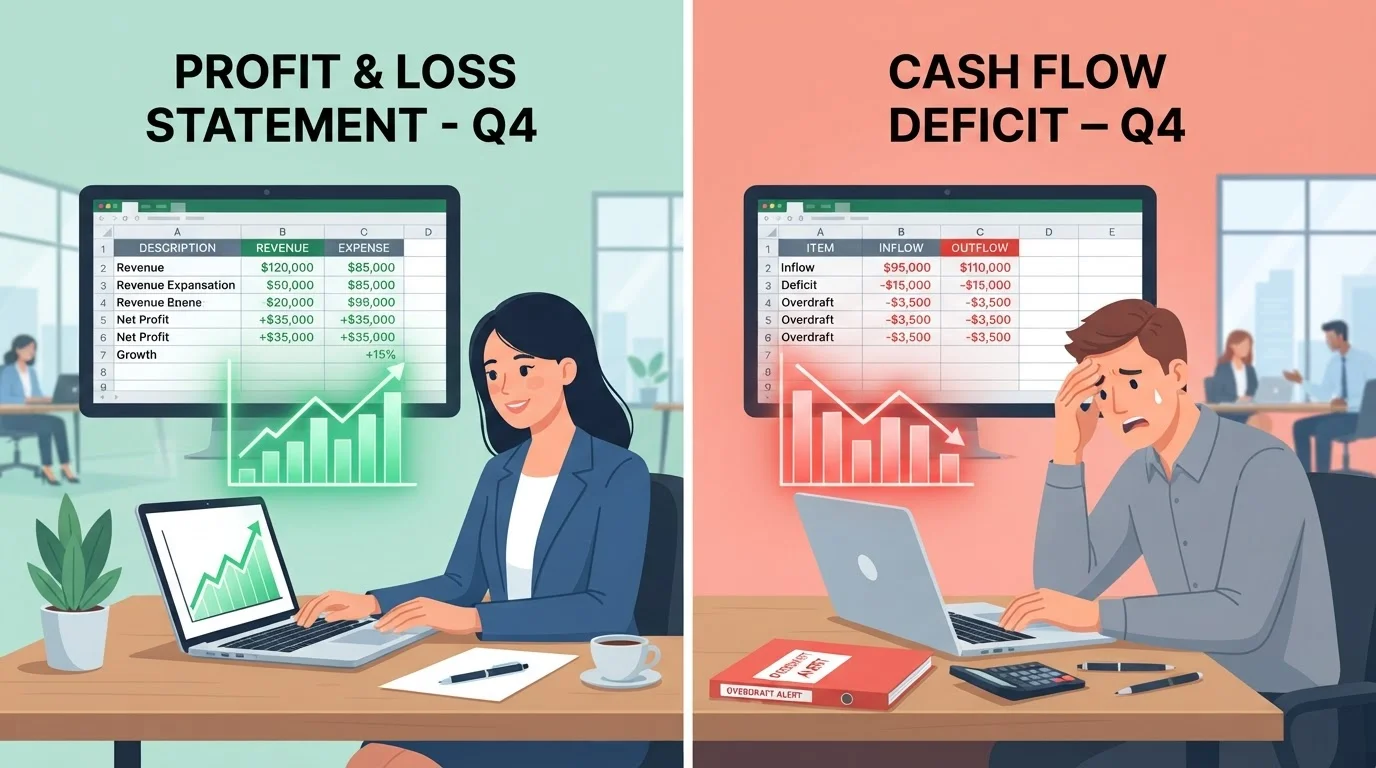
Key Takeaways
Option A
Profit
The scoreboard - what's left after all costs are subtracted from revenue.
Best for: Measuring long-term viability and whether a business model is fundamentally sound.
Option B
Cash Flow
The pulse - actual money moving in and out of the business right now.
Best for: Determining whether a business can pay its bills, staff, and suppliers this week.
If you want to know whether your business model is sustainable over time
Profit
Profit tells you whether revenue consistently exceeds costs - the foundation of a viable business. Without it, no amount of cash management will save a company long term.
If you need to know whether you can make payroll or pay a supplier next week
Cash Flow
Cash flow reflects the money actually in hand right now. A profitable business with poor cash flow can still miss payments and face serious operational disruption.
If you're trying to catch early warning signs before a crisis hits
Cash Flow
Cash flow problems typically surface weeks or months before they show up as a profit decline. Tracking it proactively gives you time to act.
If you're seeking outside investment or applying for a loan
Profit
Lenders and investors scrutinize profitability to assess repayment ability and business viability. A clear profit track record strengthens your case significantly.
Two Numbers That Tell Different Stories
Many small-business owners treat profit as the headline number - and understandably so. It feels like the ultimate scorecard. But profit and cash flow answer entirely different questions, and confusing them is one of the most common - and costly - financial mistakes a business can make.
Profit (also called net income) is what remains after you subtract all expenses from your total revenue over a given period. It's calculated on your income statement and represents whether your business model is fundamentally working.
Cash flow, by contrast, tracks the actual movement of money into and out of your business - money received from customers, money paid to suppliers, money spent on equipment or loan repayments. It shows up on the cash flow statement, which is a separate and equally important financial document. See our guide to financial statements for a breakdown of how each report works.
The critical point: profit is an accounting concept. Cash is a physical reality. A business can be profitable on paper and still be unable to pay its electric bill.
| Criterion | Profit | Cash Flow |
|---|---|---|
| What it measures | Revenue minus all costs over a period | Actual money in vs. money out |
| Where it appears | Income statement | Cash flow statement |
| Timing basis | When revenue is earned (accrual) | When money actually changes hands |
| Affected by unpaid invoices? | Yes - counts as revenue | No - cash hasn't arrived |
| Affected by loan repayments? | No - principal not an expense | Yes - direct cash outflow |
| Affected by equipment purchase? | Partially - via depreciation only | Yes - full cost hits immediately |
| Best for assessing... | Long-term business viability | Short-term solvency and operations |
How a Profitable Business Runs Out of Cash
The most common culprit is timing. Under accrual accounting - the method most businesses use - revenue is recorded when it's earned, not when payment actually arrives. If you complete a $20,000 project in March but your client doesn't pay until May, that $20,000 shows up as profit in March. Your cash account, however, sees nothing until May. Meanwhile, your rent, payroll, and supplier invoices keep arriving on schedule.
This gap between earning and receiving is called an accounts receivable lag, and it can stretch a business dangerously thin even during a period of strong sales. The difference between accrual and cash accounting explains why the method your business uses changes what the numbers actually reveal.
Other common cash drains that don't reduce profit include:
- Inventory purchases: Buying stock ties up cash immediately, but profit isn't affected until that inventory is sold.
- Loan repayments: Principal repayments reduce your bank balance without appearing as an expense on your income statement.
- Capital expenditures: Buying equipment is a cash outflow, but only the depreciation - spread over years - reduces profit incrementally.
82%
Small business failures linked to cash flow problems
According to a study by U.S. Bank, roughly 82% of small business failures are attributed to poor cash flow management or poor understanding of cash flow.
30-90 days
Typical payment lag for B2B invoices
Net-30 to net-90 payment terms are common in business-to-business transactions, creating substantial gaps between completing work and receiving payment.
Rapid growth is a surprisingly frequent trigger. A business landing bigger contracts often needs to spend more on labor, materials, and capacity before the revenue from those contracts arrives. Growth can accelerate cash outflows faster than inflows, creating a dangerous gap even as the income statement looks increasingly impressive. This is covered in depth in our look at financial blind spots that quietly sink small businesses.
Managing Both Metrics - Not Just One
The practical takeaway isn't to choose between monitoring profit and cash flow - it's to understand that each one catches things the other misses. Profit without cash flow visibility can leave you blindsided by a liquidity crunch. Cash flow without profitability analysis can disguise a business model that's slowly bleeding out.
A few discipline areas that help bridge the gap:
- Maintain a rolling cash flow forecast. Project your inflows and outflows 8-12 weeks ahead so you can anticipate shortfalls rather than react to them.
- Tighten receivables policies. Shortening payment terms, invoicing promptly, and following up on overdue accounts directly improves cash position without touching profit.
- Understand your working capital needs. Working capital - current assets minus current liabilities - is the buffer that keeps daily operations running when timing gaps appear.
- Build cash reserves deliberately. Profitable periods are the right time to build a cash cushion, not just reinvest everything into growth.
For new businesses especially, these habits are foundational. Our article on keeping a startup financially healthy outlines the early-stage practices that prevent cash flow problems from forming in the first place.
Profit tells you where your business is going. Cash flow tells you whether it will survive the journey. Both matter - and treating either one as sufficient on its own is a risk no small business can afford to take lightly.
This Is General Financial Information
The concepts described here are intended as educational guidance for small-business owners and general readers. Every business's financial situation is different. For decisions about your specific business finances, accounting methods, or cash management strategies, consult a qualified accountant or licensed financial professional.