

Key Takeaways
Start here
Why the Subtitle Barrier Is Mostly a Myth
Build context
Major World Cinema Traditions Worth Knowing
Get practical
How to Find Your Entry Point
Go deeper
What World Cinema Teaches Us About Storytelling
Take action
Where to Watch and How to Start
Why the Subtitle Barrier Is Mostly a Myth
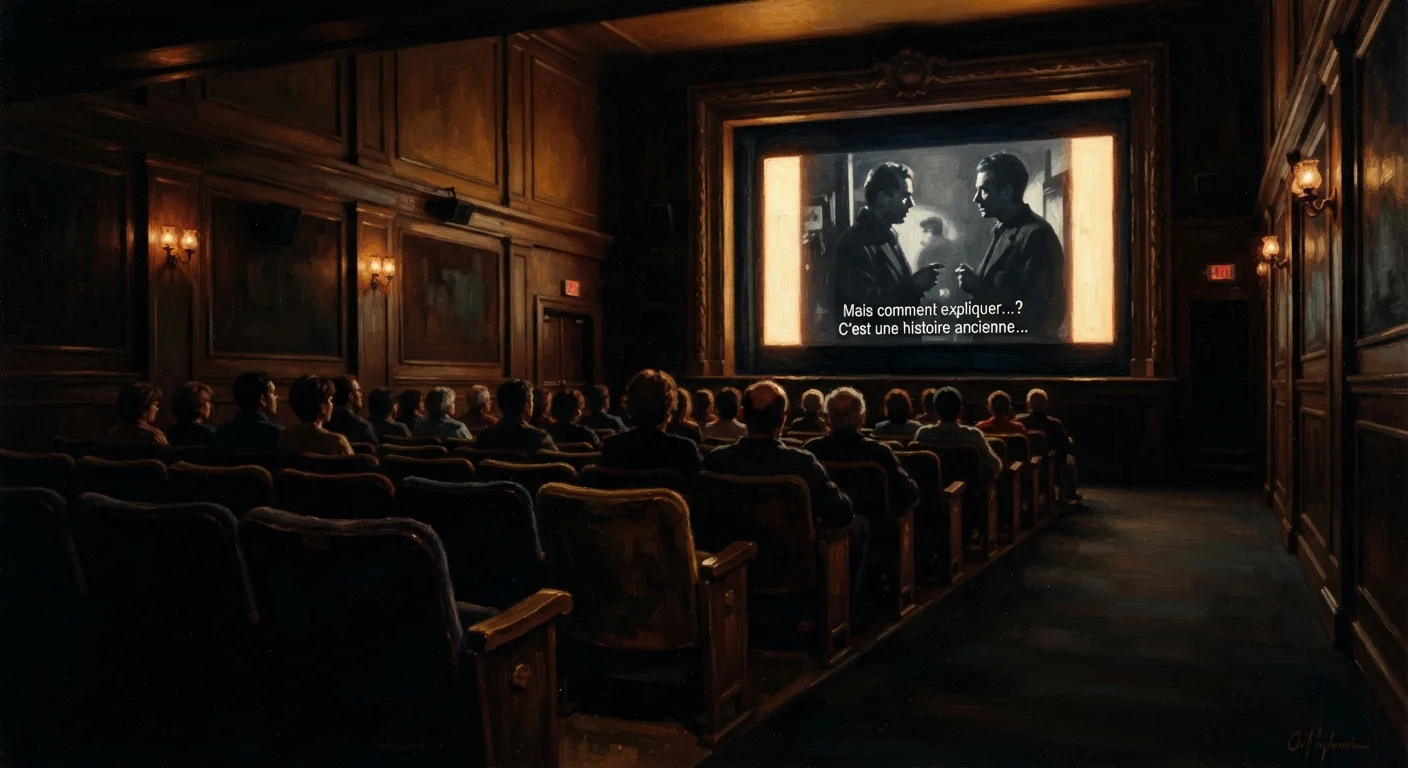
The single most common reason American viewers give for avoiding foreign language films is subtitles. It feels like extra work - like reading a book while watching television simultaneously. But the barrier dissolves faster than most people expect.
Research into how audiences process subtitled content consistently finds that readers adapt quickly, often within the opening sequence of a film. The brain learns to split its attention efficiently. Within a few minutes, subtitles tend to become ambient - present but unobtrusive, the way background music is present in a scene without dominating it.
Part of what sustains the myth is that American cinema has long operated as a dominant global export, meaning most U.S. audiences have never needed to reach outside it. Understanding that context - and what shaped Hollywood's storytelling identity - helps explain why world cinema can feel stylistically unfamiliar at first. It isn't inferior; it's simply operating from different assumptions.
Start with a Film You Already Know Is Good
If you've heard of a foreign language film - even just by reputation - that's a signal worth following. Films like 'Parasite,' 'Pan's Labyrinth,' or 'Amélie' reached American audiences precisely because they combine accessibility with genuine craft. Starting with something that already has cultural traction reduces the uncertainty of the unfamiliar.
Major World Cinema Traditions Worth Knowing
World cinema is not a monolith. Different national traditions developed in response to distinct historical, political, and cultural pressures, and understanding a few of them provides an invaluable map.
Neorealism
An Italian filmmaking movement from the 1940s and 1950s that favored stories about ordinary working-class people, filmed on real locations rather than studio sets.
French New Wave
A filmmaking movement in France beginning in the late 1950s that broke conventional storytelling rules through experimental editing, improvisation, and self-referential narratives.
Art house cinema
Films produced and distributed outside the mainstream commercial studio system, typically prioritizing artistic ambition over broad popular appeal.
National cinema
The body of films produced within a particular country, often reflecting that country's cultural values, historical experiences, and dominant filmmaking traditions.
Mise-en-scène
A French term used in film criticism to describe everything visible within a shot - set design, lighting, actor placement, and camera angle - as a unified expressive choice.
Italian Neorealism emerged in the aftermath of World War II, emphasizing everyday working-class life, location shooting, and non-professional actors. Directors like Vittorio De Sica made films that felt closer to documentary than drama - a deliberate rejection of fascist-era spectacle.
The French New Wave of the late 1950s and 1960s broke with classical filmmaking conventions through jump cuts, handheld cameras, and self-aware narratives. Directors like Jean-Luc Godard and François Truffaut were deeply influenced by American genre films - a productive irony for American viewers exploring world cinema.
Japanese cinema from the postwar period produced towering figures including Akira Kurosawa, whose samurai epics directly influenced American Westerns, and Yasujiro Ozu, whose quiet domestic dramas remain among the most emotionally precise films ever made.
South Korean cinema has emerged since the 1990s as one of the most vital national industries in the world, reaching a global mainstream audience with films combining genre craft, dark humor, and sharp social commentary. For genre-loving American viewers, it is often the most immediately accessible entry point.
How to Find Your Entry Point
Genre preference is the most reliable compass for new viewers. If you enjoy thrillers, South Korean or Spanish cinema offers films that move with the same energy as Hollywood genre pictures while delivering something tonally distinct. If literary drama appeals to you, Iranian or Romanian cinema rewards patient viewers with extraordinary emotional precision.
A useful framework: think less about language and more about what kind of story you want. Understanding how genres are defined and what conventions they carry makes it easier to navigate unfamiliar national cinemas, since many genre conventions cross linguistic and cultural lines.
Academy Award nominations for Best International Feature Film provide another reliable shortcut. While the category has its own politics and blind spots, the nominated and winning films represent a curated, widely accessible sample of world cinema across decades.
What World Cinema Teaches Us About Storytelling
American commercial cinema operates under specific structural assumptions - three acts, identifiable protagonists with clear goals, emotional catharsis resolved before credits roll. These conventions evolved partly from studio economics and audience research, as explored in our overview of how the Hollywood film industry finances and distributes its work.
World cinema regularly departs from these templates. A Romanian film might end ambiguously on purpose. A Japanese drama might devote an entire act to silence and still objects. An Iranian film might construct its entire story from bureaucratic obstruction. These are not failures of craft - they are deliberate aesthetic and philosophical choices that expand a viewer's sense of what cinema can accomplish.
Regular engagement with international film tends to make viewers more flexible and discerning readers of all film - including Hollywood pictures. It sharpens the eye for when conventions are being used skillfully and when they are being deployed mechanically.
Where to Watch and How to Start
Access to world cinema has improved dramatically in the streaming era. The Criterion Channel offers one of the most carefully curated libraries of classic and contemporary international film, with editorial context that helps situate each title. MUBI operates as a rotating selection - typically around thirty films at any given time - with a strong emphasis on art house and festival cinema.
Public library cardholders in many U.S. cities can access Kanopy, a free streaming service with a substantial world cinema catalog. Netflix and Amazon Prime Video carry international selections of variable depth depending on region.
A practical starting suggestion: choose one film from a tradition that shares familiar genre DNA with films you already enjoy. Watch it without expectation of a Hollywood experience, and pay attention to what the filmmaker chooses to linger on. The places where a film slows down - where a director holds a shot beyond apparent necessity - are often where its deepest meanings live.
World cinema is not an obligation or an exercise in cultural virtue. It is simply more cinema - more stories, more perspectives, more ways of seeing the same human experiences that American film has always been drawn to explore.