

Key Takeaways
Why the Middle East Still Matters to American Energy
Turn on any financial news channel during a flare-up in the Persian Gulf and you will almost certainly see oil prices moving. For many Americans, the link between a conflict thousands of miles away and the price at their local gas station feels abstract - or even suspicious. But the connection is real, decades old, and rooted in straightforward economics.
The Middle East - specifically the Gulf states of Saudi Arabia, Iraq, the United Arab Emirates, Kuwait, and Iran - holds roughly half of the world's proven oil reserves. Because oil is bought and sold on a single, interconnected global market, disruptions in that region send price signals across every economy on earth, including the United States.
~20%
Global oil supply through Strait of Hormuz daily
According to the U.S. Energy Information Administration, roughly one-fifth of the world's oil moves through this single chokepoint each day.
~48%
Share of proven global oil reserves in the Middle East
The U.S. EIA estimates that Middle Eastern nations collectively hold close to half of the world's proven crude oil reserves.
4x
Oil price increase during 1973 Arab Oil Embargo
The 1973 OAPEC embargo caused global oil prices to quadruple within months, triggering the first modern energy crisis in the United States.
A Brief History: How the U.S.-Middle East Energy Relationship Formed
The modern relationship between the United States and Middle Eastern oil began in earnest after World War II. American oil companies gained major concessions in Saudi Arabia starting in the 1940s, and U.S. foreign policy became increasingly oriented around securing stable access to Gulf energy supplies.
The 1973 Arab Oil Embargo crystallized the stakes for ordinary Americans. When members of the Organization of Arab Petroleum Exporting Countries (OAPEC) cut off oil exports to the U.S. in response to American support for Israel during the Yom Kippur War, gasoline lines stretched around city blocks and prices quadrupled within months. The shock permanently altered how policymakers, economists, and the public understood energy security.
Subsequent decades brought the Iranian Revolution of 1979, the Iran-Iraq War of the 1980s, the Gulf War of 1990-91, and repeated episodes of price volatility - each reinforcing the same lesson: what happens in the Gulf does not stay in the Gulf.
“The United States is so tied into the world oil market that there is no such thing as energy independence in the sense of being immune to world oil price shocks.”
— James Hamilton, Professor of Economics, University of California San Diego, and author of widely cited research on oil shocks and macroeconomic downturns
The Strait of Hormuz: The World's Most Critical Chokepoint
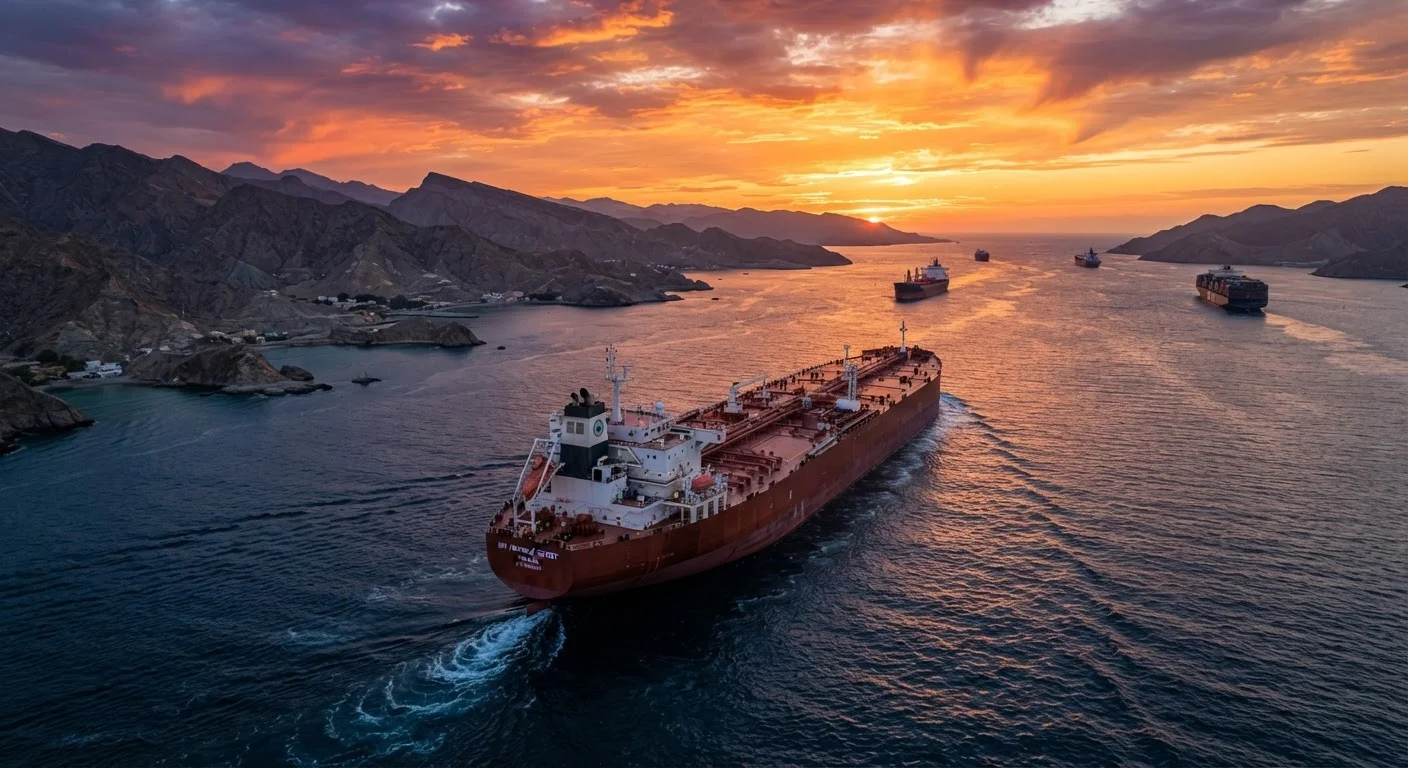
At its narrowest, the Strait of Hormuz - the waterway connecting the Persian Gulf to the Arabian Sea - is about 21 miles wide. Through that corridor passes an estimated 20% of the world's daily oil supply, according to the U.S. Energy Information Administration (EIA). There is no practical alternative route for most Gulf producers.
Any credible threat to close or disrupt that passage - whether from military conflict, mining, or naval blockade - immediately registers in global oil futures markets. Traders price in risk before a single barrel is actually delayed. That mechanism explains why a military exchange between nations that the U.S. does not directly trade with can still raise the cost of filling up a pickup truck in Ohio.
To understand how economic pressure tools interact with these dynamics, see our guide to how sanctions shape geopolitics and gas prices.
How Conflict Translates to Higher Prices at Home
The transmission mechanism from conflict to consumer cost works through several channels simultaneously.
- Futures markets: Oil is traded in advance on commodity exchanges. When geopolitical risk rises, traders bid up the price of future contracts, and those elevated prices eventually reach refiners and, subsequently, consumers.
- Supply disruptions: Actual or anticipated reductions in output - from damaged infrastructure, sanctions enforcement, or production cuts - tighten global supply and push spot prices higher.
- Shipping costs: Conflict in shipping lanes raises insurance premiums and rerouting costs for tankers, adding to the delivered cost of crude oil.
- Investor behavior: Uncertainty triggers broader market movements, often strengthening the U.S. dollar (which can partially offset oil price rises for American importers) while also compressing refinery margins.
These forces do not operate in isolation. A single event can activate all of them within hours. For a fuller picture of how foreign crises feed into domestic inflation, see how global conflicts translate into U.S. inflation.
U.S. Domestic Production: Does It Insulate Americans from Global Shocks?
The United States became the world's largest oil producer by volume around 2018, driven by the shale revolution in states like Texas, North Dakota, and Pennsylvania. This development meaningfully reduced the volume of crude the U.S. imports from the Middle East. By the early 2020s, direct U.S. imports from Gulf states had fallen sharply compared to decades past.
Yet higher domestic production did not decouple American consumers from global price swings. Here is why: U.S.-produced crude is sold at globally set prices. American oil companies are private entities that sell to the highest bidder on an international market. When global prices rise due to Middle East tension, domestic producers benefit financially - but American consumers still pay the elevated market price at the pump.
Watch the weekly EIA petroleum status report as an early indicator of supply pressure. When U.S. crude inventories fall sharply alongside Middle East tensions, price increases at the pump typically follow within two to three weeks.
Inventory data is a leading indicator that professional traders use to anticipate price movements before they reach retail consumers.
Do not conflate where the U.S. imports oil from with whether it is exposed to global price shocks. Even if every barrel consumed domestically were produced in America, the price would still be set by global market conditions.
This is one of the most common public misunderstandings about energy independence, and it leads to unrealistic expectations about the insulating effect of domestic production.
Domestic production does provide a buffer against the most severe supply shocks by adding global supply volume, but it cannot shield consumers from the price-setting mechanism of a unified global oil market.
What This Means for Everyday Americans
Energy costs are not isolated to the gas station. Because petroleum products underpin transportation, manufacturing, agriculture, and heating, a sustained oil price spike ripples across the entire cost of living. Grocery prices rise when trucking costs increase. Airline tickets become more expensive. Heating bills climb in winter months.
Understanding this connection is not about fatalism - it is about informed citizenship. When Americans see news coverage of tensions in the Persian Gulf, they are not watching a distant drama. They are watching an event that will be reflected, to varying degrees, in economic data within weeks.
Policymakers have pursued a range of responses over the decades: building the Strategic Petroleum Reserve (a government stockpile of crude oil), investing in fuel efficiency standards, subsidizing domestic energy alternatives, and engaging diplomatically to stabilize producing regions. None of these tools fully severs the link, but they can soften its impact.
For individual households, awareness of this dynamic is the first step toward understanding broader economic news - and toward evaluating the energy policy arguments that appear in every election cycle.
This article is intended for general informational purposes. It does not constitute financial, investment, or policy advice. Readers should consult qualified professionals for guidance specific to their circumstances.