

Key Takeaways
Gerrymandering
Gerrymandering is the practice of drawing the boundaries of electoral districts in a way that gives one political party an advantage over another. Politicians or legislatures in control of redistricting can pack rival voters into as few districts as possible, or spread them thinly so they never form a winning majority. The result is that a party can win far more seats than its raw share of votes would suggest it deserves.
The term dates to 1812, when Massachusetts Governor Elbridge Gerry signed a bill creating a salamander-shaped district - a portmanteau of his name and the shape gave us 'gerrymander.' Modern redistricting is guided by criteria including population equality, the Voting Rights Act, and, in some states, additional fairness standards.
The Basic Mechanics: How District Lines Become a Political Weapon
Every 10 years, the U.S. Census triggers a mandatory redrawing of electoral district boundaries, a process called redistricting. In most states, this power rests with the state legislature - which means the party in control sets the rules of the game for the next decade.
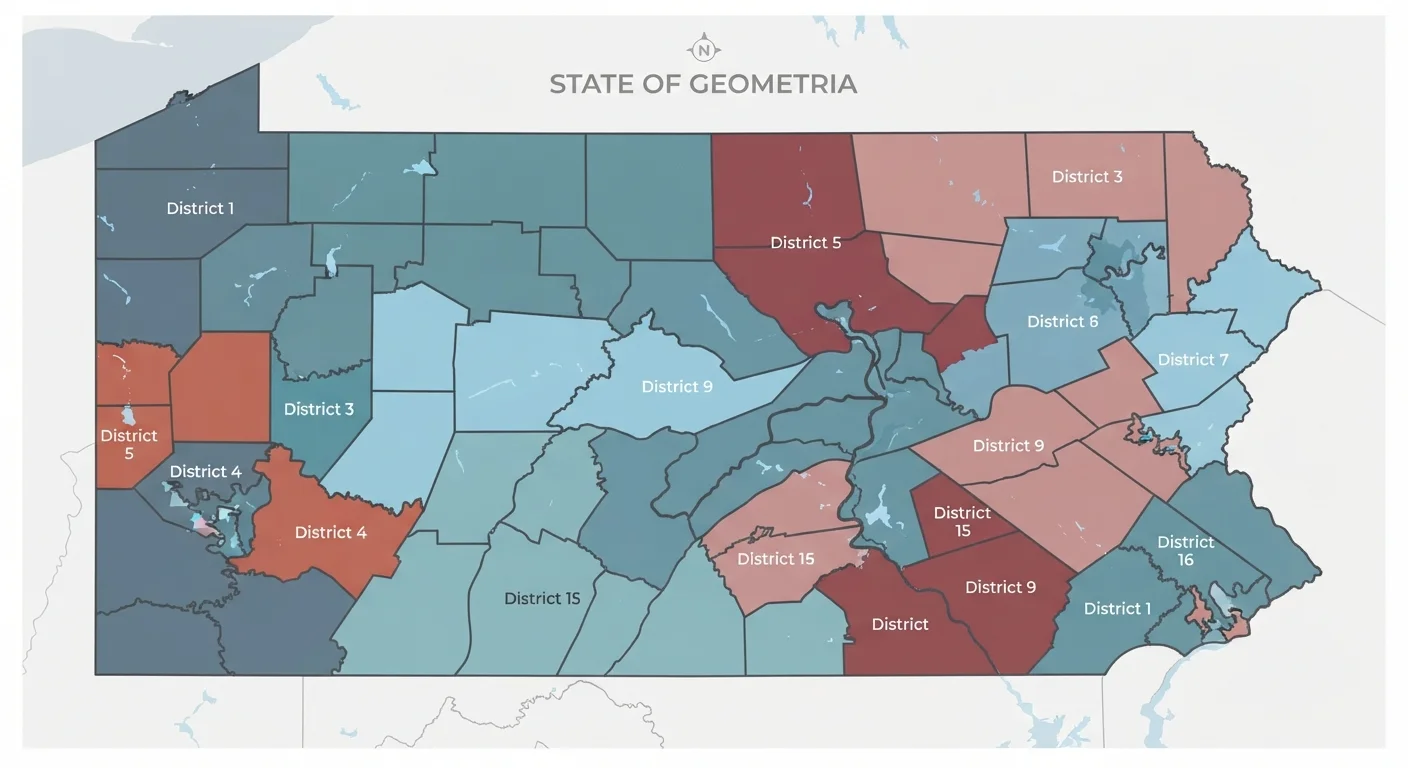
The two core techniques mapmakers use are packing and cracking. Packing funnels as many opposition voters as possible into a single district, where they win overwhelmingly but exhaust their influence in one place. Cracking divides a concentrated bloc of opposition voters across several districts, diluting their strength so they cannot form a majority in any of them. Used together, these strategies can produce a map where one party consistently wins a lopsided share of seats even when the statewide vote is roughly even.
Modern mapmakers have sophisticated demographic data and mapping software that make precise manipulation far easier than in earlier eras. Analysts can model thousands of district configurations and select the one that most reliably produces their preferred outcome.
Redistricting vs. Gerrymandering: Not the Same Thing
Redistricting simply refers to the required process of redrawing district boundaries after each Census to reflect population changes. Gerrymandering is redistricting done with the deliberate intent to advantage one group over another. Not every redistricting cycle produces a gerrymander, though critics and supporters of any given map often disagree sharply about whether the line has been crossed.
Where the Law Draws - and Doesn't Draw - the Line
Federal law places some limits on redistricting, but those limits are narrower than many people assume. The U.S. Supreme Court's 2019 ruling in Rucho v. Common Cause held that federal courts cannot review or strike down maps drawn for partisan advantage - the majority concluded this was a political question beyond judicial reach at the federal level.
Racial gerrymandering is a different matter. The Voting Rights Act of 1965 prohibits maps that systematically dilute the voting power of racial and language minorities. Courts have repeatedly struck down maps that pack minority voters in ways designed to limit their representation - or, conversely, that crack minority communities apart to prevent them from electing their preferred candidates. The line between permissible political line-drawing and illegal racial discrimination is frequently contested and litigated.
State courts operate under their own state constitutions and have, in some cases, been more willing to intervene. Pennsylvania's Supreme Court, for example, struck down and replaced a congressional map in 2018 under the state constitution's free-and-equal elections clause.
2019
Year federal courts lost jurisdiction over partisan gerrymandering
The U.S. Supreme Court's ruling in Rucho v. Common Cause closed federal courts as a venue for challenging maps drawn purely for partisan advantage.
13
States with some form of independent redistricting commission
According to the National Conference of State Legislatures, the structure and independence of these commissions varies considerably from state to state.
435
U.S. House seats reapportioned after every Census
Every decade, redistricting determines the boundaries for all 435 congressional districts, shaping representation for a full decade of elections.
Why It's So Hard to Stop - and What Reform Looks Like
The structural challenge is circular: the party with the power to draw maps has an obvious incentive to preserve that power. Legislators rarely vote to limit their own advantages. This is why reformers have increasingly turned to ballot initiatives, asking voters directly to shift redistricting authority away from legislatures.
California, Arizona, Michigan, and Colorado are among the states that have established independent redistricting commissions, where citizen panels - rather than elected officials - draw the maps. Evidence on how well these commissions reduce bias is mixed; their composition and rules vary widely, and some commissions still face political pressure or legal challenge.
Algorithmic and mathematical approaches - such as drawing thousands of random maps and evaluating where a proposed map falls in that distribution - offer another tool for detecting extreme gerrymanders. But these methods are analytical aids, not solutions in themselves; they still require political will and legal authority to act on the findings.
Gerrymandering's effects ripple through the political system. Districts drawn to be safe for one party reduce competitive races, can dampen voter turnout, and may contribute to more ideologically extreme candidates winning primaries without meaningful general-election competition. Those dynamics are directly relevant to understanding why midterm elections can produce surprising national swings even when district maps seem to favor incumbents.