

Key Takeaways
Option A
Whole Grains
The structurally intact, nutrient-dense original.
Best for: People looking to maximize fiber, vitamins, and minerals from their daily grain servings.
Option B
Refined Grains
The milled, longer-shelf-life staple of modern food systems.
Best for: Situations where palatability, digestive tolerance, or fortification fills specific gaps in a varied diet.
If you want to maximize fiber and micronutrients from grains
Whole Grains
Whole grains deliver the full nutritional package of the kernel - fiber, B vitamins, minerals, and phytonutrients - that refined processing largely removes.
If you have certain digestive sensitivities or need easily tolerated foods
Refined Grains
Lower fiber content can make refined grains gentler on the gut in specific clinical situations - always discuss this with a healthcare provider.
If you are building a balanced, long-term dietary pattern
Whole Grains
Consistent whole grain consumption is associated in large-scale studies with better cardiovascular and metabolic health outcomes over time.
If most of your diet is already rich in vegetables, legumes, and varied whole foods
Refined Grains
Occasional refined grain foods contribute little nutritional harm when the overall diet is diverse and nutrient-dense.
What Happens Inside the Mill
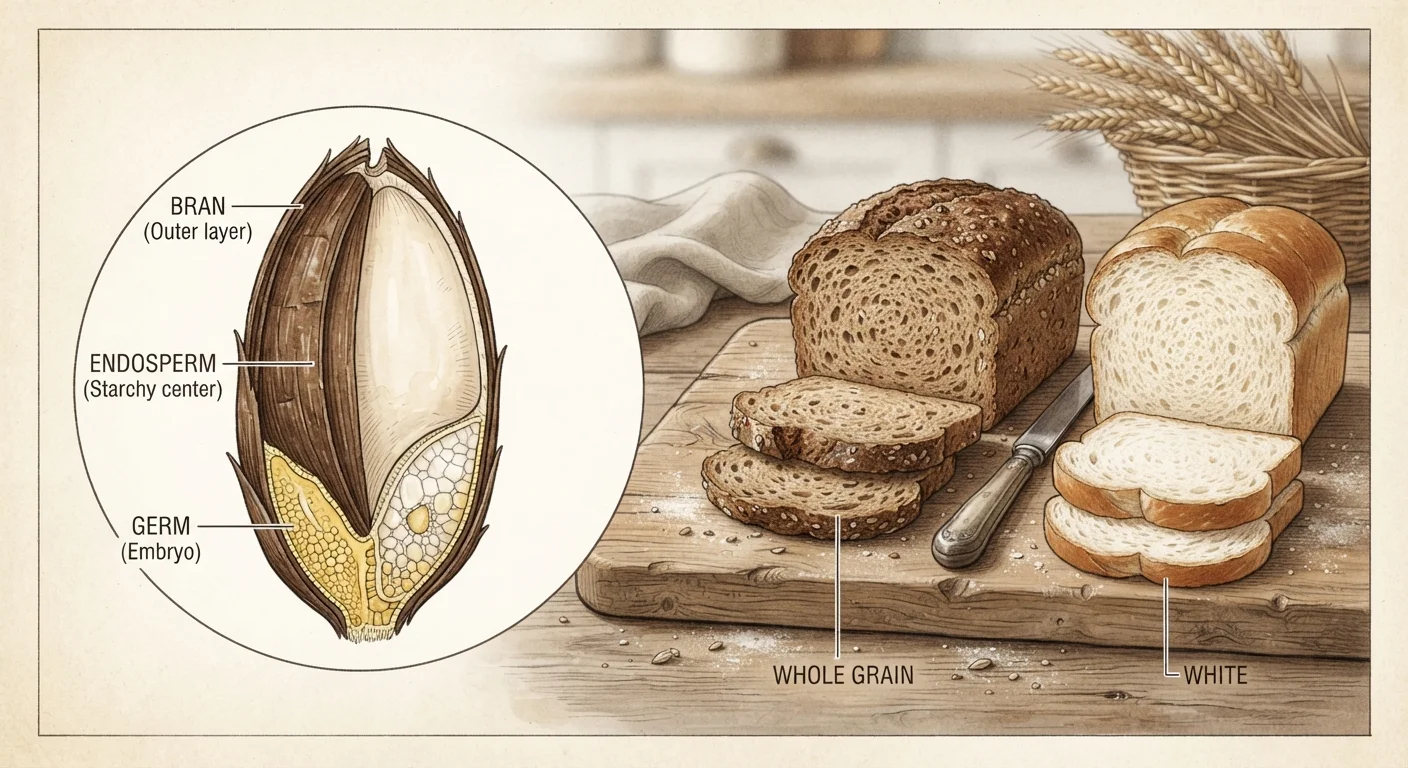
Every grain kernel - whether wheat, oats, rice, or corn - is built from three layers: the outer bran, the nutrient-rich germ, and the starchy inner endosperm. A whole grain keeps all three intact. Refining strips away the bran and germ, leaving almost exclusively the endosperm.
That sounds like a minor structural change, but the nutritional consequences are significant. The bran is the primary source of dietary fiber as well as B vitamins like thiamine, niacin, and riboflavin. The germ contributes healthy fats, vitamin E, additional B vitamins, and a range of minerals including zinc, magnesium, and iron. When both layers are removed, the endosperm that remains is calorie-dense but comparatively nutrient-light.
Refining was originally driven by practical goals: a longer shelf life (oils in the germ can go rancid), a softer texture, and a more neutral flavor that consumer markets came to prefer. Those advantages are real - but they come with a trade-off that decades of nutrition research have made hard to ignore.
| Criterion | Whole Grains | Refined Grains |
|---|---|---|
| Kernel layers retained | Bran, germ, and endosperm | Endosperm only |
| Dietary fiber content | High | Low |
| B vitamins (natural) | Naturally present in bran and germ | Mostly removed; select ones added back |
| Vitamin E | Present (from germ) | Largely removed; not enriched back |
| Minerals (magnesium, zinc) | Naturally occurring | Substantially reduced by milling |
| Glycemic response | More gradual glucose absorption | Faster glucose absorption |
| Shelf life | Shorter (germ oils can go rancid) | Longer |
| Phytonutrients & antioxidants | Rich (from bran and germ) | Minimal |
The Enrichment Question
After refining became widespread in the early 20th century, deficiency diseases linked to B-vitamin loss became a recognized public health concern. In response, enrichment programs were introduced: manufacturers began adding back specific nutrients - thiamine, riboflavin, niacin, folic acid, and iron - to refined flour and grain products. In the United States, enrichment of most commercial white flour is federally mandated.
Enrichment meaningfully restores several key vitamins, and for folic acid in particular, fortification has been credited with significant reductions in neural tube defects. However, enrichment is selective. It replaces a handful of nutrients but does not restore fiber, vitamin E, magnesium, zinc, phytonutrients, or the many other bioactive compounds found in the bran and germ. Think of it as replacing a few pages torn from a book - useful, but not the same as the original.
Reading a Grain Label Accurately
To confirm a product is genuinely whole grain, look for the first ingredient to say "whole wheat," "whole oats," "whole grain corn," or similar. Terms like "multigrain," "wheat flour," or "made with whole grains" do not guarantee a predominantly whole grain product. The Whole Grains Council's stamp, where present, indicates a certified minimum whole grain content per serving.
This distinction matters when comparing labels: a refined grain product labeled "enriched" may look nutritionally similar to a whole grain product on a short vitamin checklist, while differing substantially in fiber content and overall micronutrient density.
What the Research Actually Shows
The health associations linked to whole grain consumption are among the most consistent findings in nutritional epidemiology. Large prospective studies - including the Nurses' Health Study and analyses published in journals such as The BMJ and The Lancet - have found that higher whole grain intake is associated with reduced risk of cardiovascular disease, type 2 diabetes, and colorectal cancer. These associations hold even after adjusting for overall diet quality and lifestyle factors.
The mechanisms are plausible and well-studied. Dietary fiber slows glucose absorption, which moderates post-meal blood sugar response - a factor relevant to insulin sensitivity. Fiber also supports a diverse gut microbiome, feeds beneficial bacteria, and contributes to satiety. The phytochemicals and antioxidants concentrated in the bran and germ are thought to reduce inflammation and oxidative stress, though research on specific compounds is still evolving.
3+ servings/day
Whole grain intake linked to reduced CVD risk
A meta-analysis published in The BMJ (2016) found that three or more daily servings of whole grains were associated with a significant reduction in cardiovascular disease risk.
~25%
Fiber loss from wheat bran removal
Refining whole wheat to white flour removes roughly 75-80% of the dietary fiber, according to USDA nutrient composition data comparing whole wheat and enriched white flour.
50%
Recommended share of daily grains that should be whole
The U.S. Dietary Guidelines for Americans recommend that at least half of all grain servings consumed daily come from whole grain sources.
Refined grains, by contrast, are digested more quickly and produce steeper blood glucose spikes. Over time, a diet heavy in refined grains and low in fiber has been associated - though not proven to cause - higher rates of metabolic risk factors. It is worth noting that most studies examine dietary patterns as a whole, not single foods in isolation. Refined grains in an otherwise nutrient-rich diet are a different proposition than a diet built predominantly around them.
For a broader view of why eliminating entire food categories - including all grains - tends to create its own problems, see why cutting out entire food groups tends to backfire. And if the "natural vs. processed" framing resonates with you, added sugar vs. natural sugar explores a parallel question where the distinction is more nuanced than it first appears.
This article is for general informational and educational purposes only and is not a substitute for professional medical or dietary advice. Consult a qualified healthcare provider or registered dietitian for guidance tailored to your individual health needs.