

Key Takeaways
Macronutrients
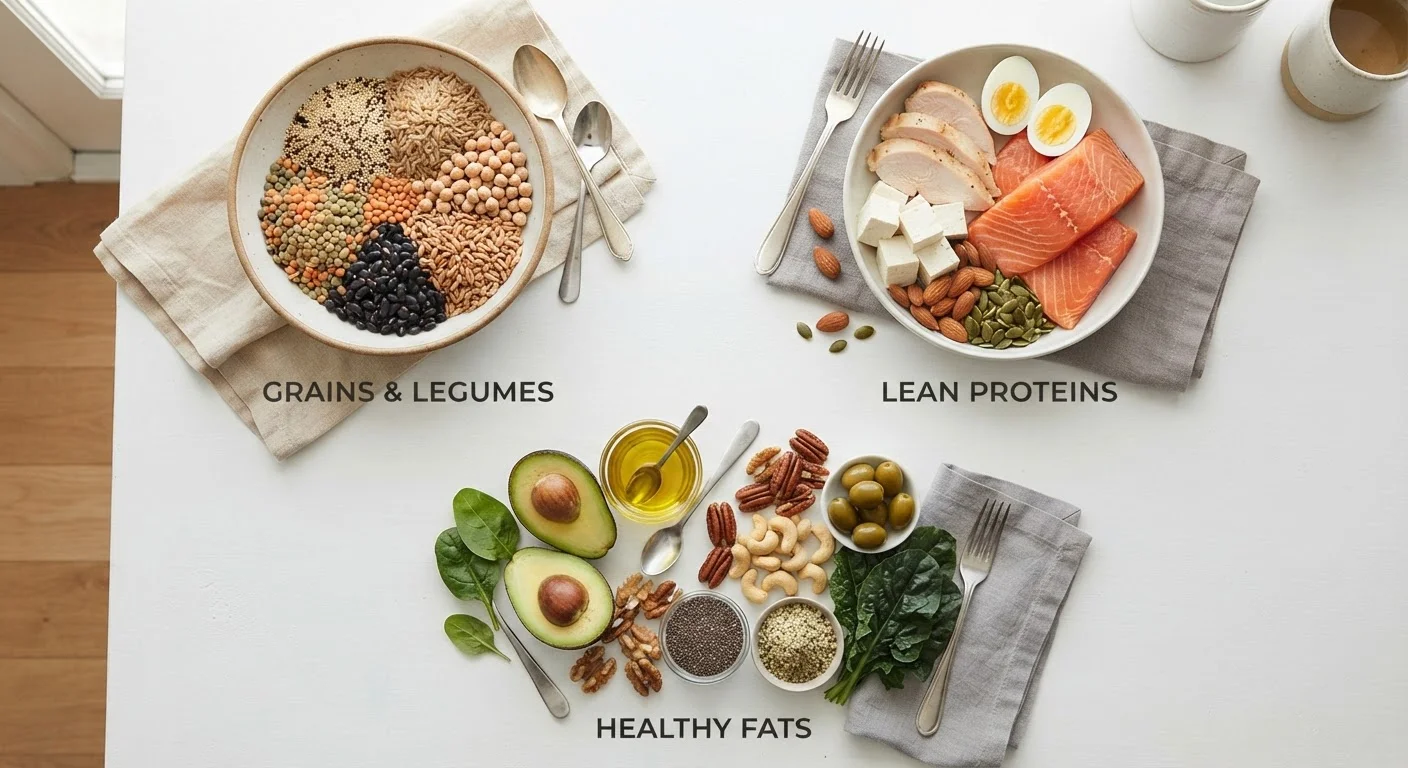
Macronutrients are the three main categories of nutrients your body requires in large amounts to function: carbohydrates, proteins, and fats. Unlike vitamins and minerals, which are needed in much smaller quantities, macronutrients provide the energy your body runs on and supply the raw materials for building and repairing tissues. Every food you eat contains some combination of these three.
Energy from macronutrients is measured in kilocalories (kcal). Carbohydrates and proteins each provide 4 kcal per gram; fats provide 9 kcal per gram.
Why Macronutrients Matter
When nutrition science talks about what food actually does in the body, macronutrients are the starting point. These three nutrient classes - carbohydrates, proteins, and fats - aren't just calorie counters. Each one performs specific, irreplaceable functions that keep your body running from one moment to the next. If you're new to thinking about food this way, this beginner-friendly overview of nutrition offers helpful grounding before diving deeper.
Unlike micronutrients such as vitamins and minerals, which the body needs in trace amounts, macronutrients are required in substantial quantities every day. Getting enough of each - and from quality sources - supports energy, growth, repair, and the hundreds of chemical reactions your body carries out continuously.
45-65%
Recommended daily calories from carbohydrates
According to the Dietary Guidelines for Americans, carbohydrates should account for roughly 45-65% of total daily calorie intake for most adults.
10-35%
Recommended daily calories from protein
The Acceptable Macronutrient Distribution Range (AMDR) for protein, as established by the National Academies of Medicine, is 10-35% of total daily calories.
20-35%
Recommended daily calories from fat
The AMDR for total fat is 20-35% of daily calories, with an emphasis on unsaturated fat sources according to the National Academies of Medicine.
Carbohydrates: The Body's Primary Fuel
Carbohydrates are broken down into glucose, which cells use as their most immediate and efficient energy source. The brain in particular relies heavily on glucose - it has little capacity to store it and draws on a near-constant supply from the bloodstream. During physical activity, working muscles also prioritize glucose (stored in muscle as glycogen) before turning to other fuel sources.
Not all carbohydrates behave the same way. Whole food sources - such as legumes, vegetables, whole grains, and fruit - come packaged with fiber, which slows digestion, supports gut health, and helps stabilize blood sugar. Heavily processed carbohydrates, by contrast, are digested rapidly and provide little nutritional value beyond calories.
Fiber itself is technically a carbohydrate, but because it isn't fully digested, it functions differently: feeding beneficial gut bacteria, supporting bowel regularity, and contributing to feelings of fullness.
Protein: Building Blocks for Every Cell
Protein is made up of chains of amino acids - twenty in total, nine of which the body cannot synthesize on its own and must obtain from food. These essential amino acids are the reason dietary protein is non-negotiable, not simply optional.
Every cell in the body contains protein. It forms the structural scaffolding of muscle, skin, hair, and connective tissue. It also makes up enzymes that drive metabolic reactions, antibodies that support immune defense, and hormones that carry signals between organs. When you eat protein, digestion breaks it into individual amino acids that are reassembled into whichever structures the body currently needs most.
Animal foods - meat, fish, eggs, and dairy - tend to supply all nine essential amino acids in sufficient amounts and are referred to as complete proteins. Many plant foods contain protein but may be low in one or more essential amino acids; eating a variety of plant-based sources across the day generally covers this gap without requiring precise combining at every meal.
Fats: More Than Stored Energy
Dietary fat has a complicated public reputation, but the science is clear: fat is essential. It enables the absorption of fat-soluble vitamins A, D, E, and K - nutrients that simply cannot enter the bloodstream without fat present. It also serves as a raw material for steroid hormones, including those involved in reproductive health and stress response, and it insulates nerves with myelin sheaths that allow signals to travel efficiently.
Fat also provides a concentrated energy reserve. At 9 kilocalories per gram, it stores more energy per unit of weight than either carbohydrates or protein, making it a useful long-term fuel source during low-intensity, sustained activity.
The type of fat consumed influences how it functions in the body. Our field guide to saturated, unsaturated, and trans fats breaks down these distinctions in detail.
It's also worth noting that fat plays a structural role in every cell membrane in the body, influencing how cells communicate and respond to signals - a function no other macronutrient can replicate.
Balance in Practice
The body doesn't operate in macronutrient silos - carbohydrates, proteins, and fats interact continuously. When carbohydrate intake is adequate, the body spares protein for its structural and enzymatic roles rather than burning it for energy. When fat intake is sufficient, fat-soluble vitamins can be absorbed from food. Each macronutrient supports the others.
This is why eliminating any single macronutrient entirely - a strategy promoted by various diet trends - tends to create unintended trade-offs. Very low-fat diets can impair vitamin absorption and hormone production. Very low-carbohydrate diets shift the body into ketosis, a metabolic state that some people use deliberately but which requires careful nutritional management. High-protein diets emphasize one macronutrient at the potential cost of the others.
Evidence-based dietary guidelines across multiple countries consistently emphasize dietary pattern over any single macronutrient ratio. For a practical framework on how to apply these principles at mealtime, see building a balanced plate. And because water is central to the metabolic processes that use all three macronutrients, how hydration fits into the bigger picture is worth understanding alongside this foundation.
This article is for general informational and educational purposes only and is not a substitute for personalized medical or dietary advice. Consult a qualified healthcare professional or registered dietitian for guidance tailored to your individual health needs.