

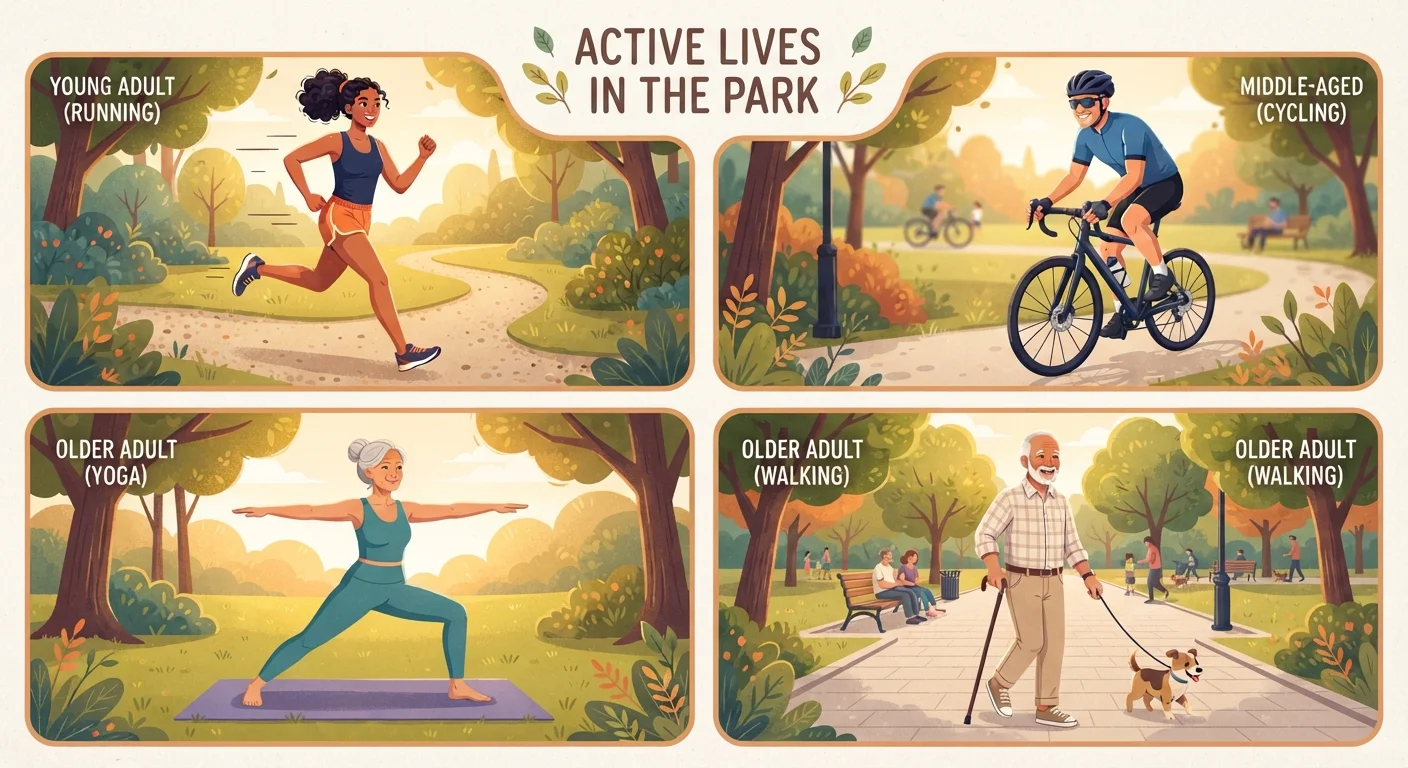
Key Takeaways
Why Exercise Needs Change With Age
The human body is not a static machine. Hormonal profiles, muscle fiber composition, bone density, cardiovascular efficiency, and connective tissue resilience all shift gradually - and measurably - across the adult lifespan. These changes don't happen on a single birthday; they accumulate over years and decades. What that means for exercise is straightforward: the workout that served you well at 25 may need meaningful revision by 45, and a thoughtful overhaul by 65.
This isn't cause for alarm - it's cause for awareness. The physical activity guidelines established by public health authorities account for these shifts, and the evidence consistently shows that appropriately matched movement at every age delivers substantial benefit. The goal of this guide is to map what those shifts look like and what they mean practically.
3-5%
Muscle mass lost per decade after mid-30s
According to published research on sarcopenia, adults without resistance training typically lose this proportion of skeletal muscle per decade.
~10%
VO₂ max decline per decade after 30
Aerobic capacity declines roughly 10% per decade in sedentary adults, though regular exercise substantially reduces this rate.
30%
Fall risk reduction with balance training
A Cochrane review of exercise interventions found that programs targeting balance and functional fitness reduced fall rates in older adults by approximately 23-30%.
Your 20s: Building the Foundation
The twenties represent a physiological peak for many markers of athletic capacity. Muscle mass, bone density, aerobic power (often measured as VO₂ max), and recovery speed are typically at or near their lifetime high points during this decade. That doesn't mean exercise is optional - it means the investments made now compound over time.
Strength training in the twenties helps establish a higher peak bone density, which matters decades later when age-related losses begin. Developing cardiovascular fitness now creates a buffer against future decline. Equally important is learning movement patterns - proper squat mechanics, hip hinging, upper-body pulling - that reduce injury risk across a lifetime.
Despite these advantages, many people in their twenties underinvest in recovery and mobility. Tendons and ligaments adapt more slowly than muscle, so overtraining is a real risk when enthusiasm outruns wisdom. If you're new to structured exercise, see our guide to starting a movement practice for a sensible on-ramp.
In your twenties, prioritize learning movement patterns over chasing maximum weight. Correct mechanics ingrained early become protective habits that pay off for decades.
Connective tissue adaptations lag behind muscle strength gains, meaning poor form under heavy load during early training often produces injuries that recur throughout life.
After 50, treat recovery days as training days - the adaptation to exercise happens during rest, not during the session itself, and this process slows with age.
Research on muscle protein synthesis rates shows that older adults require longer recovery windows to achieve comparable adaptation to younger adults performing the same workload.
Your 30s and 40s: Maintaining Momentum
Sometime in the mid-thirties, sarcopenia - the gradual loss of skeletal muscle mass - begins in earnest, typically at a rate of roughly 3-5% per decade without intervention. Metabolic rate tends to slow modestly. Life demands (careers, caregiving, family) often crowd out the unstructured activity that filled earlier years.
The practical priority in this phase is preserving what you built. Resistance training becomes less optional and more essential. Two to three sessions per week targeting major muscle groups is consistent with established guidelines and sufficient to blunt age-related muscle loss meaningfully. Cardiovascular work remains important both for heart health and metabolic function.
This decade is also when chronic stress and sleep disruption begin to affect recovery more noticeably. Honest attention to sleep quality is not a lifestyle luxury here - it directly influences how the body repairs muscle tissue and manages inflammation after exercise. Explore movement options beyond the gym if scheduling or access has become a barrier.
Your 50s and 60s: Protecting What You've Built
Hormonal changes accelerate in this phase - declining estrogen in women around menopause and gradually declining testosterone in men - both of which affect muscle retention, bone density, and recovery. Cartilage health becomes a more active concern, and joint-friendly movement choices grow more important.
Balance training, often neglected in earlier decades, becomes a genuine priority here. Falls are among the leading causes of injury in older adults, and research consistently shows that targeted balance and proprioception work reduces fall risk. Incorporating exercises like single-leg stands, heel-to-toe walking, or tai chi is evidence-based, not merely precautionary.
Flexibility and mobility work also earn a larger share of the training week. The interplay between strength and flexibility is nuanced - our piece on strength training vs. flexibility work explores why both belong in most programs. Recovery windows lengthen, so a schedule that includes adequate rest between sessions is not a concession to aging - it's sound programming.
Before resuming or intensifying exercise after a health event or long break, consulting a healthcare provider is advisable. Our pre-workout movement check offers a useful self-assessment framework.
Your 70s and Beyond: Movement as Medicine
The evidence for exercise in older adults is among the most robust in all of health research. Regular physical activity in the seventies and beyond is associated with reduced risk of cardiovascular disease, improved cognitive function, lower rates of depression, better glycemic control, and - critically - preservation of independence. These are not marginal effects.
The emphasis at this stage tends to shift toward functional fitness: strength adequate for daily tasks, balance sufficient to prevent falls, and aerobic capacity that sustains everyday mobility. Walking remains one of the most accessible and well-evidenced tools available - see what the evidence says about walking as exercise for a detailed look at its real effects.
High-impact activities may need modification or substitution depending on joint health, but low-impact alternatives - water aerobics, cycling, resistance bands, chair yoga - deliver meaningful benefits without undue mechanical stress. The key principle is some movement is always better than none, and starting is never too late.
This article is for general informational purposes only and is not a substitute for personalized medical advice. Always consult a qualified healthcare provider before beginning, changing, or intensifying an exercise program, particularly if you have existing health conditions or concerns.
What Stays the Same Across Every Decade
Despite the meaningful shifts described above, several principles hold across every life stage. Consistency outperforms intensity: a moderate, sustainable routine practiced regularly beats sporadic peak efforts every time. The body responds to progressive overload - gradual increases in challenge - regardless of age, though the rate and magnitude of progression should be calibrated to recovery capacity.
The fundamental components of a well-rounded program also remain constant: aerobic activity for cardiovascular and metabolic health, resistance training for muscle and bone, and flexibility or mobility work for joint function and injury prevention. Proportions and intensities shift; the components themselves don't disappear.
Finally, movement that fits your life is movement you'll sustain. The diversity of movement options available means there is no single correct path - only the one you can realistically continue. Adapting your approach as your body and circumstances evolve isn't giving up on fitness. It's practicing it intelligently.
“Exercise is the closest thing we have to a magic bullet. No drug has been shown to do what exercise does - and it works at every age.”
— Frank Booth, Exercise physiology researcher, University of Missouri