

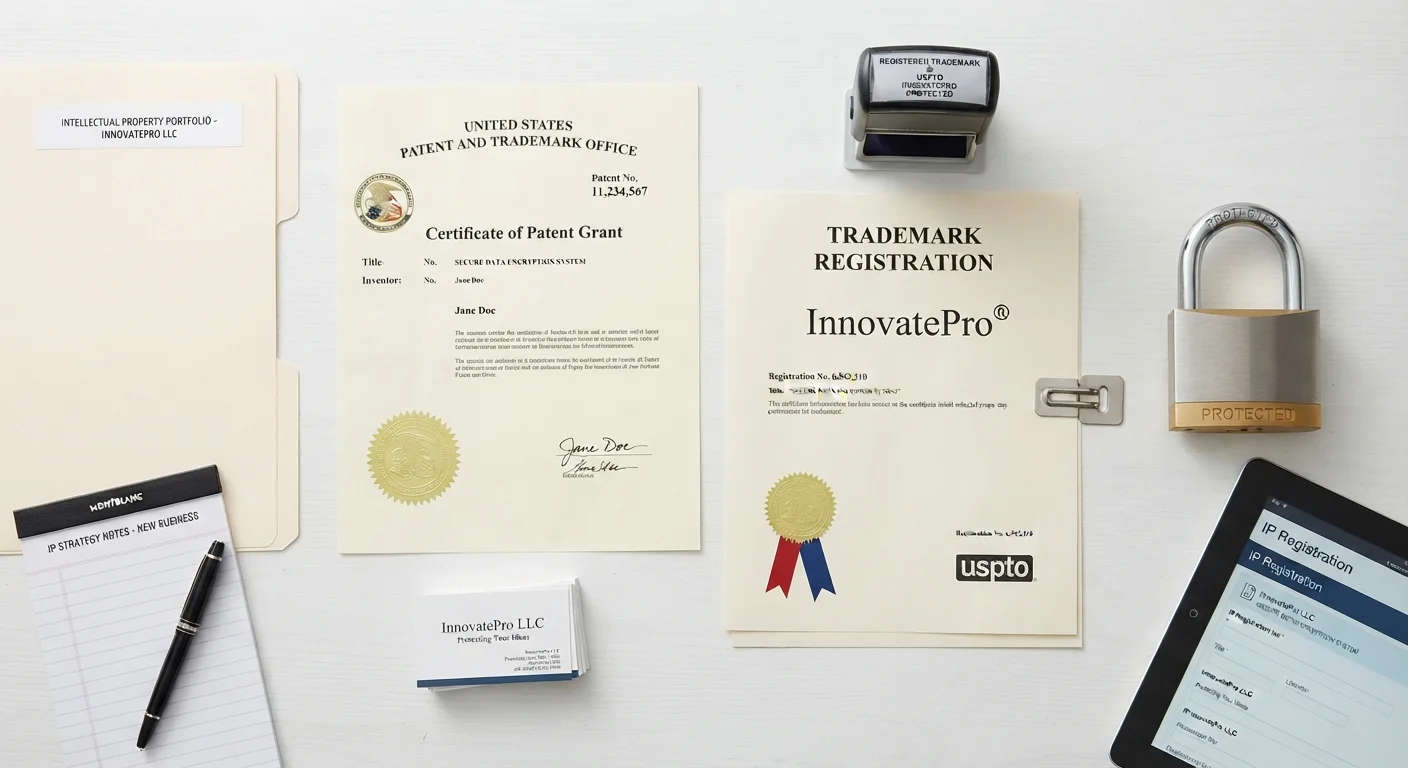
What Intellectual Property Means for a New Business
When you launch a business, you create assets that go beyond equipment and inventory. Your brand name, original content, inventions, and proprietary processes all have legal value - and without the right protections in place, competitors can legally copy or exploit them. Intellectual property (IP) law is the framework that prevents that.
IP protection isn't just for large corporations filing patents in Silicon Valley. Even a solo founder selling handmade goods, a freelance designer, or a neighborhood service business likely has at least one form of protectable IP. The four primary categories - trademarks, copyrights, patents, and trade secrets - each cover different types of assets and carry different rules. Understanding which applies to your business is a foundational early-stage decision.
For a broader look at how IP fits within the full process of launching a legal entity, see the full early-stage business journey.
The Four Core IP Categories Explained
Each IP category protects something distinct. Knowing the differences prevents both under-protection and misapplied expectations.
Trademarks
A trademark protects brand identifiers - names, logos, slogans, and in some cases colors or sounds - that distinguish your goods or services from others in the marketplace. Trademark rights can arise through use alone (a so-called common law trademark), but federal registration with the U.S. Patent and Trademark Office (USPTO) provides significantly stronger, nationwide protection and the right to use the ® symbol. Registration requires demonstrating that the mark is distinctive and not likely to cause confusion with an existing registered mark. Trademarks can be renewed indefinitely as long as the mark remains in use.
If you're registering a business name, note that a state-level business registration does not automatically grant trademark rights. Those are separate processes - see how business name registration works for more on that distinction.
Copyrights
Copyright protects original works of authorship - written content, photographs, software code, music, videos, graphic designs, and more. Protection arises automatically the moment a qualifying work is created and fixed in a tangible form. Registration with the U.S. Copyright Office isn't required to own the copyright, but it is required before you can sue for infringement in federal court and enables you to seek statutory damages. Copyright generally lasts for the author's lifetime plus 70 years.
Patents
A patent grants the inventor an exclusive right to make, use, sell, or license an invention for a defined period - typically 20 years for a utility patent. In exchange, the inventor must publicly disclose how the invention works. There are three patent types: utility (functional inventions and processes), design (ornamental appearance), and plant (new plant varieties). The application process is complex, time-consuming, and can be expensive; most businesses engage a patent attorney. Crucially, the U.S. follows a first-to-file system, meaning the first applicant - not necessarily the first inventor - generally prevails.
Trade Secrets
A trade secret is any confidential business information that provides a competitive edge and is subject to reasonable steps to maintain its secrecy - a formula, algorithm, customer list, or manufacturing process. Unlike patents, trade secrets require no government registration. Protection lasts as long as secrecy is maintained. The obligation to protect them falls entirely on the business, typically through non-disclosure agreements (NDAs), employee confidentiality policies, and access controls.
Trademark
A word, symbol, logo, or other identifier that distinguishes one company's goods or services from another's. Federal registration is handled by the USPTO and provides nationwide protection.
Copyright
Automatic legal protection for original creative works fixed in a tangible form, including writing, art, music, and software. Registration strengthens enforcement rights.
Patent
A government-granted exclusive right to an invention, preventing others from making, using, or selling it without the inventor's permission for a set period.
Trade Secret
Confidential business information - such as formulas, processes, or data - that provides a competitive advantage and is actively kept secret by the owning business.
Non-Disclosure Agreement (NDA)
A legally binding contract in which one or more parties agree not to share confidential information with unauthorized third parties. Commonly used to protect trade secrets.
Common Law Trademark
Trademark rights that arise automatically through actual use of a mark in commerce, without federal registration. These rights are typically limited to the geographic area of use.
Practical Steps for Early-Stage IP Protection
New founders often delay IP decisions until problems arise. A more effective approach is to build basic protections into the business from the start.
- Conduct clearance searches before committing to a brand name. The USPTO's TESS database lets you search existing registered marks. A name that clears a state business registration check may still conflict with a federal trademark.
- Use copyright notices and register key works. Adding a copyright notice (© ) is not legally required but signals ownership. Register commercially important works - your website, product photography, original software - with the Copyright Office to preserve your litigation options.
- Document invention dates and processes. If you develop a novel product or process, maintain clear, dated records of the development process. This supports a future patent application and helps establish inventorship.
- Implement confidentiality agreements early. Have employees, contractors, and partners sign NDAs before sharing any proprietary information. Review these periodically with an attorney to ensure they're enforceable in your state.
- Consult a qualified IP attorney. IP law carries significant complexity and jurisdiction-specific nuances. An attorney can conduct thorough clearance searches, advise on filing strategy, and help structure agreements that actually hold up.
IP considerations connect to other early business decisions, too - particularly around business structure. Your choice of entity can affect how IP ownership is held and transferred. See how business structures differ for first-time founders for relevant context.
This article is for general informational and educational purposes only and does not constitute legal advice. Consult a licensed attorney for guidance specific to your business and circumstances.