

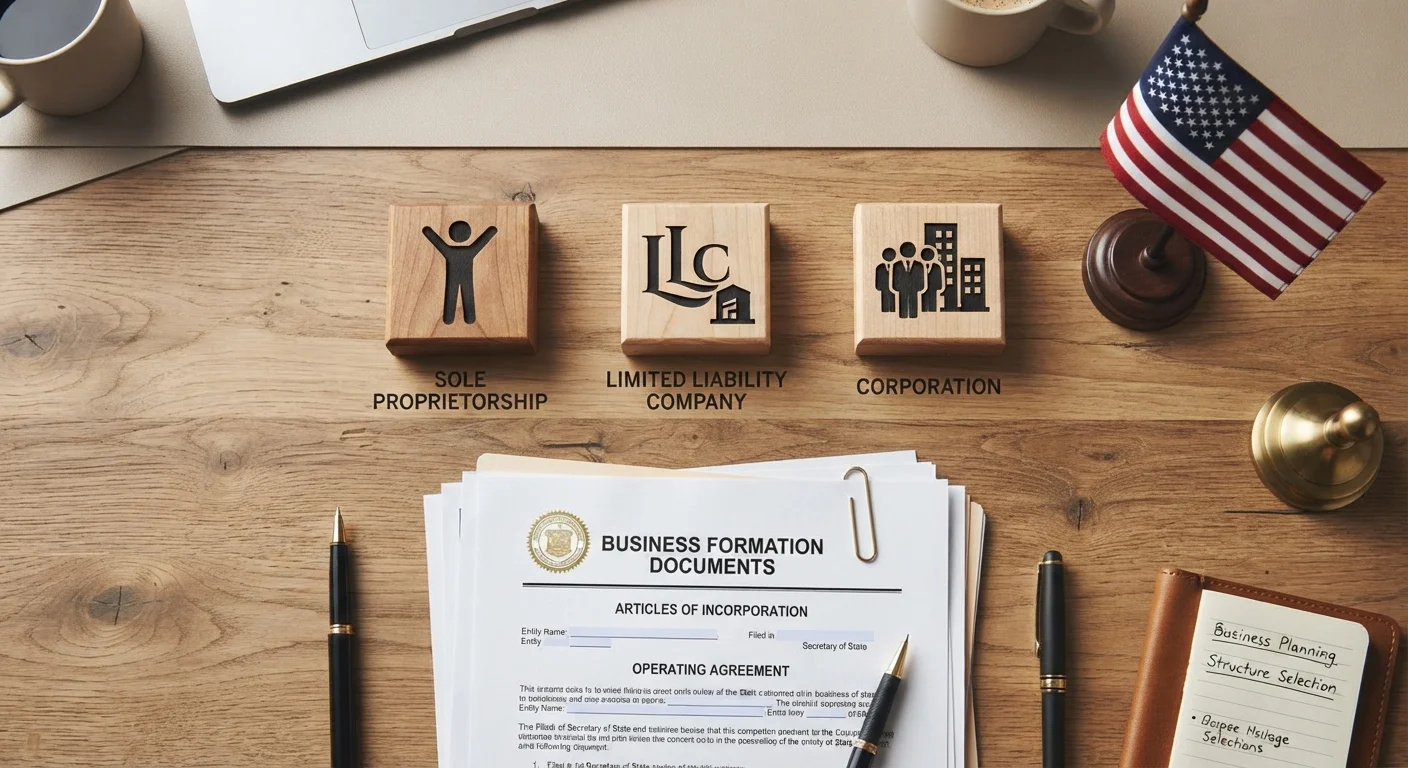
Key Takeaways
Our Verdict
For most solo founders just getting started, a sole proprietorship offers immediate simplicity, while an LLC provides a practical middle ground between protection and flexibility. A corporation makes the most sense when the business model involves investors, stock issuance, or complex ownership structures. No single structure is universally correct - the right choice depends on your risk exposure, growth plans, and tax situation.
| Best for | Recommended |
|---|---|
| Freelancers and solo operators testing a business idea with low liability risk | Sole Proprietorship |
| Small business owners who want personal asset protection without heavy administrative burden | LLC |
| Founders planning to raise venture capital or issue shares to multiple investors | Corporation (C-Corp) |
| Small businesses with fewer than 100 shareholders seeking pass-through taxation with a corporate structure | S-Corporation |
Why Your Business Structure Decision Matters More Than You Think
When you start a business, the legal structure you choose isn't just paperwork - it shapes how you pay taxes, whether your personal savings can be seized if the business is sued, who can invest in your company, and how complex your annual compliance obligations will be. Yet many first-time founders either pick a structure by default or choose one simply because a friend did the same.
This article explains the three most common U.S. business structures - sole proprietorship, limited liability company (LLC), and corporation - in plain terms, so you can understand what each actually means before you commit. For a broader look at the full early-stage journey, see the complete guide from idea to registered business.
This article is general educational information, not legal or financial advice. Consult a licensed attorney or accountant for guidance specific to your situation.
Sole Proprietorship: The Default Starting Point
A sole proprietorship is the simplest business structure in the United States. If you start doing business on your own - freelancing, consulting, selling goods - without formally registering a separate legal entity, you are automatically operating as a sole proprietor. There is no state filing required to create one, though you may still need local business licenses or permits depending on your industry and location.
The major advantage is simplicity: minimal setup costs, straightforward tax filing (business income and expenses appear on your personal return via Schedule C), and no ongoing corporate formalities.
The significant trade-off is liability. As a sole proprietor, you and your business are legally the same entity. If your business is sued or cannot pay its debts, creditors can pursue your personal assets - your savings, car, or home. For low-risk activities with minimal client interaction, this may be acceptable. For anyone providing professional services, handling physical goods, or working with contracts, the exposure deserves serious consideration.
Protect Your Business Name Early
Even if you operate as a sole proprietorship, you may want to file a 'doing business as' (DBA) name so you can operate under a brand name rather than your personal name. This doesn't provide liability protection, but it helps with branding and can be required to open a business bank account. Check your county or state rules for DBA registration requirements.
LLC: The Most Popular Structure for Small Businesses
A limited liability company (LLC) is a state-registered legal entity that separates your personal assets from your business obligations. If the business faces a lawsuit or debt, your personal finances are generally protected - though there are exceptions, such as when an owner personally guarantees a loan or commits fraud.
LLCs are formed by filing Articles of Organization with your state and paying a filing fee that typically ranges from around $50 to several hundred dollars, depending on the state. Most LLCs also benefit from an operating agreement - a document that spells out how the business is managed and how profits are shared among members (owners).
For tax purposes, single-member LLCs are taxed like sole proprietorships by default; multi-member LLCs are taxed like partnerships. Owners can also elect to be taxed as an S-corporation in some cases, which can affect self-employment tax. These mechanics can be nuanced - how small business taxes work covers the specifics in more detail.
LLCs offer significant flexibility and are the structure most commonly recommended for small businesses that want liability protection without the full compliance burden of a corporation.
| Sole Proprietorship | LLC | C-Corporation | S-Corporation | |
|---|---|---|---|---|
| Personal Liability Protection | None | Yes (with exceptions) | Yes | Yes |
| Formation Complexity | None required | Low to moderate | High | High |
| Ongoing Compliance | Minimal | Moderate | Extensive | Extensive |
| Default Tax Treatment | Pass-through (Schedule C) | Pass-through | Corporate tax + dividend tax | Pass-through |
| Ability to Raise Investment | Very limited | Limited | Broad (multiple share classes) | Restricted (100 shareholder cap) |
| Best Suited For | Solo, low-risk operators | Most small businesses | Venture-backed startups | Small corps seeking pass-through tax |
Corporations: More Complexity, More Capability
A corporation is a fully separate legal entity owned by shareholders. It can enter contracts, own property, and be sued in its own name. Corporations have a formal management structure - a board of directors, officers, and shareholders - and must maintain strict records, hold annual meetings, and file separate corporate tax returns.
There are two main types relevant to small business owners:
- C-Corporation: The standard corporate form. C-corps pay corporate income tax on profits, and shareholders pay tax again on dividends - a situation called double taxation. However, C-corps can issue multiple classes of stock and have an unlimited number of shareholders, making them the preferred structure for venture-backed startups.
- S-Corporation: A tax election (not a separate legal structure) that allows corporate income to pass through to shareholders' personal returns, avoiding double taxation. S-corps have strict eligibility rules: no more than 100 shareholders, all must be U.S. citizens or residents, and only one class of stock is permitted.
Most founders who choose a corporate structure do so because their business model requires it - outside investors, employee stock options, or an eventual acquisition. If that's not your path, the added administrative burden of a corporation is usually unnecessary early on. Consider also how your structure interacts with your business model: service and product businesses face different structural considerations from the outset.
Key Factors to Weigh Before You Decide
No business structure is inherently superior - the right choice depends on your specific circumstances. Here are the core factors to think through:
- Liability exposure: Do you have personal assets worth protecting? Are you in an industry where lawsuits or client disputes are realistic?
- Tax implications: How will profits be taxed, and how does that affect your take-home income? Self-employment tax, pass-through income, and quarterly estimated payments all vary by structure.
- Funding plans: Do you intend to bring in investors or issue equity? Sole proprietorships and most LLCs aren't set up for that.
- Administrative capacity: Are you prepared to maintain the ongoing compliance requirements - annual reports, registered agents, operating agreements - that some structures demand?
- Cost: Setup and ongoing state fees differ. For a realistic picture of what starting a business costs across the board, startup costs for new businesses is a useful reference.
Once you've chosen a structure, your next step is typically registering your business name. Registering a business name in the U.S. walks through that process step by step.