

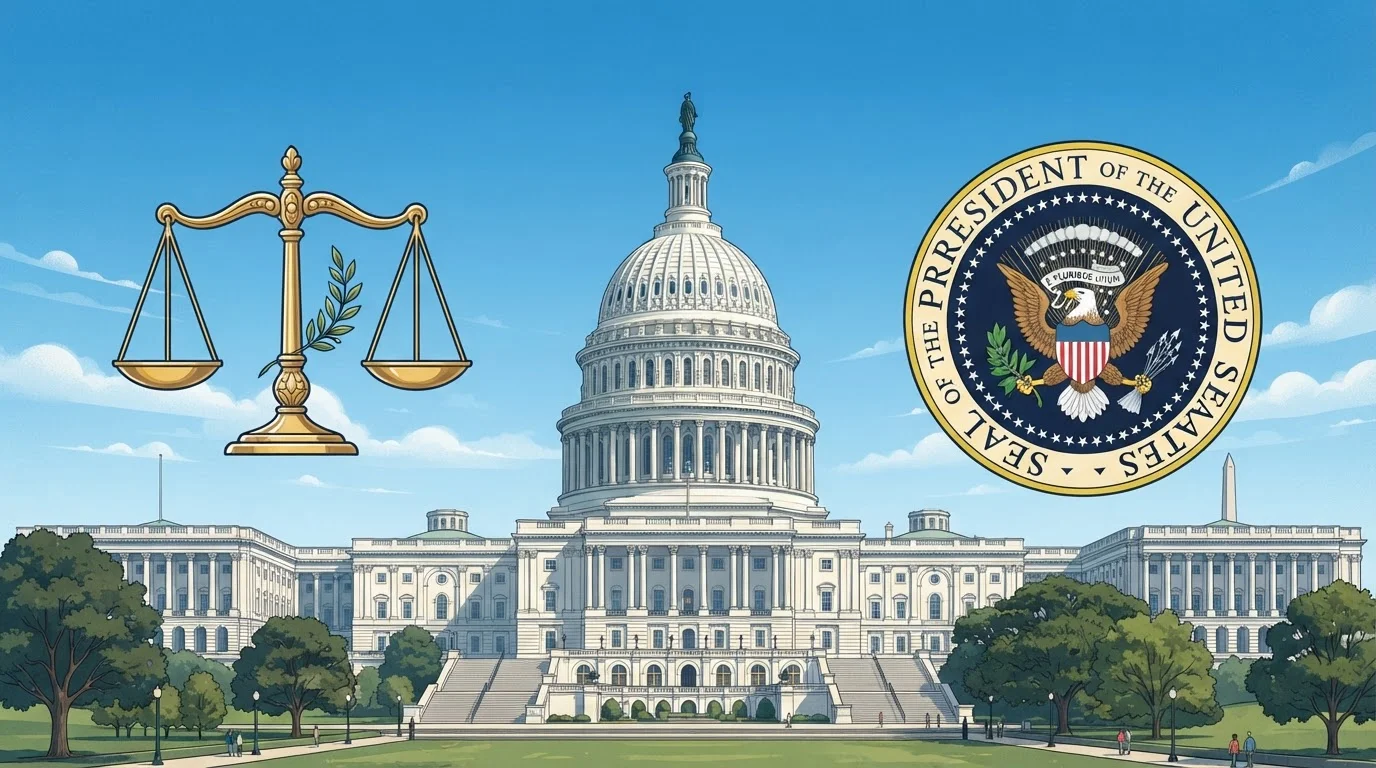
Key Takeaways
Separation of Powers
The separation of powers is the constitutional principle that divides the federal government of the United States into three distinct branches: the legislative, executive, and judicial. Each branch holds specific powers that neither of the other two can fully control. This design was intentional - the Founders wanted to prevent the concentration of authority that they had experienced under British rule.
The principle draws heavily from French political philosopher Montesquieu's 'The Spirit of the Laws' (1748), which argued that liberty is best protected when governmental powers are distributed across separate institutions.
The Legislative Branch: Where Laws Begin
Congress - composed of the Senate and the House of Representatives - is given the power to make federal law under Article I of the Constitution. The Senate has 100 members, two from each state, while the House has 435 representatives apportioned by population.
For a bill to become law, it must pass both chambers in identical form and then be signed by the President. If the President vetoes it, Congress can override that veto with a two-thirds majority in both chambers - a deliberately high bar. Congress also controls the federal budget, has the power to declare war, and the Senate must confirm major presidential appointments such as cabinet secretaries and federal judges.
This gives Congress considerable leverage over both the executive and judicial branches without allowing it to act unilaterally on those fronts.
The Executive Branch: Implementing the Law
The executive branch, led by the President, is tasked with enforcing and implementing federal law under Article II. The President serves as commander-in-chief of the armed forces, negotiates treaties (subject to Senate ratification by a two-thirds vote), and nominates federal judges and other key officials.
The executive branch also encompasses a vast network of federal departments and agencies - from the Department of Defense to the Environmental Protection Agency - that carry out the day-to-day work of governing.
“If men were angels, no government would be necessary. If angels were to govern men, neither external nor internal controls on government would be necessary.”
— James Madison, Principal architect of the US Constitution and co-author of the Federalist Papers
While the President holds significant authority, that power is bounded on multiple sides. Congress controls funding. Courts can strike down executive actions. And the President can be removed through the impeachment process, which begins in the House and is tried in the Senate.
The Judicial Branch: Interpreting the Rules
The judicial branch - headed by the Supreme Court and including lower federal courts established by Congress - does not make or enforce law. Its role, defined in Article III, is to interpret what the law means and whether it conforms to the Constitution.
The power of judicial review - the ability to strike down laws or executive actions as unconstitutional - is not explicitly written into the Constitution but was firmly established by the Supreme Court in Marbury v. Madison (1803). This decision has shaped American governance ever since.
1803
Year judicial review was established
The Supreme Court's ruling in Marbury v. Madison established the judiciary's power to review the constitutionality of laws - a power not explicitly named in the Constitution.
2/3
Majority needed to override a presidential veto
Both the House and Senate must each achieve a two-thirds supermajority to override a presidential veto, a threshold that has made successful overrides historically rare.
Justices are nominated by the President and confirmed by the Senate, creating another link in the chain of mutual accountability. Their lifetime tenure is designed to shield them from short-term political winds, though the confirmation process itself has become a high-stakes political event.
Why the System Was Built to Be Slow
The friction built into the US system is intentional. James Madison, one of the Constitution's primary architects, argued in Federalist No. 51 that the structure of government itself must supply the checks that human nature cannot reliably provide on its own. He wrote that each branch needed sufficient means and personal motivation to resist encroachments by the others.
This means that passing major legislation, confirming judges, and exercising executive authority all require negotiation, compromise, and sometimes sustained public pressure. Critics often argue the system is too slow or too prone to gridlock. Defenders respond that this friction protects against hasty or dangerous concentrations of power.
Understanding these mechanics helps readers cut through a great deal of political noise. When a President issues an executive order, when a court blocks a regulation, or when the Senate refuses to act on a nomination, these are not aberrations - they are the system functioning as designed. Just as the layers of the American banking system reflect deliberate structural choices, so too does every apparent obstacle in the federal government.