

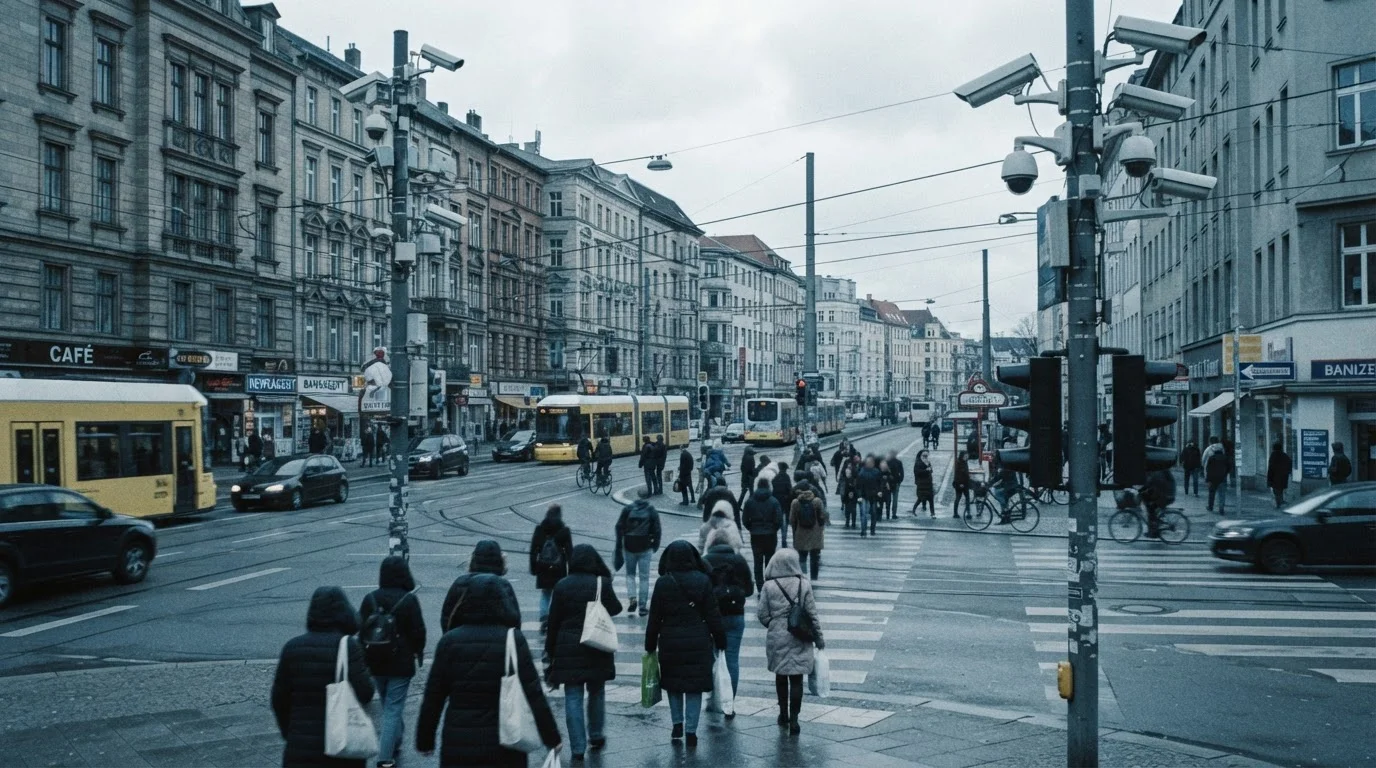
Key Takeaways
Demonstrated crime reduction in targeted environments
Research supports meaningful reductions in property crime when visible cameras are deployed in defined spaces like parking structures and transit systems, though effects in open urban areas are less consistent.
Assists post-incident investigation
Surveillance footage and license plate data have played documented roles in solving crimes and locating missing persons, providing investigators with leads that wouldn't otherwise exist.
Can extend limited law enforcement resources
Automated monitoring systems allow agencies to cover geographic areas or vehicle volumes that human patrols alone could not realistically surveil around the clock.
May deter would-be offenders in visible deployments
The visible presence of cameras is thought to deter opportunistic crime by raising the perceived risk of detection, an effect documented in several controlled studies.
Facial recognition has documented accuracy disparities
NIST evaluations found higher false-positive rates for Black, Asian, and female faces in many commercial algorithms, raising serious concerns about equitable application in law enforcement.
Chilling effect on lawful expression and assembly
Research in surveillance studies finds that awareness of being monitored can suppress political protest, religious practice, and other constitutionally protected activities.
Weak and inconsistent legal oversight in the U.S.
No comprehensive federal law governs law enforcement use of facial recognition or purchased location data, leaving protections to vary dramatically by state and municipality.
Data retention creates long-term privacy risks
Information collected for one stated purpose can be repurposed, shared with other agencies, or exposed through breaches - risks that grow as data is stored indefinitely without clear retention limits.
Crime displacement rather than reduction in open spaces
Some research suggests surveillance in open urban areas may shift criminal activity to adjacent, unwatched locations rather than eliminating it, complicating claims of net community benefit.
Our Verdict
Public surveillance technology offers genuine public-safety benefits in specific, targeted deployments - but those gains come with real costs to privacy, civil liberties, and equitable treatment. The research does not support a blanket conclusion that more surveillance always means safer communities, and it clearly flags risks when systems operate without strong oversight and transparency.
Readers who want to understand the evidence behind surveillance policy debates, without partisan spin, before forming their own views or engaging with local policy decisions.
What 'Public Surveillance' Actually Covers
The phrase "surveillance technology" covers a broad and growing toolkit. At its simplest, it means fixed CCTV cameras on street corners or in transit stations. At its most sophisticated, it includes real-time facial recognition systems, automated license plate readers (ALPRs), cell-site simulators (sometimes called "Stingrays") that intercept phone signals, and aggregated location data harvested from smartphones.
These technologies increasingly operate together. A camera network might feed footage into an AI system that flags faces against a watchlist, while location data from a suspect's phone is pulled from a commercial data broker - all potentially without a warrant, depending on jurisdiction. Understanding what the research says requires keeping this technological breadth in mind, since evidence on one tool doesn't automatically transfer to another.
A Note on 'Public Space' and Legal Expectations
In U.S. law, people generally have a reduced expectation of privacy in public spaces compared to private property. However, courts have increasingly recognized that pervasive, aggregated surveillance - tracking someone's movements over time - may cross constitutional thresholds even in public. The Supreme Court's 2018 Carpenter v. United States ruling, which required a warrant for extended cell phone location records, signaled that older legal frameworks may not translate cleanly to modern surveillance capabilities.
The Case For: Safety, Deterrence, and Investigation
Proponents of expanded surveillance point to concrete evidence of benefit in certain settings.
Demonstrated crime reduction in targeted environments
Research supports meaningful reductions in property crime when visible cameras are deployed in defined spaces like parking structures and transit systems, though effects in open urban areas are less consistent.
Assists post-incident investigation
Surveillance footage and license plate data have played documented roles in solving crimes and locating missing persons, providing investigators with leads that wouldn't otherwise exist.
Can extend limited law enforcement resources
Automated monitoring systems allow agencies to cover geographic areas or vehicle volumes that human patrols alone could not realistically surveil around the clock.
May deter would-be offenders in visible deployments
The visible presence of cameras is thought to deter opportunistic crime by raising the perceived risk of detection, an effect documented in several controlled studies.
A frequently cited body of work concerns CCTV in parking lots and transit systems, where meta-analyses - including research published in the Journal of Experimental Criminology - have found statistically significant reductions in crime, particularly property crime, when cameras are clearly visible and paired with other interventions. The effect is generally smaller and less consistent in open public spaces like parks or city streets.
License plate readers have assisted law enforcement in recovering stolen vehicles and locating missing persons. Proponents argue these tools extend limited police resources, allowing departments to cover more ground than foot or vehicle patrols alone could manage.
189
U.S. cities using ALPR systems
A 2022 survey by the International Association of Chiefs of Police found automated license plate reader technology deployed by law enforcement agencies across nearly 200 U.S. cities.
~1 in 7
Facial recognition false-positive rate gap
NIST's 2019 vendor testing found some algorithms produced false positives up to 100 times more frequently for certain demographic groups compared to white male faces.
The Case Against: Accuracy, Bias, and Civil Liberties
The concerns raised by researchers, civil liberties organizations, and affected communities are substantial and well-documented.
Facial recognition has documented accuracy disparities
NIST evaluations found higher false-positive rates for Black, Asian, and female faces in many commercial algorithms, raising serious concerns about equitable application in law enforcement.
Chilling effect on lawful expression and assembly
Research in surveillance studies finds that awareness of being monitored can suppress political protest, religious practice, and other constitutionally protected activities.
Weak and inconsistent legal oversight in the U.S.
No comprehensive federal law governs law enforcement use of facial recognition or purchased location data, leaving protections to vary dramatically by state and municipality.
Data retention creates long-term privacy risks
Information collected for one stated purpose can be repurposed, shared with other agencies, or exposed through breaches - risks that grow as data is stored indefinitely without clear retention limits.
Crime displacement rather than reduction in open spaces
Some research suggests surveillance in open urban areas may shift criminal activity to adjacent, unwatched locations rather than eliminating it, complicating claims of net community benefit.
On facial recognition specifically, the National Institute of Standards and Technology (NIST) published evaluations - most notably its 2019 Face Recognition Vendor Testing report - finding that many algorithms produced significantly higher false-positive rates for Black and Asian faces compared to white faces, and for women compared to men. False positives in law enforcement contexts can mean wrongful stops, investigations, or arrests. At least a handful of documented wrongful arrests linked to facial recognition errors have been reported by journalists and civil liberties groups.
Beyond accuracy, researchers studying surveillance's effect on behavior point to a "chilling effect" - the tendency of people to self-censor or avoid lawful activities (protests, religious gatherings, political organizing) when they believe they are being watched. This dynamic connects to broader questions about how information environments shape public participation, a theme also explored in research on algorithmic influence on public opinion.
Governance: Where Policy Lags Behind Technology
A recurring finding across the academic and policy literature is that legal frameworks have struggled to keep pace with how quickly these tools have been deployed. In the United States, Fourth Amendment protections against unreasonable search and seizure apply in some surveillance contexts but are interpreted inconsistently across courts and jurisdictions.
Several cities - including San Francisco, Boston, and Portland - have passed ordinances restricting or banning government use of facial recognition. Other jurisdictions have moved in the opposite direction, funding camera expansion programs with federal grants. There is no single federal law comprehensively governing law enforcement use of facial recognition or commercial location data purchases.
Researchers and policy analysts broadly agree that transparency requirements - such as public reporting on how often surveillance tools are used, what data is retained, and what errors occur - are a minimum baseline for accountability, regardless of where a community ultimately lands on the policy questions.