

Key Takeaways
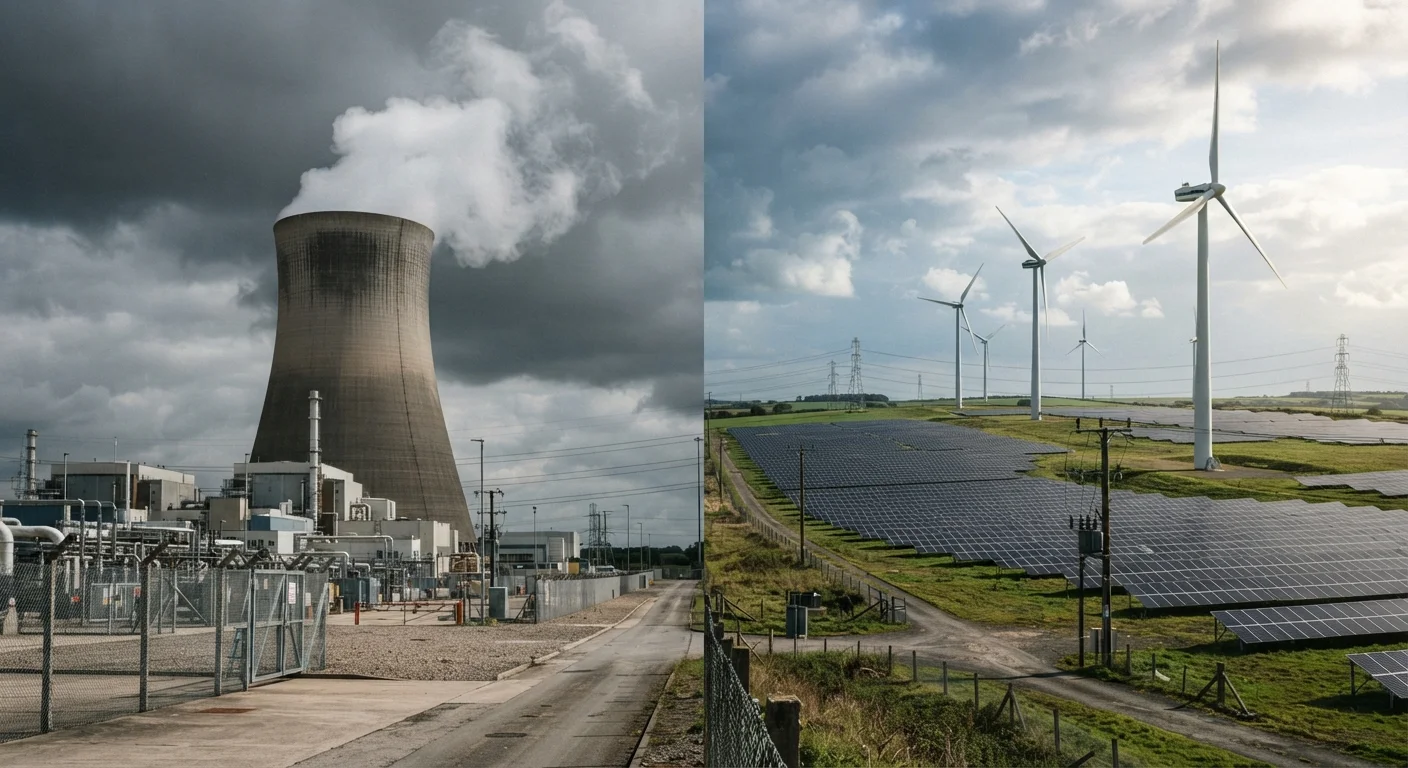
Option A
Nuclear Energy
The high-output, low-carbon baseload option.
Best for: Grids that need steady, around-the-clock power generation regardless of weather conditions.
Option B
Renewable Energy
The rapidly scaling, naturally replenished alternative.
Best for: Regions with strong sun, wind, or water resources seeking lower upfront emissions and scalable deployment.
If a grid needs reliable 24/7 power generation
Nuclear Energy
Nuclear plants run continuously at high capacity regardless of weather, making them well-suited for meeting constant baseline electricity demand.
If a region wants fast, scalable deployment at lower upfront cost
Renewable Energy
Solar and wind projects can be built and commissioned in months rather than decades, and their costs have dropped dramatically since 2010.
If long-term grid stability and decarbonization are both priorities
Nuclear Energy
Nuclear's consistent output complements variable renewables and can stabilize grids where battery storage isn't yet sufficient.
If minimizing waste and site-safety concerns is a top community priority
Renewable Energy
Wind and solar produce no long-lived radioactive waste and carry lower public-safety concerns for nearby communities.
Why the Comparison Matters Now
As governments accelerate efforts to cut greenhouse gas emissions, the question of which energy sources qualify as "clean" has grown politically charged. Nuclear power and renewables - solar, wind, hydro, and geothermal - are frequently bundled together under that umbrella, both contrasted against fossil fuels. That grouping is understandable in a broad sense: all of them emit far less carbon dioxide per kilowatt-hour of electricity produced than coal or natural gas. But lumping them together obscures important differences that matter enormously for policy, infrastructure investment, and public debate.
The confusion has real consequences. Legislation, utility planning, and public opinion polling often treat the two categories as interchangeable alternatives to oil and gas, when in practice they involve starkly different technologies, economics, timelines, and risk profiles. Understanding what actually separates them - not in political terms, but in technical and practical ones - is essential for any informed conversation about energy's future.
| Criterion | Nuclear Energy | Renewable Energy |
|---|---|---|
| Power consistency | Continuous baseload output | Intermittent (sun/wind dependent) |
| Carbon emissions (operational) | Very low per kWh | Very low per kWh |
| Construction timeline | Typically 10-20+ years | Months to a few years |
| Recent cost trend | High and often rising | Fallen sharply since 2010 |
| Land use | Small footprint per output | Large footprint for solar/wind |
| Waste concerns | Long-lived radioactive waste | Minimal; some panel disposal issues |
| Fuel source | Mined uranium (finite) | Sun, wind, water (replenishing) |
How Each Technology Actually Works
Nuclear energy generates electricity through fission - splitting uranium or plutonium atoms to produce heat, which drives steam turbines. The process runs continuously and is not dependent on external environmental conditions. A single nuclear plant can power hundreds of thousands of homes around the clock for decades. The trade-off is complexity: plants require sophisticated engineering, extensive regulatory oversight, and careful management of radioactive fuel and waste.
Renewable energy sources vary considerably among themselves. Solar photovoltaic panels convert sunlight directly into electricity. Wind turbines harness kinetic energy from moving air. Hydroelectric dams use flowing water. Each source is considered renewable because it draws on naturally replenishing processes. The shared limitation of the most widely deployed forms - solar and wind - is intermittency: they generate power only when the sun shines or the wind blows. Grid operators must compensate using battery storage, backup generation, or transmission links to other regions.
What 'Baseload' Actually Means
Baseload refers to the minimum level of electricity demand on a grid over a given period - the power that must always be available, day and night, regardless of conditions. Nuclear plants are designed to supply this constant floor of demand. Most solar and wind installations cannot guarantee baseload supply on their own without large-scale storage, which remains costly and limited in capacity at grid scale.
Cost, Speed, and Scale
This is where the two diverge most sharply in recent years. The cost of utility-scale solar power fell by roughly 90 percent between 2010 and 2023, according to analysis from the International Renewable Energy Agency (IRENA). Wind costs dropped by comparable margins. New nuclear projects, by contrast, have frequently run over budget and over schedule in Western countries. The two most prominent recent examples - the Vogtle plant in Georgia and the Hinkley Point C project in the United Kingdom - both encountered significant cost overruns and construction delays.
Supporters of nuclear point out that these comparisons can be misleading. An operational nuclear plant delivers far more energy per acre of land than solar or wind, requires no storage system to maintain consistency, and can run for 60 to 80 years. Proponents of next-generation technologies, including small modular reactors (SMRs), argue that newer designs could significantly reduce construction time and upfront costs - though most SMR projects remain in early development stages as of the mid-2020s.
~90%
Drop in utility-scale solar costs since 2010
According to the International Renewable Energy Agency (IRENA), solar power costs fell approximately 90 percent over the 2010-2023 period.
92%
Average U.S. nuclear capacity factor
The U.S. Energy Information Administration (EIA) reports nuclear plants operate at roughly 92% capacity - higher than any other energy source.
~3g CO₂/kWh
Nuclear lifecycle carbon emissions
The IPCC median estimate for nuclear lifecycle emissions is approximately 3-4 grams of CO₂-equivalent per kilowatt-hour, comparable to wind.
The Political and Scientific Divide
Neither nuclear nor renewables is universally embraced across the political spectrum, and the scientific community does not speak with one voice on energy mix strategy. Environmental groups have historically opposed nuclear on waste and safety grounds, though a number of prominent climate scientists - including some associated with NASA and major research universities - have argued that rapidly phasing out nuclear would make deep decarbonization harder, not easier. Other researchers and energy analysts contend that storage costs will fall fast enough for an all-renewable grid to become viable within a few decades.
What the science is clearest on is that both paths produce dramatically lower lifecycle carbon emissions than fossil fuels. The disagreements center on feasibility, cost, risk tolerance, and the pace of transition - all of which involve value judgments that go beyond pure physics. The most practical near-term question for policymakers may not be "nuclear or renewables" but rather how much of each a given grid needs, and at what pace, to keep the lights on while cutting emissions.