

Key Takeaways
Science That Changed the Rules of How We Live
Scientific breakthroughs rarely announce themselves as civilization-altering at the moment they occur. A researcher describes a pattern in data; a laboratory confirms a mechanism; an engineer connects two systems. Yet certain discoveries carry consequences so far-reaching that the world before and after them looks fundamentally different. The milestones below aren't just achievements in knowledge - they remade public health systems, reshaped economies, and rewired daily human behavior at scale.
Understanding these turning points matters beyond academic curiosity. They explain why life expectancy doubled over the past century, why cities light up at night, and why this article can reach a reader anywhere on earth within seconds. They also illustrate how the relationship between discovery and social change unfolds - rarely instantly, often through decades of resistance, policy debate, and incremental adoption. For more on how scientific understanding itself shifts over time, see why scientific consensus evolves.
Germ Theory of Disease
Before the mid-19th century, the dominant explanation for illness was miasma - bad air emanating from rotting organic matter. The work of Louis Pasteur, Robert Koch, and their contemporaries replaced this with the germ theory of disease: specific microorganisms cause specific illnesses. This wasn't merely an academic correction. It gave medicine a precise, testable target.
The practical consequences were enormous. Surgical antisepsis, safe drinking water systems, food preservation standards, and eventually antibiotic therapy all flow directly from this foundational understanding. Death rates from infectious diseases that had killed millions annually fell dramatically across the 20th century as germ theory moved from laboratory to public health infrastructure.
Germ theory gave medicine a precise target, making surgery, clean water, and antibiotics possible.
Vaccination
Edward Jenner's 18th-century observation that cowpox exposure seemed to protect against smallpox was the seed of a practice that would eventually eradicate one of humanity's deadliest diseases. Smallpox killed an estimated 300 million people in the 20th century alone before being declared eradicated in 1980 - the only human disease to be fully eliminated through deliberate public health effort.
Vaccination fundamentally altered the relationship between governments and public health. It created the model of population-level immunity management and established that coordinated state action could prevent, not merely treat, catastrophic disease. Polio, measles, and other conditions that once caused mass disability have been reduced by orders of magnitude in vaccinated populations.
Vaccination created the model for managing immunity at a population scale - a genuinely new form of public health.
Electrification
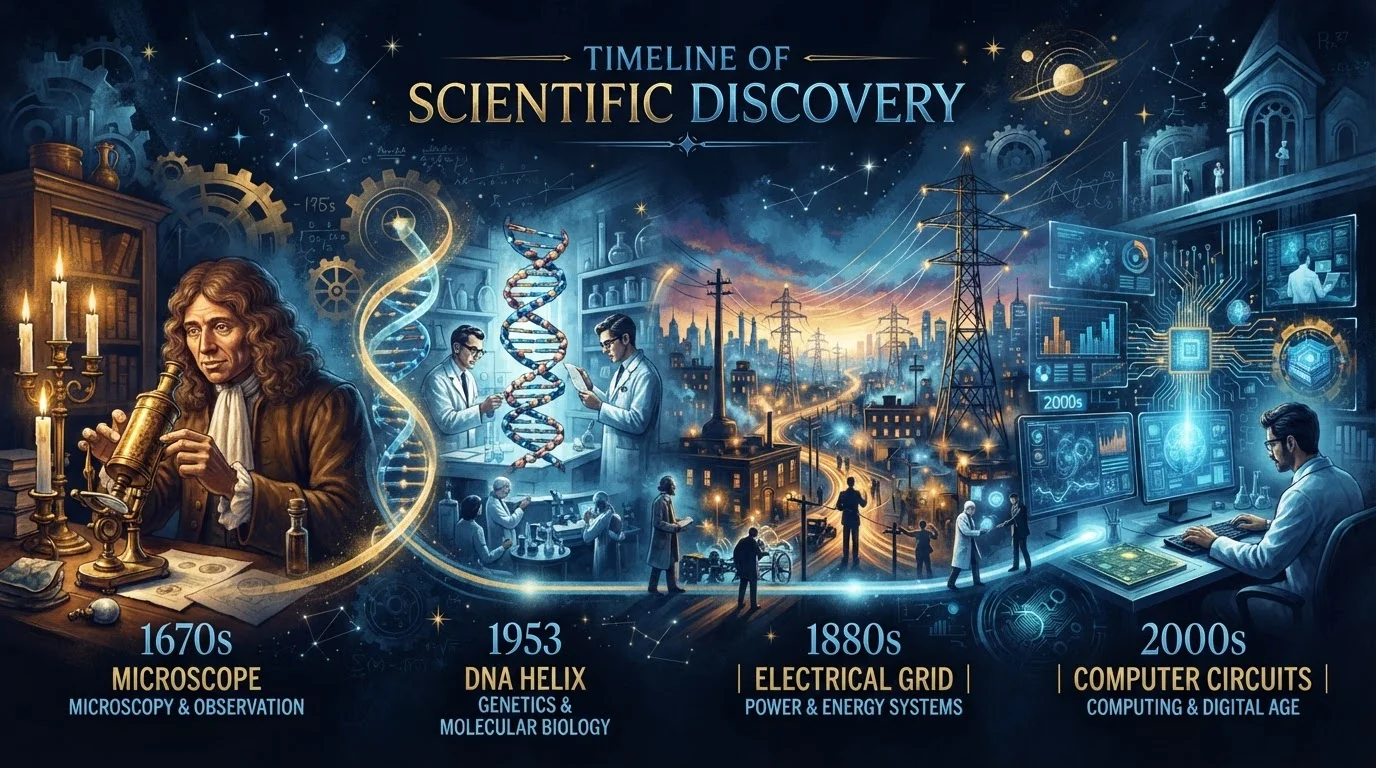
The practical harnessing of electricity - from Alessandro Volta's battery to Thomas Edison's distribution grid to Nikola Tesla's alternating current systems - transformed the physical fabric of society across the late 19th and early 20th centuries. Artificial lighting extended the productive day. Electric motors replaced human and animal labor across manufacturing, agriculture, and transportation. Refrigeration changed how food was stored and distributed globally.
Historians of technology often rank electrification as the single most transformative infrastructure development of the modern era. Homes, hospitals, factories, and communication systems all depend on it. Virtually every subsequent technological milestone - from radio to computing to the internet - rests on electrical infrastructure as a prerequisite.
Electrification extended the productive day and enabled every major technology that followed it.
The Structure of DNA
The 1953 publication by James Watson and Francis Crick describing the double-helix structure of deoxyribonucleic acid (DNA) - building on the X-ray crystallography work of Rosalind Franklin and others - opened an entirely new scientific domain. Understanding that genetic information is encoded in a molecule with a specific, copyable structure made it possible to read, and eventually edit, the instructions of life.
Forensic science, pharmaceutical development, agricultural biotechnology, and genetic medicine all trace their modern forms to this discovery. The mapping of the human genome in 2003 and emerging gene-editing tools like CRISPR are downstream consequences of understanding what DNA actually is and how it functions.
Understanding DNA's structure made it possible to read - and eventually rewrite - the instructions of life.
Internet Protocols (TCP/IP)
The internet as most people experience it - a seamless, global network - rests on a set of communication rules developed in the 1970s and formalized in the early 1980s: the Transmission Control Protocol and Internet Protocol, collectively known as TCP/IP. These protocols define how data is broken into packets, routed across networks, and reassembled at its destination, regardless of the physical infrastructure carrying it.
What made TCP/IP historically consequential was its design philosophy: open, standardized, and not owned by any single government or corporation. This decentralized architecture allowed the network to grow far beyond any single planned system and enabled a communication layer that now underpins commerce, journalism, scientific collaboration, and social organization worldwide. For a clearer explanation of how these underlying systems work, visit our Internet and Networks resource.
TCP/IP's open, decentralized design let the internet grow into a global layer no single entity controls.
A Pattern Worth Recognizing
Each of these milestones shares a common arc: an idea that seemed radical, a period of institutional resistance, and eventually a transformation so complete that the original world becomes difficult to imagine. Germ theory faced physicians who dismissed invisible pathogens. Electrical infrastructure required decades of public and private investment before it reached rural homes. The internet's protocols were academic tools long before they became commerce, communication, and culture.
How to Evaluate Claims About 'Revolutionary' Science
Not every announced breakthrough reshapes society. Look for whether a discovery has been independently replicated, whether it has moved from laboratory to real-world application, and whether scientific institutions - not just individual researchers - have incorporated it into standard practice. Genuine milestones tend to accumulate supporting evidence across multiple disciplines over time, rather than resting on a single dramatic study.
Scientific progress rarely travels in a straight line, and the social changes that follow discoveries are shaped by economics, politics, and public trust as much as by the evidence itself. Recognizing this complexity is part of how we distinguish genuine breakthroughs from overhyped claims - a challenge that remains live today, particularly in fields like longevity research. See what researchers are actually studying in anti-aging science for a grounded assessment of that frontier.