

Key Takeaways
The Debt-Saving Tension
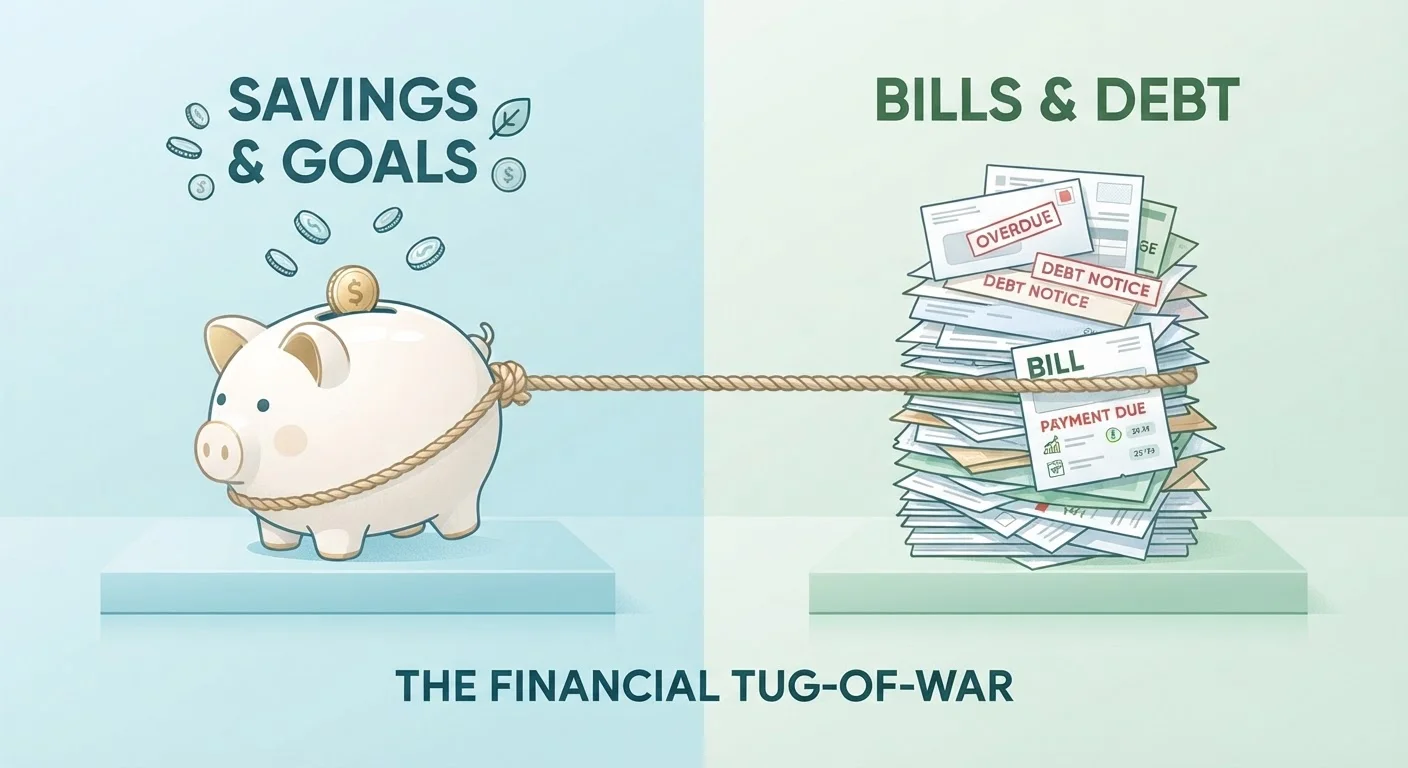
The debt-saving tension describes the financial reality that every dollar directed toward debt repayment is a dollar not going into savings - and vice versa. Because most households have a fixed income, paying down debt and building savings simultaneously means doing both more slowly. The challenge isn't a failure of discipline; it's simple math.
The core trade-off hinges on interest rates: debt typically carries an explicit cost (the interest rate you pay), while savings carry an explicit benefit (the interest rate or return you earn). When the cost of debt exceeds the return on savings, accelerating debt payoff generally produces a better net financial outcome.
Why the Tension Is Real, Not a Myth
Personal finance content often makes saving and debt payoff sound like parallel tasks you can run simultaneously without much friction. In reality, most households operate within a budget ceiling. Once fixed expenses - housing, food, transportation - are covered, what remains is a finite pool. Every dollar in that pool has competing claims on it.
Debt repayment demands regular, often minimum, payments just to stay current. Saving requires consistently setting money aside before it gets absorbed by spending. Doing both at maximum intensity at the same time is only possible if income substantially exceeds expenses - a situation that doesn't describe most American households.
This isn't a personal failing. It's a structural feature of having limited income and existing financial obligations. Understanding the tension clearly is the first step toward making deliberate choices about it.
This Is General Education, Not Personal Advice
The concepts discussed here apply broadly, but individual circumstances vary significantly. Interest rates, income levels, debt types, and personal goals all influence which approach makes the most sense. For decisions about your own finances, consider consulting a licensed financial professional who can evaluate your complete picture.
The Interest Rate Equation at the Heart of the Trade-Off
The most important variable in this trade-off is the difference between what your debt costs you and what your savings earn you. Consider two simple scenarios:
- You carry a credit card balance at 22% annual interest and put $200 a month into a savings account earning 4.5%. Every month, the interest charges on your card are likely outpacing what your savings account generates.
- You carry a mortgage at 3.5% fixed interest. A savings account earning 4.5% or a retirement account with employer matching could potentially outperform what you'd save by making extra mortgage payments.
This comparison - sometimes called the interest rate arbitrage - is why blanket rules like "always pay off debt first" or "always maximize savings" fall short. The math depends on your specific rates. For a fuller look at how interest rate differences play out over time, see our piece on how high-interest debt erodes savings.
~$6,000
Median U.S. household credit card balance
According to Federal Reserve data, the median balance among households carrying credit card debt has consistently been in this range in recent years.
20%+
Average credit card interest rate
The Federal Reserve tracks average credit card interest rates, which have exceeded 20% APR in recent periods - far above typical savings account returns.
~57%
Americans living paycheck to paycheck
Various surveys over recent years have consistently found that a majority of U.S. adults report having little financial cushion after monthly expenses, underscoring how real the debt-saving tension is for most households.
Where an Emergency Fund Changes the Calculus
One scenario where saving takes priority even during debt payoff is the emergency fund. Without a financial buffer, an unexpected car repair or medical bill often gets charged to a credit card - adding new high-interest debt on top of existing obligations. A modest cash reserve can break that cycle.
This is why many financial educators suggest building a small emergency fund - enough to cover a few hundred to a few thousand dollars in unexpected expenses - before aggressively accelerating debt payments. The logic: the cost of new high-interest debt triggered by an emergency can exceed the interest saved by making extra payments now.
For a closer look at how to weigh these two goals directly, our article on emergency fund versus debt payoff walks through the reasoning behind each approach.
Factors That Shift the Balance for Different Situations
Because the right balance is situational, it helps to identify which factors are most relevant to your own picture:
- Employer retirement match
- If your employer matches a portion of retirement contributions, declining that match to accelerate debt payoff means leaving compensation on the table. Many financial educators treat capturing the full employer match as a high-priority step before directing extra cash elsewhere.
- Debt interest rate
- High-rate consumer debt - credit cards, some personal loans - generally warrants more aggressive payoff. Lower-rate debt, like certain student loans or mortgages, may warrant a different balance. Tools like the snowball and avalanche methods can help structure multi-debt repayment.
- Income stability
- Variable or uncertain income can make a larger cash reserve more valuable as insurance, even at the cost of slower debt payoff.
- Debt-to-income ratio
- Understanding your debt-to-income ratio can help clarify how much financial flexibility you actually have and how lenders may view your overall position.
Start With the Interest Rate Comparison
Before deciding how to split extra dollars between debt and savings, look up the exact interest rate on each debt and compare it to what you're earning - or could realistically earn - on savings. This single comparison often clarifies which goal deserves priority without requiring complex calculations. If rates are close, other factors like employer matching and income stability become the deciding variables.
The Psychological Dimension
Math alone doesn't explain every financial decision. The emotional weight of debt - the stress it creates, the avoidance it can trigger - shapes behavior in ways that pure calculation doesn't capture. For some people, eliminating a debt entirely produces a psychological benefit that motivates continued progress across other financial goals. For others, seeing a savings balance grow provides the encouragement to stay disciplined.
Neither response is irrational. Understanding your own relationship with money is part of making a strategy you can actually sustain. Our article on the psychological side of debt explores why the emotional dimensions of debt payoff are real and worth accounting for.
Additionally, it's worth distinguishing saving from investing - saving and investing serve different purposes, and knowing which goal you're pursuing helps clarify which trade-offs are actually relevant to your situation.
This article is for general informational and educational purposes only and does not constitute personalized financial, investment, tax, or legal advice. Consult a qualified, licensed financial professional for guidance specific to your circumstances.