

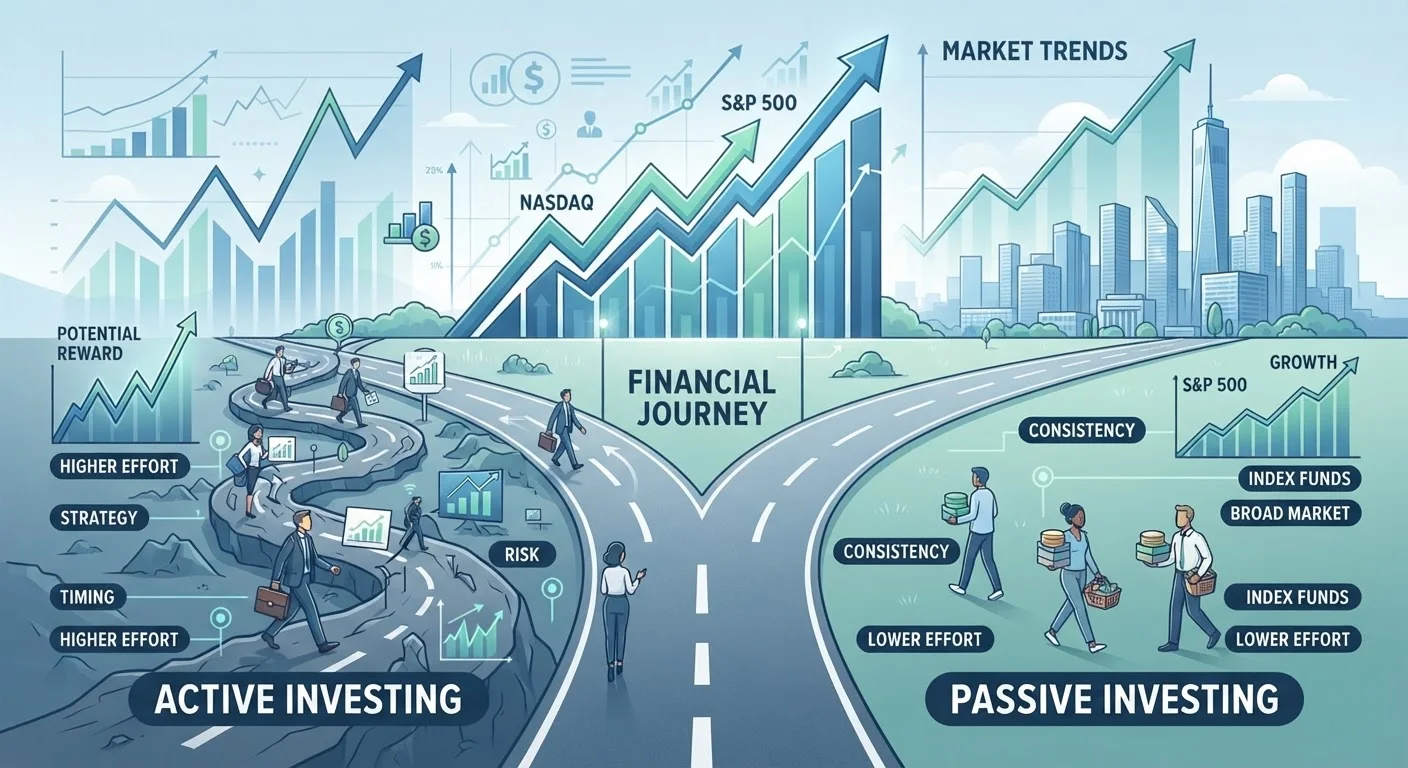
Key Takeaways
Option A
Index Funds
The low-cost, hands-off approach to market participation.
Best for: Investors seeking broad market exposure with minimal fees and no need for active oversight.
Option B
Actively Managed Funds
The professional, research-driven alternative to simply tracking the market.
Best for: Investors who want a fund manager making strategic decisions in pursuit of market-beating returns.
If you're just starting out and want a straightforward, low-cost approach
Index Funds
Index funds offer broad diversification and minimal fees, making them a widely accessible starting point for new investors building long-term wealth.
If you want a professional manager actively responding to market conditions
Actively Managed Funds
Active funds give you access to dedicated research teams and strategic decision-making, though this comes at a higher cost with no guaranteed outperformance.
If keeping investment costs as low as possible is a top priority
Index Funds
Index funds typically carry expense ratios well below 0.10%, compared to 0.50%-1.00% or more for many actively managed options - a gap that compounds significantly over time.
If you're investing in a niche market or sector where active expertise may add value
Actively Managed Funds
In less efficient markets - such as small-cap stocks or emerging economies - skilled active managers may have a better chance of identifying overlooked opportunities.
What Each Fund Type Actually Does
Before comparing costs, it helps to understand what each fund type is designed to do. If you're newer to investing, you may want to first review the distinction between saving and investing - the two serve very different financial goals.
An index fund is a type of investment fund built to mirror the performance of a specific market index - for example, a broad U.S. stock market index or an index of large American companies. Rather than selecting individual stocks, the fund simply holds the same securities as the index it tracks, in roughly the same proportions. No one is making daily buy-or-sell decisions; the portfolio updates only when the index itself changes.
An actively managed fund takes the opposite approach. A professional fund manager - supported by a team of analysts - reviews data, evaluates companies, and makes deliberate decisions about which securities to buy, hold, or sell. The stated goal is to outperform a benchmark index, not merely match it.
Both types hold collections of securities, which means investors in either structure gain some degree of diversification. The key differences emerge when you look at cost, strategy, and real-world outcomes over time.
The Fee Gap and Why It Compounds
The most consequential difference between index funds and actively managed funds isn't their strategy - it's their cost. Every fund charges an expense ratio: an annual fee expressed as a percentage of your investment. It's deducted automatically, so many investors don't notice it directly, but it reduces returns year after year.
| Criterion | Index Funds | Actively Managed Funds |
|---|---|---|
| Investment strategy | Tracks a market index passively | Manager selects securities actively |
| Typical expense ratio | 0.03%-0.20% per year | 0.50%-1.25% per year |
| Benchmark goal | Match the index return | Outperform the index |
| Trading frequency | Low - changes with the index | High - manager-driven decisions |
| Tax efficiency | Generally higher (less turnover) | Generally lower (more turnover) |
| Long-term outperformance rate | Consistently beats most active funds after fees | Majority underperform benchmarks long-term |
| Transparency | High - holdings mirror the index | Variable - holdings updated periodically |
Consider what happens when a 0.80% annual fee is applied to a $10,000 investment growing at 7% per year versus a 0.05% fee on the same investment. Over 30 years, that difference in fees can result in tens of thousands of dollars less in the higher-fee account - not because the market performed differently, but simply because of what was taken out each year. This is the compounding cost of fees, and it's one of the most underappreciated forces in personal investing.
~85%
Active large-cap funds underperforming S&P 500 over 15 years
According to S&P Dow Jones Indices' SPIVA U.S. Scorecard, roughly 85% of actively managed large-cap U.S. equity funds underperformed the S&P 500 over a 15-year period.
0.03%
Lowest common index fund expense ratios
Some broad-market index funds have expense ratios as low as 0.03% annually, compared to industry averages for active funds that can exceed 0.70%.
$30,000+
Estimated 30-year fee drag on $10,000 investment
Illustrative modeling shows that a 1% annual fee difference on a $10,000 investment compounding at 7% annually can erode more than $30,000 in potential growth over 30 years.
This doesn't mean actively managed funds are always the wrong choice - but it does mean the burden of proof is higher. An active fund needs to outperform its benchmark by enough to justify its extra cost. Research from institutions like S&P Dow Jones Indices has consistently shown that a majority of actively managed funds underperform their benchmark index over longer time horizons, particularly after fees are factored in. That said, past performance does not guarantee future results, and outcomes vary by fund, manager, and market environment.
For a broader look at the kinds of mistakes fee-blindness can cause, see our piece on common beginner investor missteps.
How to Think About the Choice
Neither index funds nor actively managed funds are the right answer for every investor in every situation. What matters is understanding what you're paying for and whether that aligns with your goals.
Index funds appeal to investors who accept that matching the market - rather than beating it - is a reasonable and historically productive long-term strategy. They also eliminate the risk of manager underperformance: the possibility that the person making decisions for your fund will make costly mistakes.
Actively managed funds may still play a role for investors with specific needs - such as exposure to niche markets where information isn't as widely available, or where a manager's expertise in a particular sector is genuinely differentiated. However, selecting an active fund requires scrutiny of long-term performance records, fee structures, and manager consistency.
Whatever path you take, your fund choices don't exist in a vacuum. They work alongside your broader financial habits - including how you think about fixed and variable expenses and how much you're able to invest consistently over time.
This article is for general informational and educational purposes only and does not constitute personalised financial or investment advice. Past performance does not guarantee future results. Consult a qualified financial adviser before making investment decisions.