

Key Takeaways
Compound Interest
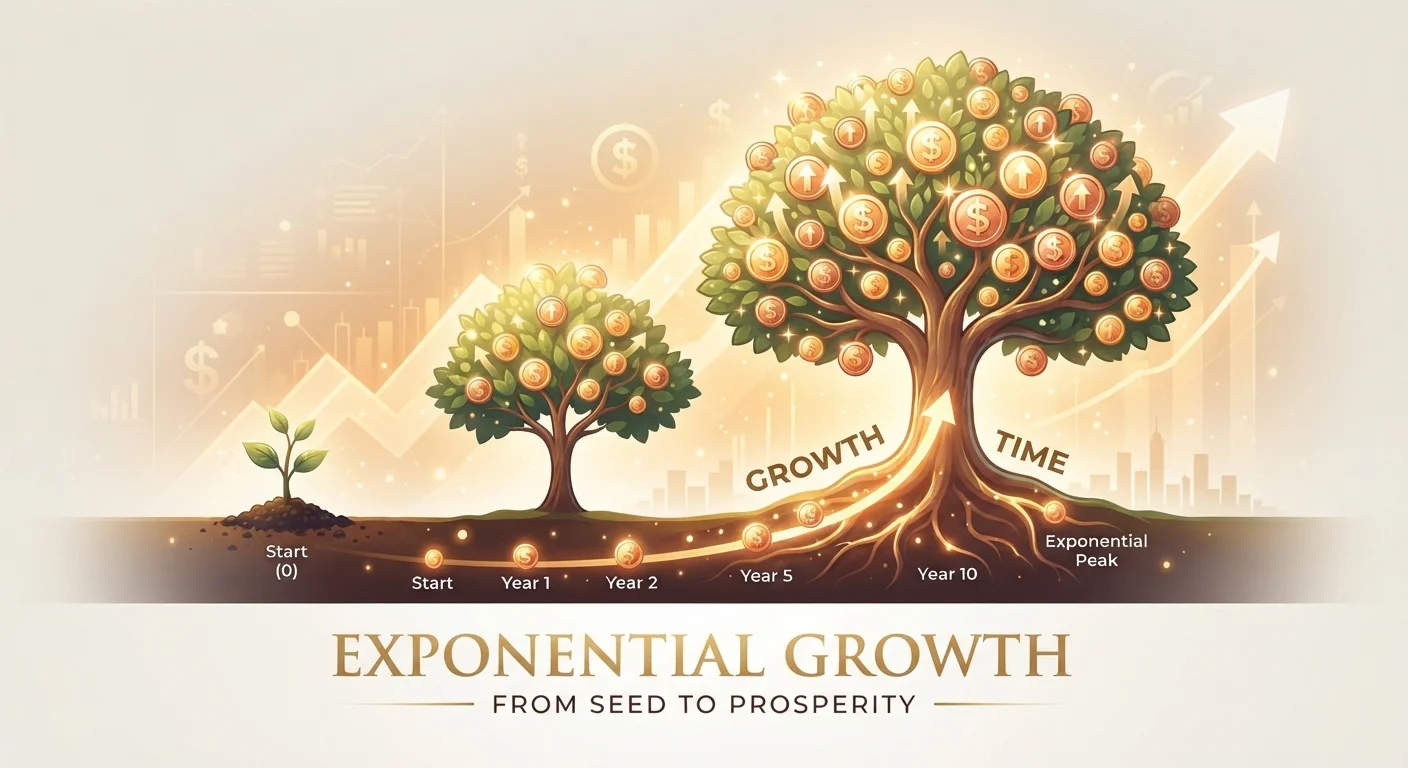
Compound interest is interest calculated not just on your original deposit or investment, but also on all the interest you've already earned. This means your money earns returns on its returns, creating a snowball effect that accelerates growth over time. The longer money stays invested, the more powerful compounding becomes.
The standard formula is A = P(1 + r/n)^(nt), where P is the principal, r is the annual interest rate, n is the number of compounding periods per year, and t is the number of years.
How Compounding Actually Works
Most people understand earning interest on money they deposit. What makes compound interest different is that the interest itself starts earning interest. Each period, your total balance - not just your starting amount - becomes the base for the next round of growth.
Consider a straightforward example. If you deposit $1,000 at a 5% annual interest rate:
- Year 1: You earn $50, bringing your balance to $1,050.
- Year 2: You earn 5% on $1,050 - that's $52.50, bringing your total to $1,102.50.
- Year 10: Your balance reaches approximately $1,629 - without adding a single dollar.
- Year 30: That same $1,000 grows to roughly $4,322.
No additional contributions. No effort. Just time and a consistent rate. To understand the broader context of where compounding fits in a financial plan, see what investing actually means.
Rule of 72
Estimate years to double your money
Divide 72 by your annual interest rate to estimate how many years it takes your balance to double - a well-known mathematical shortcut used in financial education.
~4,322%
Growth of $100 at 5% over 75 years
A single $100 deposit compounded annually at 5% becomes approximately $4,322 after 75 years, demonstrating the extreme long-term impact of leaving money untouched.
365x
Daily vs. annual compounding periods
Daily compounding calculates interest 365 times a year versus once annually, producing a marginally higher return at the same stated rate - an advantage that compounds over time.
Why Time Is the Most Powerful Variable
The math behind compounding is exponential, not linear. That distinction matters enormously in practice. A person who begins setting aside money at age 25 versus age 35 doesn't just get 10 more years of growth - they get 10 more years of compounding on an ever-growing balance.
A commonly used illustration: imagine two people each contribute $5,000 per year. One starts at 25 and stops at 35 (10 years of contributions). The other starts at 35 and contributes every year until 65 (30 years). Assuming the same hypothetical rate of return, the person who started earlier can end up with a larger final balance - despite contributing far less money - purely because of the additional years of compounding. This is a general illustration, not a guaranteed outcome; actual investment returns vary and are not predictable.
This is why financial educators consistently emphasize starting early, even with modest amounts. The value of time cannot be made up with larger contributions later.
Start Small, But Start Now
You don't need a large lump sum to benefit from compounding. Even modest, regular contributions to an interest-bearing or investment account can produce meaningful growth over a long time horizon. The single most impactful financial habit is simply beginning - the math rewards consistency and patience above all else.
Compounding Frequency and Rate Differences
Two factors shape how fast compounding works: the interest rate and how often compounding occurs. A higher rate accelerates growth, while more frequent compounding periods produce slightly larger balances than annual compounding at the same stated rate.
For example, 6% compounded monthly will yield a modestly higher balance than 6% compounded annually over the same period. The difference may seem small in a single year, but over decades it adds up. This is why savings accounts advertising daily compounding aren't simply marketing language - frequency genuinely matters, even if the effect is subtle.
It's also worth noting that compound interest operates in both directions. The same mechanics that grow an investment account also grow debt balances. Compound interest on debt can be a serious financial drain, particularly with high-interest products. Understanding both sides of this equation is essential for anyone building a financial plan.
Putting Compounding to Work in Practice
The clearest way to harness compounding is to start contributing to interest-bearing or investment accounts as early as possible and leave the money alone. Withdrawing early interrupts the compounding cycle and reduces the effect dramatically.
Regular contributions amplify results further. Adding even small amounts consistently - rather than making one large deposit and stopping - keeps feeding the compounding base. This is sometimes called dollar-cost averaging when applied to investment accounts, though the compounding benefit exists in savings accounts as well.
Compounding doesn't work in isolation. The assets in which money is held - whether savings accounts, bonds, or stocks - each carry different return profiles and risk levels. To understand how those building blocks fit together, stocks, bonds, and funds explained offers a useful starting point. And for those managing debt alongside savings, how high-interest debt erodes savings progress explains why the two must be considered together.
This article is for general informational and educational purposes only and does not constitute personalized financial, investment, or tax advice. Consult a qualified financial professional before making decisions about your own financial situation.